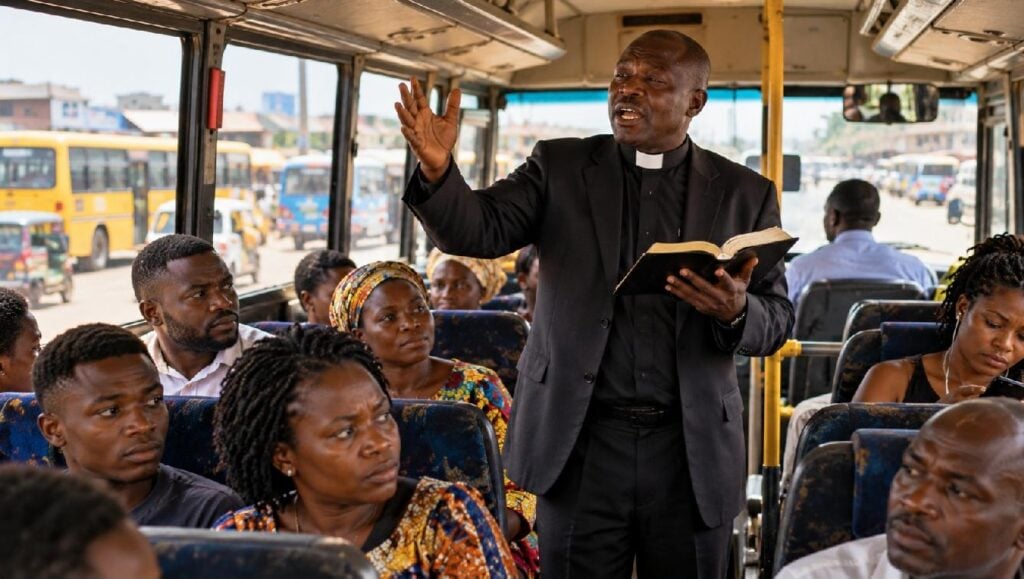
*Ghana is getting serious about pastors preaching aboard moving commercial buses, with tougher penalties threatening a familiar form of evangelism — and, for some preachers, an important source of income.
Under Ghana’s 2026 road traffic regulations, preaching or hawking while a public or commercial vehicle is in motion can result in a fine, imprisonment for up to eight months or both.
But the restriction itself isn’t entirely new. Preaching on moving commercial vehicles was prohibited under regulations introduced in 2012.
Weak enforcement allowed the practice to remain common, while the new rules increase the consequences for violations.
For pastors who have long turned crowded buses into mobile pulpits, the tougher enforcement could mean losing both a captive congregation and the donations that sometimes accompany their sermons.
Scroll to continue reading









Preaching Where the People Are
In Ghana, a predominantly Christian country, pastors can regularly be heard delivering sermons aboard buses, sometimes preaching for extended periods as passengers travel between cities.
The BBC reports that 61-year-old pastor Boateng Bismark James has been preaching on commercial vehicles leaving Accra’s Neoplan station since 2023.
“I preach on commercial vehicles because not everyone is able to go to church on Sunday,” Boateng told the BBC. “There are a lot of passengers who need our message of salvation to repent from their sins.”
The new regulation applies while vehicles are in motion. Preachers using megaphones at lorry parks and markets are not covered by the same restriction.
For Some Pastors, It’s Also Income
Boateng says the consequences go beyond limiting his ministry. Passengers sometimes give money to bus preachers, and he told the BBC those donations have helped him support his family and educate his children.
“I have been able to take care of my children’s education,” he said, adding that roughly half the financial support for his youngest child’s recently completed university education came from preaching.
Boateng wants religious preachers exempted from the tougher regulation.
Passengers Are Divided
Not everyone wants a sermon with their bus ride. One passenger told the BBC she considers the preaching a nuisance because of the noise and said some pastors inadvertently spit on nearby passengers while delivering animated sermons.
Another passenger defended the practice, saying a pastor’s message can offer hope to someone experiencing stress, although she believes preaching should happen only with passengers’ consent.
Rev. Enoch Paul Hayes of Ghana’s International Central Gospel Church offered a different perspective. He told the BBC he doesn’t believe the rules violate religious freedom and encouraged pastors to find other ways to reach people, including social media.
For Ghana’s bus preachers, tougher enforcement now leaves a choice: adapt their ministries, surrender a source of donations or risk penalties for continuing a tradition that has long been part of the country’s public transportation culture.
(If You Like This EURweb Story, Please SHARE it!)
RELATED NEWS ON EURWEB.COM: Ghana Passes Sweeping Anti-LGBTQ+ Law, Sparking Fear and International Condemnation
We Publish Breaking News 24/7. Don’t Miss Out! Sign up for our Free daily newsletter HERE.