
*You call your bank, contact an airline or open a company’s online chat expecting help. The response comes immediately, sounds friendly and even addresses you by name. But are you talking to a real person or artificial intelligence?
AI customer service is changing how companies communicate with customers. Automated systems can answer routine questions, track orders and provide account information.
However, they can also leave consumers frustrated when problems require human judgment.
The Consumer Financial Protection Bureau (CFPB) has warned that poorly designed chatbots can provide inaccurate information, mishandle disputes and make reaching human representatives difficult.
Here’s what consumers should know.
Scroll to continue reading









How to Recognize AI Customer Service
Some automated systems identify themselves as virtual assistants. Others use conversational language that makes them sound remarkably human.
Possible warning signs include unusually fast responses, repeated phrases, scripted answers and difficulty understanding questions outside a narrow subject.
A chatbot might repeatedly direct customers to the same help page instead of addressing their specific concerns. However, none of these behaviors proves you’re communicating with AI. Human representatives also use prepared responses, and sophisticated chatbots can imitate natural conversation.
The simplest approach is to ask directly: “Am I speaking with an automated system or a human representative?”
How to Request a Real Person
When automated assistance isn’t solving your problem, try typing or saying “human representative,” “live agent” or “customer service supervisor.”
If the system keeps repeating itself, look for a company’s official telephone number, contact form or complaint procedure.
Explain the problem clearly, provide relevant dates and request a case or reference number.
Don’t assume repeatedly typing “agent” will work. Some companies offer limited options for transferring customers from automated systems.
Protect Your Personal Information
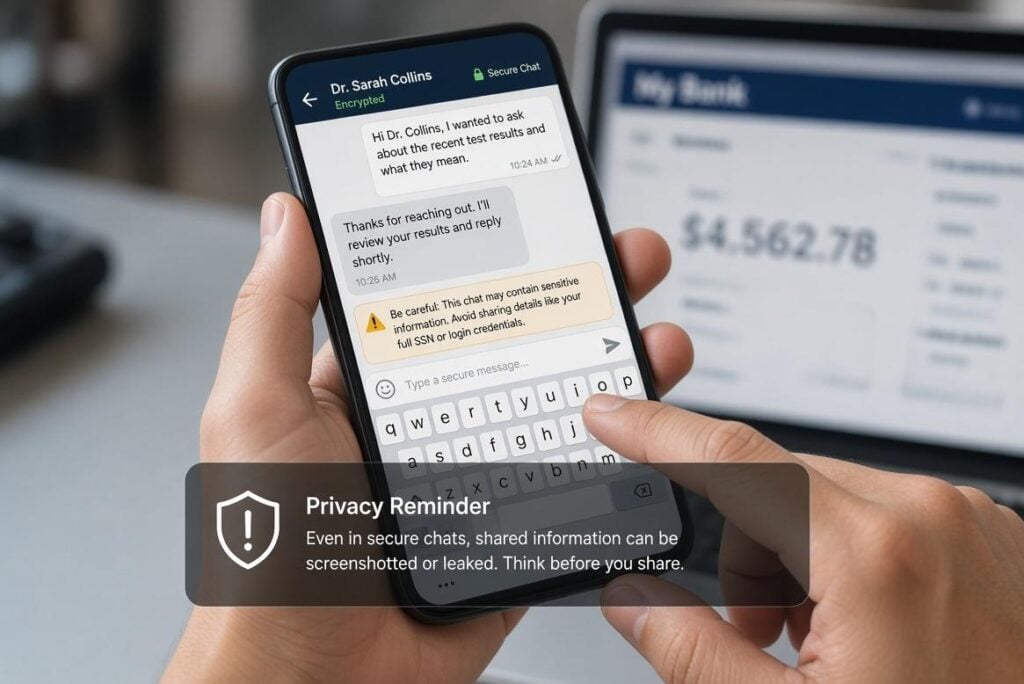
AI customer service also creates privacy concerns, particularly when consumers share sensitive information through online conversations.
The CFPB warns that chatbot conversations may contain personal financial information requiring appropriate protection.
Avoid entering passwords, Social Security numbers, complete payment-card details or one-time security codes into an unfamiliar chat window.
Use the company’s official website or mobile application rather than links received through unexpected messages.
The Federal Trade Commission (FTC) advises consumers to take action when scammers obtain personal information or financial account details.
Remember, a convincing voice or professional-looking chat interface does not guarantee that the person or system contacting you is legitimate.
What If the Chatbot Gets It Wrong?
For billing disputes, unauthorized transactions or other serious problems, save screenshots, emails and chat transcripts.
Request written confirmation of important decisions, including refunds, payment arrangements and account changes.
If a financial institution fails to resolve a problem, consumers can submit complaints through the CFPB’s complaint system.
AI customer service may save companies money and help customers with simple requests. But convenience should not come at the expense of accuracy, privacy or meaningful assistance.
The bottom line: Use automated assistance when it works. When your money, personal information or consumer rights are at stake, insist on answers you can verify.
(If You Like/Appreciate This EURweb Story, Please SHARE it!)
RELATED NEWS ON EURWEB.COM: Meta’s Muse AI Takes Off — Amazon Just Said No | WATCH
We Publish Breaking News 24/7. Don’t Miss Out! Sign up for our Free daily newsletter HERE.