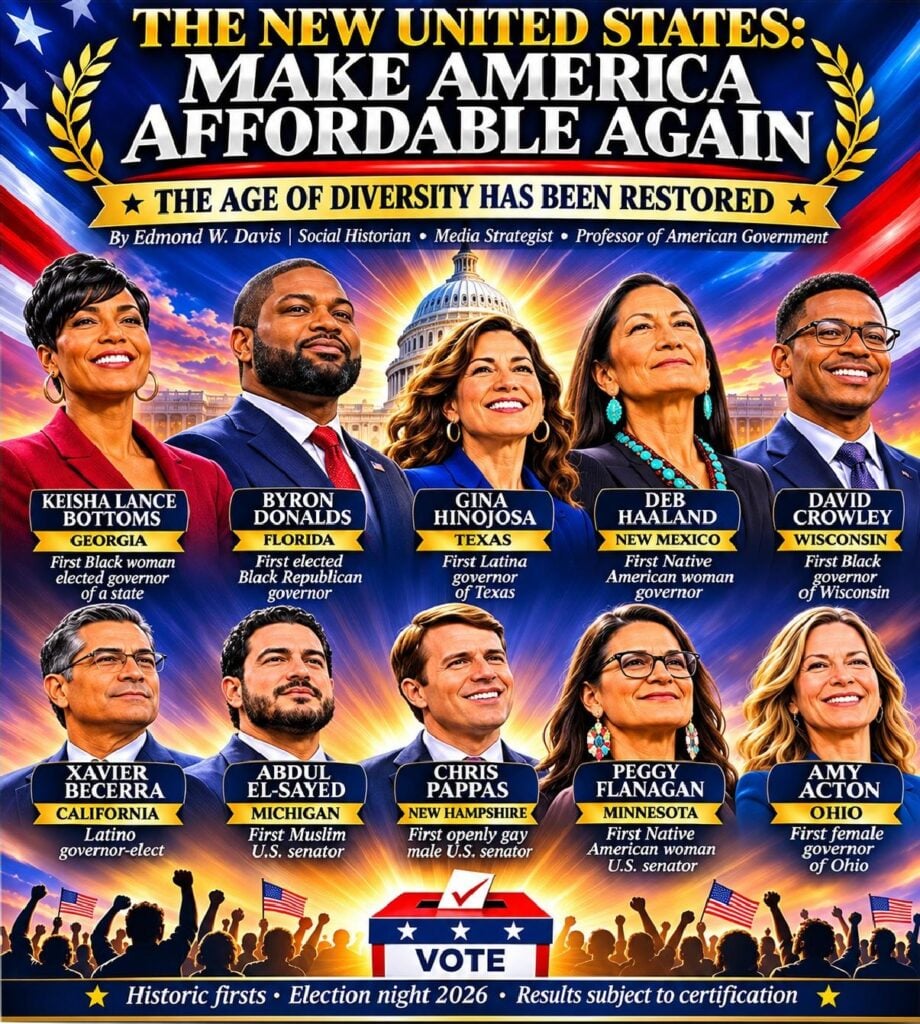
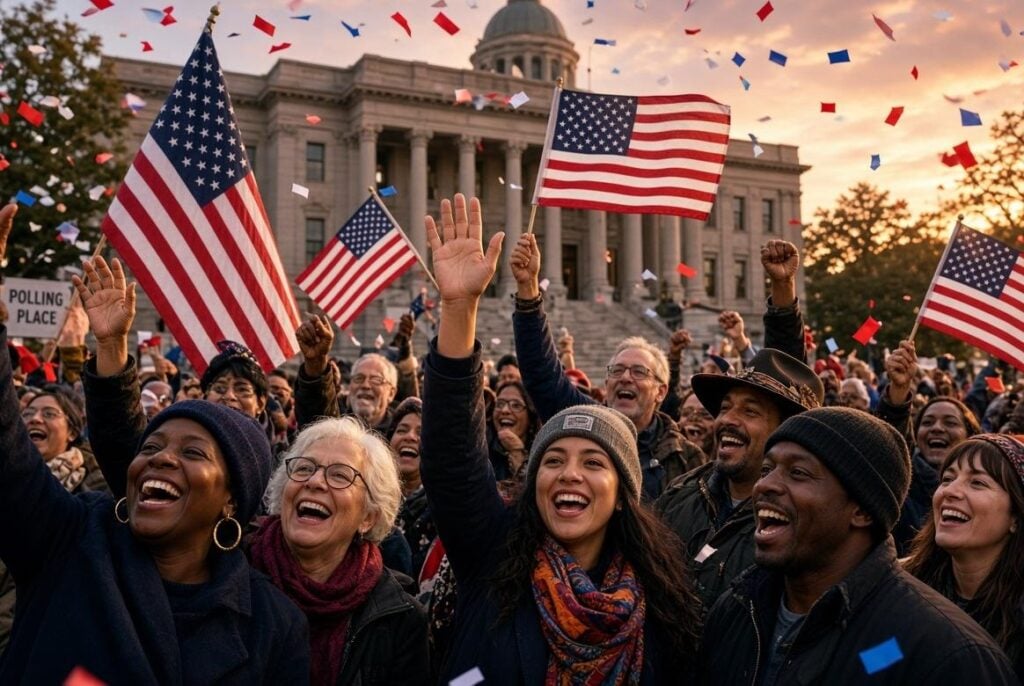
*America, take a good look at these faces! You voted for them last night. This more accurately personifies the United States of America versus the elite, all-male, one-race, wealthy, and older cast of leaders on Capitol Hill and at our state capitols. This image does well for the future lawmakers and inspires others to see their American dream.
This is what democracy looks like when it can breathe. This is what happens when the American electorate reminds the political establishment that the United States of America belongs to the people—not billionaires, not political dynasties, not corporate oligarchs, and certainly not one political movement. America is not perfect. Far from it! Even when this nation is clicking on all cylinders, we have our struggles. But America has swagger, resilience, and an extraordinary capacity to reinvent itself.
And on November 3, 2026, America reminded the world that we can still make history!
The historic midterm elections delivered a political shellacking to President Donald Trump, the MAGA movement, and much of the Republican establishment. But this election was about something much bigger than Democrats defeating Republicans. It was about Americans demanding accountability, economic dignity, constitutional government, and a political leadership that better represents the people. As CBS News’ election-night exit polling demonstrated, Americans were deeply concerned about the affordability of groceries, gasoline, utilities, and ordinary life. The political message was unmistakable:
Make America affordable again!
Scroll to continue reading






The New Faces of America: History Was Made!
Consider what happened in one extraordinary election.
Keisha Lance Bottoms, 56, an African American woman and former Atlanta mayor, became the first Black woman elected governor of a U.S. state and Georgia’s first female governor. Byron Donalds, 48, an African American Republican, became Florida’s first Black governor and America’s first elected Black Republican governor. And what irony! On a devastating national election night for MAGA, one of the Republican Party’s most significant historical victories was delivered by a Black man in the American South.
Let that marinate!
Gina Hinojosa, 52, a Latina, defeated Greg Abbott to become Texas’ first Latina governor. Xavier Becerra, 68, a Latino American, became California’s first elected Latino governor. Think about that! Two of America’s largest states, Texas and California, will be led by Latino governors. David Crowley, 40, became Wisconsin’s first Black governor. Deb Haaland, 65, a member of Laguna Pueblo, became America’s first Native American woman elected governor, winning in New Mexico. Amy Acton, 60, became Ohio’s first female governor. Abdul El-Sayed, 42, an Egyptian American Muslim, became the first Muslim elected to the United States Senate. Chris Pappas, 46, became the first openly gay man elected to the U.S. Senate. Peggy Flanagan, 47, an Ojibwe woman and member of the White Earth Nation, became the first Native American woman elected to the U.S. Senate. Wes Moore, Maryland’s African American governor, secured reelection. Aaron Ford, an African American Democrat, defeated Nevada’s Republican incumbent to become the state’s first Black governor. And Stacey Plaskett won the governorship of the U.S. Virgin Islands, becoming its first female elected governor.
This is America!
Five Black Governors—A Historical Breakthrough!
Before this election, only three Black Americans had ever been elected governor of a U.S. state. Now five Black governors have won elections to serve simultaneously: Wes Moore, Keisha Lance Bottoms, Byron Donalds, David Crowley, and Aaron Ford. Five! Democrat and Republican. Male and female. Southern, Northern, Eastern, and Western states. Reporting on the historic victories confirms that this level of simultaneous Black gubernatorial representation is unprecedented. These victories do not mean that racism has disappeared or that every Black official shares the same political philosophy. They mean that American voters are increasingly willing to elect leaders who would have faced almost insurmountable racial barriers in previous generations.
The Generational Revolution—and the Age Question
Consider another significant reality. The ten historic figures highlighted above range in age from 40 to 68. Their combined average age is approximately 52 years, or Generation X, like me. They represent different generations, cultures, professional backgrounds, and experiences. I believe America must have a serious national discussion about political longevity and term limits. I support reasonable term limits at every level of government, from municipal boards to Congress and the presidency. I would also favor serious debate about a retirement threshold around age 75 for elected officials, recognizing that such a proposal would require constitutional and legal consideration. Age alone does not determine competence. But neither should incumbency guarantee a lifetime appointment. Political leadership must always be renewed.
The Political Reckoning: Did Trump Create This Democratic Wave?
President Trump and his Republican allies cannot escape the central irony of this election. The very political movement that campaigned against diversity, equity, and inclusion witnessed an extraordinary wave of historically underrepresented Americans winning elected office. The Republican establishment had opportunities to challenge the president’s rhetoric, controversial policies, and a confrontational approach. Too often, party loyalty prevailed over independence judgment. Now voters have delivered their assessment. This does not mean every Republican is racist or that every Democrat is morally superior. Such generalizations would repeat the divisiveness this election should encourage us to overcome. But it does mean that political leadership must understand America’s changing electorate. The country cannot be governed indefinitely through fear, resentment, or nostalgia for an era when political power was concentrated among a narrow segment of society.
The Biblical Mandate: Justice, Humility, and Accountability
Three biblical passages speak directly to this political moment. Galatians 6:7: “Whatsoever a man soweth, that shall he also reap.” Political leaders eventually confront the consequences of the decisions they make. Proverbs 29:2: “When the righteous are in authority, the people rejoice: but when the wicked beareth rule, the people mourn.” Leadership should be evaluated through justice, integrity, and service—not party affiliation alone. Micah 6:8: “To do justly, and to love mercy, and to walk humbly with thy God.” Humility is especially important for elected officials who wield enormous influence over the lives of ordinary citizens. No political party possesses a monopoly on righteousness.
Barack Obama, Kamala Harris and the Politics of Possibility
The election of Barack Obama in 2008 shattered a barrier that generations of Americans once considered immovable. Kamala Harris later became America’s first female, first Black, and first South Asian American vice president. Neither achievement resolved the country’s longstanding inequalities. But representation influences political imagination. Young Americans who once rarely saw themselves reflected in the highest offices of government now have additional examples of what is possible. Keisha Lance Bottoms, Gina Hinojosa, Deb Haaland, Amy Acton, and other victorious women are adding new chapters to American political history. Does this guarantee that America will elect its first female president in 2028? Certainly not. But the field of possibility is expanding.
The Republican Party Is Still Invited to the Table
This election should not become an excuse to marginalize anyone. White Americans, Black Americans, Latino Americans, Asian Americans, Native Americans, Christians, Muslims, Jews, LGBTQ Americans, conservatives, liberals, and independents all have a legitimate place in our democracy. Even those who suffered devastating electoral defeats remain Americans whose voices and constitutional rights deserve respect. You may have lost the election, but you are still invited to the table. That is the difference between democratic competition and political exclusion. The Republican Party must decide what lessons it will learn. Democrats must now prove that electoral victories can become measurable improvements in everyday American life. The test is not merely who governs. The test is whether children receive a good education, parents can afford housing, workers earn dignified wages, families have access to healthcare, and older Americans can retire without financial desperation.
This Is the New United States
The United States has seen better days. I believe it can see them again. We are witnessing a political transformation that will not be completed in a single election. Racism, economic inequality, political extremism, and institutional distrust remain significant challenges. But the American electorate has demonstrated that political power can change hands and that historical barriers can fall. This was not simply a victory for Black Americans, women, Latinos, Muslims, Native Americans, or LGBTQ Americans. It was a victory for the possibility of a more representative democracy.
America did not become a good nation overnight. But America reminded the world that its greatest strength is its capacity to change. We are still under construction, and yes, we still are an experiment. Last night we drank the punch of democracy, not the MAGA Kool-Aid of Trumpism. This is not a Democratic America or a Republican America. This is the United States of America!
We have history to honor, differences to respect, institutions to strengthen, and an economic future to rebuild. November 3rd will go down as a day that will live in infamy for MAGA. Above all, we have a responsibility to deliver what millions of voters demanded on Election Day: MAKE AMERICA AFFORDABLE AGAIN!
About the Author:
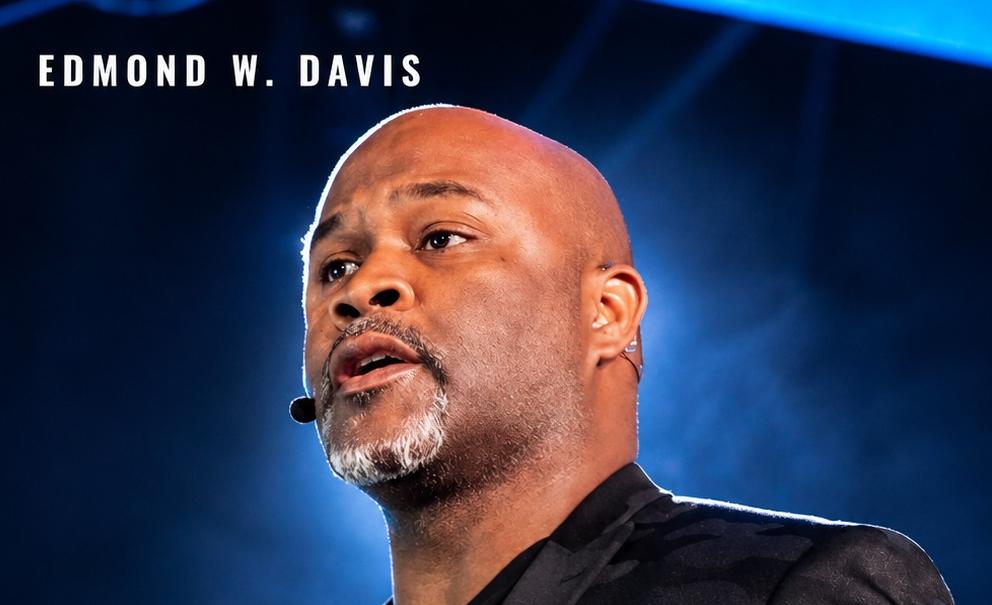
Edmond W. Davis is an American social historian, media strategist, international journalist, Grambling State University graduate, professor at Arkansas Baptist College and Philander Smith University, and founder of the National HBCU Black Wall Street Career Festival. His work focuses on history, education, emotional intelligence, civic engagement, economic mobility, and the advancement of historically Black colleges and universities. Davis was a grand marshal at the National African American History Month Parade, the largest in the U.S. during Black History Month.
(If You Like/Appreciate This EURweb Story, Please SHARE it!)
MORE NEWS ON EURWEB.COM: Trump Defends Record, Targets Democrats in Election-Eve Speech at Lincoln Memorial
We Publish Breaking News 24/7. Don’t Miss Out! Sign up for our Free daily newsletter HERE.