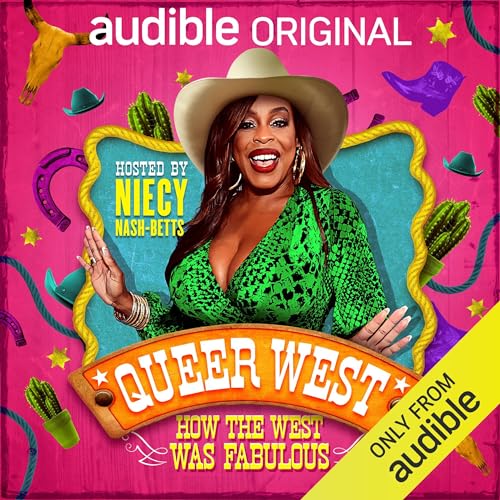
*We had the pleasure of chopping it up the charismatic Niecy Nash-Betts to discuss her latest project, the Audible Original “Queer West: How the West Was Fabulous.”
In this captivating series, Niecy takes listeners on an enlightening journey through the lesser-known LGBTQ+ history of the American West, shattering the traditional cowboy image with stories of diverse and vibrant queer lives. From gay rodeos and two-spirit identities to trans truckers, “Queer West” uncovers the hidden contributions and ongoing impact of LGBTQ+ individuals in shaping the West’s unique cultural landscape.
When asked what inspired her to take on this project and bring these stories to life, Nash-Betts told EURweb, “Well, the lives and the lies. Because oftentimes, when you are prolific in history, and you are monumental and doing great things, you always have people that feel like you should be erased and your story should not be told,” she explained. “I was like, listen, I just got to the community five minutes ago. I love it here, and I want to be a part of telling stories or unpacking them and inviting you to think differently about what you thought you knew.”
In Queer West, Niecy reveals surprising details about the queer origins of the popular Broadway musical Oklahoma, secret meanings of seemingly straight songs, and the real story of the legendary Calamity Jane.
Per the news release: “Queer West contains both somber and humorous stories of queer people creating joy and finding ways to be themselves during a time when LGBTQ+ people were considered socially unacceptable and how today’s LGBTQ+ culture is influenced by the brave queer pioneers of the American West. Queer West was written by Brenna Farrell, Zakiya Gibbons, and Ellen Horne.”
Scroll to continue reading


Was there a particular story in this audio series that resonated with you the most?
Niecy: They were all so interesting. But my better half and I, she was my engineer for my sessions, so she helped me record. When I finished Calamity Jane, deep-dive conversations into the idea of being masculine identified in that day and age. When I finished “Old Mrs. Nash,” it’s like, you don’t even have the respect of people to let you be because who you are and what you want to keep private, people feel like they have a right to. When I finished talking about the (Gay) rodeo, America has claimed this as being so forward-leaning when it comes to straight or masculine identity, and it’s the gayest thing that has ever happened in life between the chaps and the bangles and the bows and the sequins, the tassels. There were so many that when it was over, we got a chance to sit down and continue the conversation. I can’t pick just one.
Were there any surprising or intriguing discoveries you made or discussed with your wife while working on this project?
We talked about it all, but I guess the one we unpacked the most was Calamity Jane. Was she identified as masculine? Why was it at that time, who and what she was, was accepted? In some way, it transitioned into a space of being shunned or something you should be ashamed of in society. We spent a lot of time talking about that one.
Queer West features interviewees, including actors, recording artists, playwrights, journalists, and more who lived through or who have studied the queer stories of the American West. How do you hope their stories and experiences will resonate with listeners unfamiliar with the LGBTQ+ history and culture in the West?
Well, I think the same way any history you are unfamiliar with is brought forth to you. The gateway could either be, “Oh, I love this actress. Let me see what she’s up to.” Or you could be, “I’m a part of the queer community, what are the stories that I don’t know?” Or you could lean in from a space or a place that is, “Oh, how do I learn? I just want to learn. I have queer children or family members and I just want to know what I don’t know.” And some may just be, “I know you lying!” Because they think that people just got hatched in an egg 20 years ago. So, whatever the reason that you show up, I feel like there is something in it for you that invites you to new information or to think differently about old information you may have received.
In what ways do you think the stories in Queer West reflect broader societal changes and challenges faced by the LGBTQ+ community today?
I think that in any story, there’s always going to be a linear analysis. It’s like, “Oh, you’re talking about this person? That’s the so-and-so of my day.” You know what I mean? “Oh, you’re talking about this story? Oh, remember when a story similar to that trended in social media a month ago?” You’re always going to find a place where there’s a far-reaching experience you can put your finger on as opposed to something that you totally can’t identify with. I mean, even though we’re talking about how the West was founded, you still have legislation right now banning people who lived in the same spaces and places where you’re living right now. You are always going to find a space and a place that is relatable to what we’re living right now.
What do you hope listeners take away from Queer West? Are there any specific messages or themes this audio series aims to highlight?
I hope the takeaway is that everybody from every community, whether it’s gender or race specific, has added value. That there are a few things about how the West was won that maybe you didn’t know. That you can either see yourself in and understand that the community you’re a part of has always added value from the beginning or that some of the struggles that existed at that time you understand how they overcame them and what you can bake into what you have going on now. Or it’s just informative because you thought you knew everything, and you didn’t.
What are you most excited about listeners experiencing when they deep dive into Queer West: How the West Was Fabulous?
I hope that they go on a journey. Some of the stories are a little hard. Some of them are light, bright, and all right. I try to bring a bit of comedy to each session so the listeners go on a journey. I just hope the takeaway ultimately is that whoever you are, you have added value. Whoever you are, your stories deserve to be told. Anyone in the queer community who has felt like they were pushed into the margins or tried to be erased would say, “Oh no, we’ve been here from the beginning.”
Lastly, how does working on an audio project like this compare to your experiences in television and film? Are there any unique opportunities the audio format offers that you enjoyed exploring on this project?
Well, for me, mine is very selfish. I love the fact that I got to work with my spouse. I love the fact that she recorded all my sessions. I love that she knows me and can say, “Your voice didn’t sound good right there. Take a break, go drink some tea, come back.” She could say, “Hey, remember that story you told me about this? That’d be good for you to tell that right there.” So, I enjoyed working with my favorite person.
“Queer West: How the West Was Fabulous” is now available HERE via Audible Original. Below is an episode breakdown:
Episode 1: “Welcome, Y’all!”
Saddle up and get ready to make some lifestyle choices! Host Niecy Nash-Betts introduces herself and the series–explaining how folks like her, a Black Hollywood star who’s married to a woman, find power in sorting out their place in the American West by bucking the typical stereotypes. From John Wayne to Lil Nas X, dressing the part has always been part of the package in coming to terms with a complicated history.
Episode 2: “Oklahomos!”
The musical Oklahoma! is a saga of the plains often performed as a high school musical and presented as an American Classic. But the man behind its creation–a gay Cherokee playwright named Lynn Riggs–is barely known today. We get to know Lynn Riggs, who mined the yearning in old cowboy songs to express himself, and ended up revealing the spiritual connections between the West, musicals, and queer identity.
Episode 3: “The Man in Lavender”
Country cred is a confusing mix of cheesy marketing and hard-to-put-your-finger-on-it authenticity. And that leaves a lot of room for country music to speak to tons of queerdos and fans from all walks of life. Back in 1973, a real-deal outlaw musician named Patrick Haggerty gave the finger to all the rules in Nashville and made the first gay country album–breaking a mold that, decades later, still needs remaking.
Episode 4: “Calamity Jane”
Calamity Jane–whose name became shorthand for gender-bendy nonconformity in the old West–was a legend in her own time, and remains a puzzle in ours. But in 1953, when homosexuality was illegal in every state, Doris Day brought her to life in a very queer film with a hit song that echoed off the walls of gay bars for decades.
Episode 5: “A Gay Utopia in Alpine County”
In 1970, an earnest vision to create a gay utopia took on a life of its own—by turns a prank, a punchline, a valid plan, and a source of panic for right-wing pundits. We’ll look at how a proposal to take over a small town in the Sierra Nevadas became a national story that forever changed how the media covered gay and lesbian people.
Episode 6: “Deborah’s Mission”
Mission-style has come to be part of California’s vibe…from architecture to burritos. But two-spirit writer Deborah Miranda is flipping the picture of California’s missions, and helping us to see California’s real history. As a California Indian whose sexuality is deeply tied to her understanding of herself and her community, Deborah’s story about finding her ancestors and finding her truth is the work of a lifetime.
Episode 7: “Old Mrs. Nash”
This is a story about how queer stories get erased from the history of the West, and why. At the very moment that new ideas about sexuality (and the words hetero and homosexual) were gaining ground in America, there was a huge freak-out happening about “the death of the frontier”. The ways these ideas collided in a battle about American identity show the power of questioning whose history matters. And this reflects the way we see not just the past but our current moment and future. One powerful example: Old Mrs. Nash (no relation to Niecy!), a Mexican laundress for General Custer in the 1870s.
Episode 8: “Gay Rodeo”
In the 1980s, the rodeo became a lifeline for queer folks to cowboy up and be themselves out West. Gay men, especially, found a place to be country and be out and proud at a time when that could cost them everything. Then, when the AIDS crisis hit, gay rodeo became a life-saving community, a place to stare down the odds and cheer each other on. But can an organization confronting the myths of a bygone past find a way to honor its own history without that getting in the way of moving into the future?
Episode 9: “Concrete Cowboys”
Are cowboys…passé? Take ‘em or leave ‘em, we can’t seem to quit ‘em. One form of modern-day cowboy is the trucker–or concrete cowboy. We meet a Black lesbian trucker who finds solace in a kind of cowboy code of ethics and explore how modern queer and trans truckers find freedom in being lone wolves on the open road. But independence can be a double-edged sword for drivers who are trying to be both themselves and stay safe. Our series ends out on the open road, reflecting on the many ways queerness embodies the myths and ideals of America itself: bold, brave, authentic, system-bucking, and always changing.
READ MORE FROM EURWEB.COM: Paramount Drops Final Trailer for ‘A Quiet Place: Day One’ | Watch