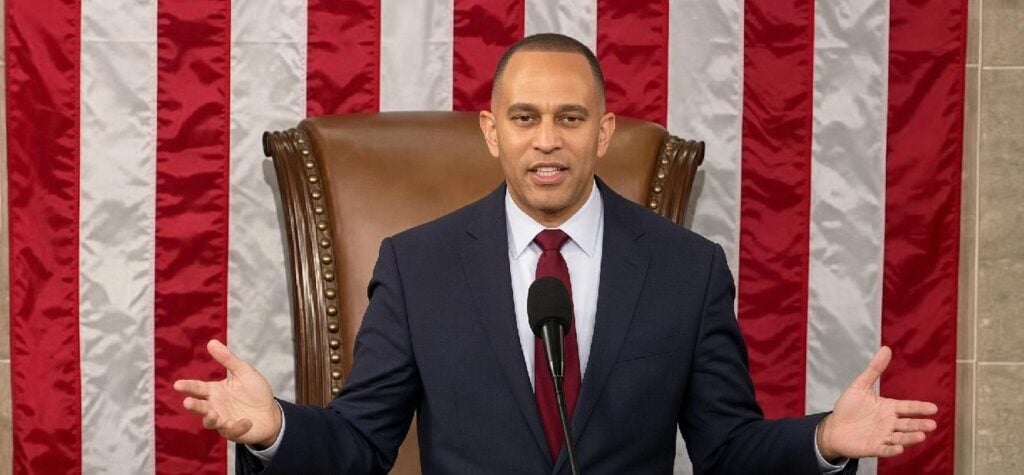
*Rep. Hakeem Jeffries is on the verge of making American political history after House Democrats formally nominated the New York congressman Wednesday to become the first Black speaker of the U.S. House of Representatives.
Jeffries, 56, secured the nomination November 18 in a closed-door, secret-ballot vote of 251-11, according to NBC News. No Democrat challenged him despite concerns among progressives demanding bolder leadership.
The nomination follows Democrats’ successful campaign to reclaim the House majority. NBC News projects the party will control 259 seats when the new Congress convenes, its largest majority in 35 years.
Rather than accepting a nomination by acclamation, Jeffries insisted on a recorded vote, allowing members to express their support or opposition.
“It certainly seems to me to be appropriate that we take exactly the same approach,” Jeffries told reporters Tuesday, referencing Nancy Pelosi’s return to the speakership after the 2018 midterms, “to give every single person the opportunity to weigh in one way or the other on who the caucus feels is best positioned based on track record, experience, vision, to help move us forward in the new Congress.”
Scroll to continue reading








A Historic First More Than Two Centuries in the Making
Since the House first convened in 1789, no Black American has held the speaker’s gavel. Jeffries’ expected election on January 3, 2027, would break that barrier after 237 years.
Among those nominating him was veteran South Carolina congressman Jim Clyburn, a former House majority whip, civil rights veteran and longtime political mentor.
“This is a very surreal moment for me,” Clyburn told reporters.
Jeffries, a Brooklyn native and former attorney, became the first Black lawmaker to lead either major party in Congress when Democrats elevated him to their leadership position in 2022.
As speaker, he would stand second in the presidential line of succession, behind the vice president, while wielding substantial influence over legislation, committee leadership and federal spending.
That authority could prove especially consequential for Black communities on issues ranging from voting rights and economic opportunity to health care, education and federal civil rights protections. However, the extent of his influence would depend on negotiations with the Senate and White House.
Progressive Democrats Signal They Want More
Although Jeffries won overwhelmingly, 11 Democrats voted against his nomination, exposing disagreements over the party’s direction.
Seven dissenting lawmakers, including Reps.-elect Darializa Avila Chevalier of New York, Frederick Haynes of Texas and Claire Valdez of New York, issued a joint statement explaining their opposition.
“Whether on Medicare for All, stopping ICE terror, getting money out of politics, or ending the genocide in Gaza, our constituents sent us to Congress with a mandate on these issues,” they wrote.
The lawmakers acknowledged progress in discussions with Jeffries but said additional commitments were necessary.
“Those conversations are ongoing. As such, our vote in caucus today was no,” they concluded.
With Democrats projected to hold 259 House seats, Jeffries enters the January 3 floor vote with a substantial numerical advantage, although he must still secure a majority of votes cast for a named candidate.
New Leadership, New Expectations
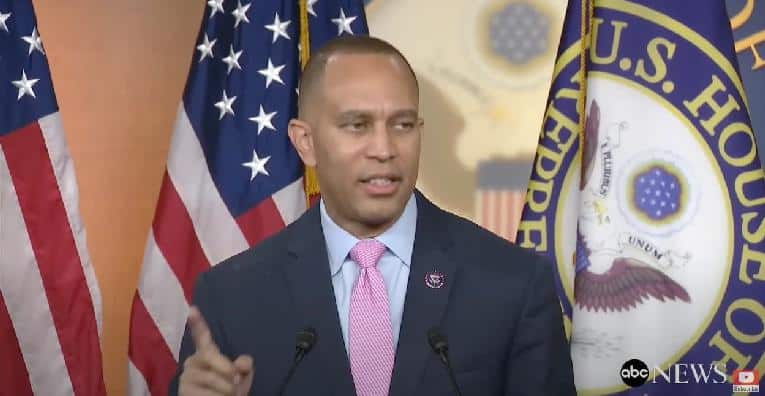
Jeffries will lead a Democratic leadership team reflecting several historic breakthroughs.
Rep. Katherine Clark of Massachusetts was elected majority leader, becoming the first woman to hold that position in either chamber. California Rep. Pete Aguilar will serve as majority whip, while Rep. Ted Lieu becomes the first Asian American Democratic Caucus chairman. Colorado Rep. Joe Neguse was elected assistant speaker.
Jeffries has already begun meeting with progressive and moderate Democratic factions to establish priorities for the incoming Congress, including affordability and economic concerns.
“It’s a great class, and they have a lot of wonderful ideas, fresh ideas, new ideas about how to advance the ball in a bold way for the American people,” Jeffries told reporters.
For Clyburn, whose political career was shaped by the Civil Rights Movement, the moment represents another chapter in a decades-long struggle for Black representation at the highest levels of American government.
For Jeffries, the challenge ahead is turning that historic breakthrough into legislative results.
(If You Like This EURweb Story, Please SHARE it!)
MORE NEWS ON EURWEB.COM: Report: Funeral Prices Have Jumped 310% Since 1986 as More Families Borrow to Pay
We Publish Breaking News 24/7. Don’t Miss Out! Sign up for our Free daily newsletter HERE.