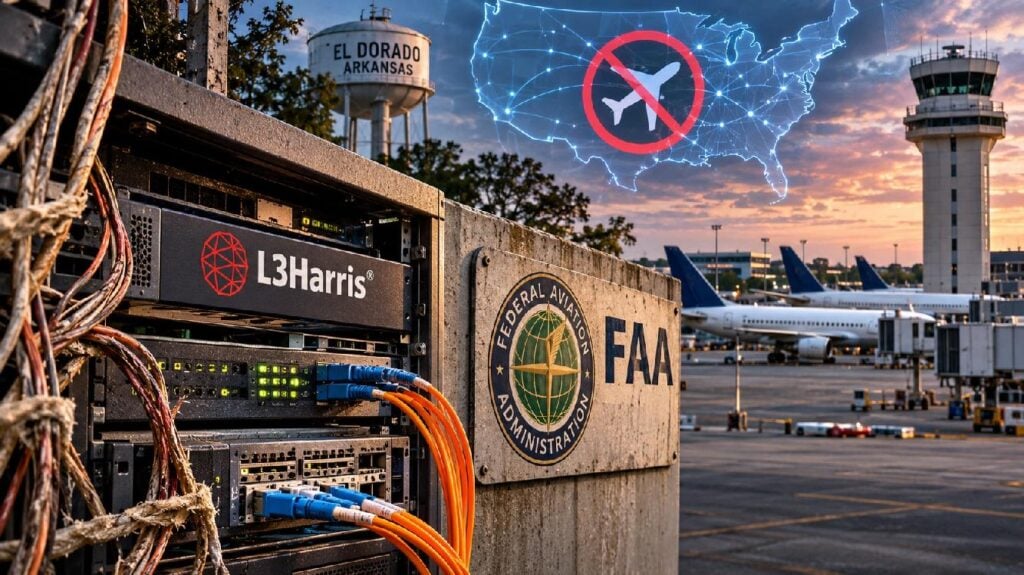
*Who would have imagined that a small southern Arkansas city, historically celebrated for oil discoveries and economic prosperity, would become internationally recognized for a telecommunications breakdown that virtually paralyzed American aviation?
On Friday, November 13, 2026, El Dorado, Arkansas, became an unlikely epicenter of a national aviation emergency.
A routine modernization project involving outdated copper wiring, fiber-optic communications, and newly installed routers contributed to a cascading failure that prompted the Federal Aviation Administration (FAA) to halt departures nationwide.
According to Reuters’ November 17 investigation, the disruption lasted nearly five hours, making it the longest nationwide aviation ground stop since September 11, 2001.
But this is not simply another story about technological failure. It raises serious questions about corporate accountability, federal oversight, long-standing government contracts, and America’s dependence on privately operated infrastructure.
Scroll to continue reading









The Company Behind the Network: L3Harris Technologies
The company at the center of the investigation is L3Harris Technologies, an American defense and aerospace corporation formed through the 2019 merger of L3 Technologies and Harris Corporation.
Its relationship with the federal government predates that merger.
On July 15, 2002, Harris Corporation announced a 15-year, $1.7 billion FAA telecommunications contract, with a projected potential value of $3.5 billion by 2017.
The agreement entrusted Harris with developing and managing the FAA Telecommunications Infrastructure network, commonly called FTI.
A 2006 Department of Transportation Inspector General report documented the project’s original objectives, spending framework, and implementation challenges.
Twenty-four years later, that corporate relationship continues.
According to L3Harris’s telecommunications program documentation, the company designed, implemented, operates, and maintains a nationwide communications network connecting more than 4,400 FAA facilities and supporting over 29,000 telecommunications services.
This is not an ordinary internet service.
It is a critical communications backbone connecting facilities responsible for managing American airspace.
Who Actually Owns America’s Aviation Communications Infrastructure?
On November 15, Transportation Secretary Sean Duffy appeared on CBS’s Face the Nation, where journalist Margaret Brennan questioned him about El Dorado’s role.
In the published CBS interview transcript, Duffy identified L3Harris as the company operating and owning the affected network.
He distinguished FAA-owned radios and radar equipment from contractor-owned telecommunications infrastructure.
That distinction deserves national attention.
Federal authorities regulate American airspace, but essential communications supporting that authority depend partly on infrastructure owned and maintained by a private corporation.
Consequently, Americans should ask: Who independently verifies the reliability of these systems? Who authorizes maintenance? And how should responsibility be divided when a routine equipment installation causes nationwide disruption?

What Actually Happened in El Dorado?
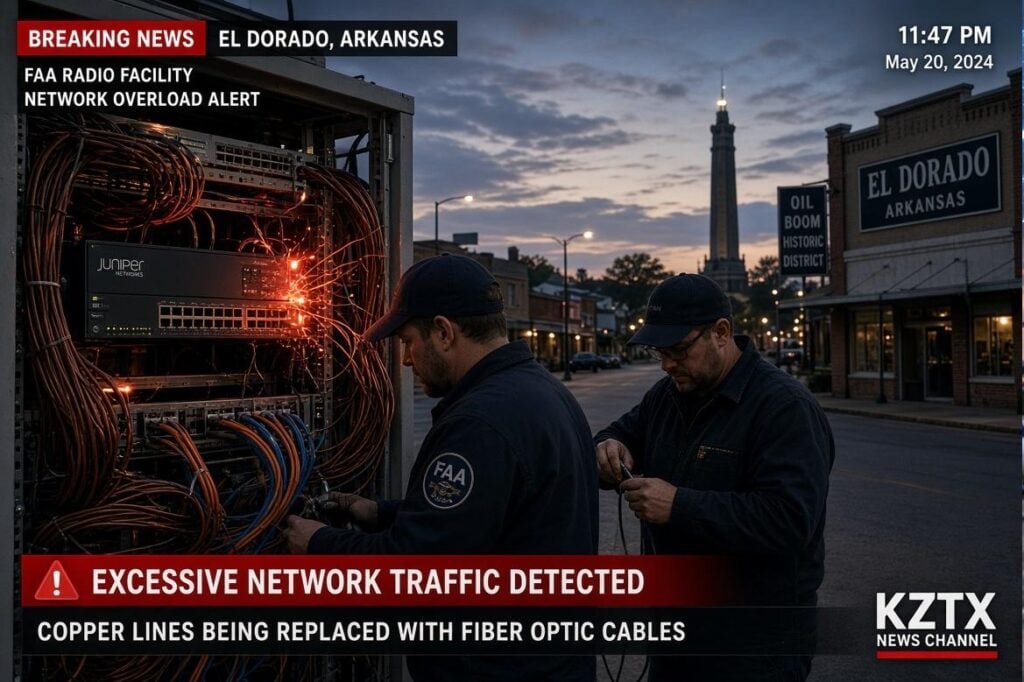
Technicians were replacing aging copper telecommunications connections with fiber-optic technology at an FAA radio facility in El Dorado.
During the process, a newly installed router began generating excessive network traffic.
According to Reuters’ November 16 reporting, officials described approximately 1,000 connection attempts every four to five seconds.
The resulting disruption affected communications across multiple air traffic control centers.
Investigators also examined a second facility in Amarillo, Texas.
Duffy explained that some existing equipment dated to 2001, with components already obsolete by 2006.
However, officials had not conclusively established whether installation procedures, hardware failure, or other technical interactions caused the disruption.
As of November 17, the FAA had suspended additional installations of the implicated Juniper routers while testing continued.
El Dorado’s Arkansas Connection Runs Deeper
El Dorado, historically known as Arkansas’s oil boomtown, emerged as an economic powerhouse following the 1921 petroleum discovery.
The Encyclopedia of Arkansas documents its transformation from a small agricultural community into a nationally significant oil-producing center.
Now the city has entered another chapter of American industrial history.
L3Harris also maintains a substantial presence elsewhere in southern Arkansas through its Aerojet Rocketdyne operations in Camden, where rocket motors support American defense capabilities.
The Arkansas Economic Development Commission documents the company’s continuing investments in the state.
Nevertheless, El Dorado’s local airport management has emphasized that the affected federal communications facility is not operated by South Arkansas Regional Airport.
The city should not be confused with the contractor.

From $12.5 Billion to $50 Billion: Who Pays?
Congress approved $12.5 billion for air traffic control modernization in 2025.
Following the November breakdown, Duffy advocated a much larger $50 billion investment.
The Associated Press reported that the funding debate has intensified scrutiny of existing infrastructure and contractor accountability.
But before taxpayers authorize tens of billions more, Congress should demand independent technical findings, detailed financial accounting, and enforceable contractor-performance standards.
Three biblical principles apply:
Luke 12:48 reminds us that greater responsibility accompanies greater trust.
Proverbs 11:1 emphasizes honest dealings.
And 1 Corinthians 4:2 teaches that stewards must demonstrate faithfulness.
The Warning From South Arkansas
The football legend Paul “Bear” Bryant rose from rural Arkansas near Fordyce to national prominence. El Dorado’s latest international attention offers a different reminder of how profoundly small Arkansas communities can figure in American history.
This time, however, the story is not about athletic excellence.
It is about technological dependency, infrastructure vulnerabilities, and public accountability.
**El Dorado did not
About the Author:
Edmond W. Davis is an American social historian, media strategist, international journalist, Grambling State University graduate, professor at Arkansas Baptist College and Philander Smith University, and founder of the National HBCU Black Wall Street Career Festival. His work focuses on history, education, emotional intelligence, civic engagement, economic mobility, and the advancement of historically Black colleges and universities. Davis was a grand marshal at the National African American History Month Parade, the largest in the U.S. during Black History Month. Davis is a nationally recognized Tuskegee Airman authority.
(If You Like This EURweb Story, Please SHARE it!)
MORE NEWS ON EURWEB.COM: Extraordinary Circumstances: A Planned Political Strategy to Use the FAA Grounding Crisis for Funding?
We Publish Breaking News 24/7. Don’t Miss Out! Sign up for our Free daily newsletter HERE.