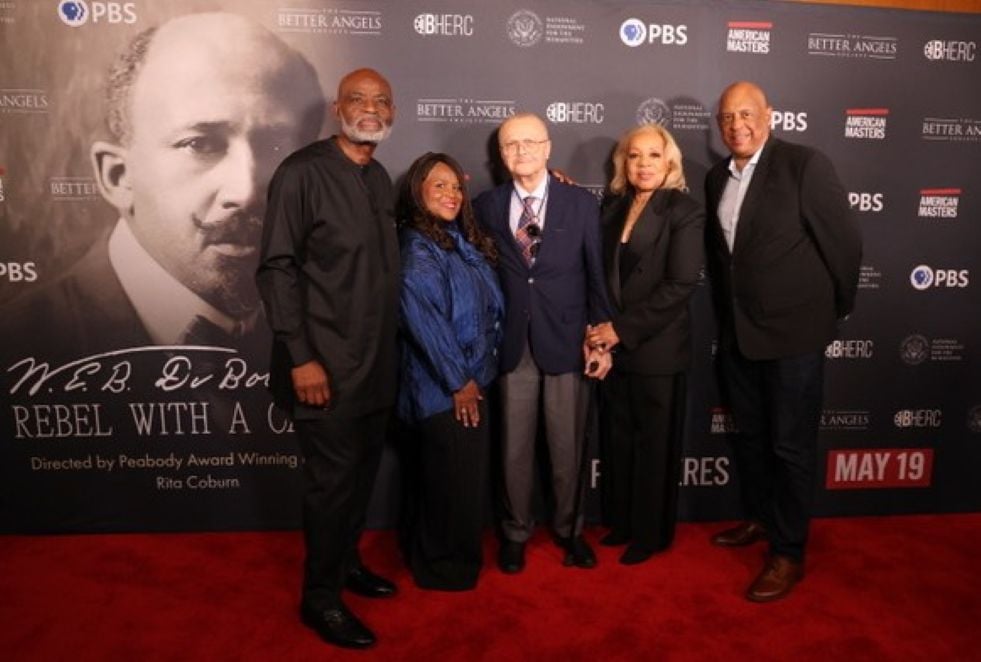
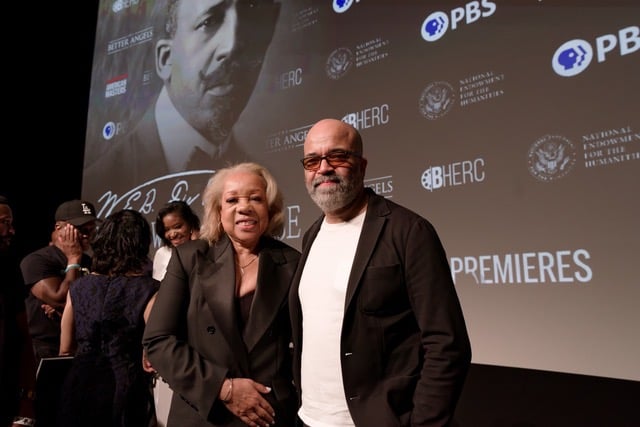
*The Black Hollywood Education and Resource Center (BHERC) recently hosted the world premiere of the documentary W.E.B. Du Bois: Regel With a Cause.
The film is directed by Rita Coburn, narrated by Oscar winner Viola Davis and includes commentary from Pulitzer Prize winner David Levering Lewis and cultural sociologist Karida Brown.
The film also features dramatic interpretation from the award-winning Jeffrey Wright, Courtney Vance and Common.
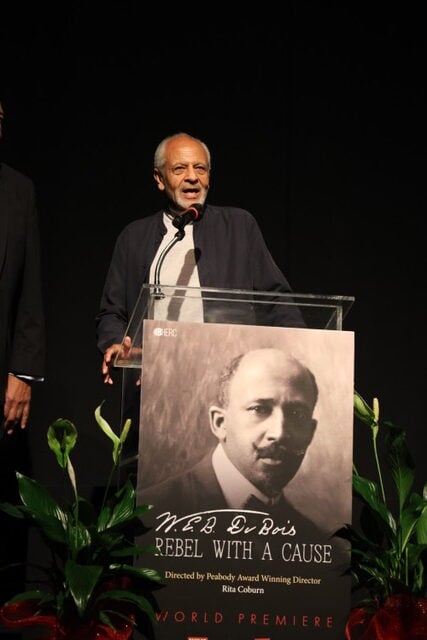
The mood was high as Hollywood luminaries, scholars and cultural curators filled the Directors Guild for an informative and festive celebration. The life of W. E. B. Du Bois is lifted from history pages and academic conversations and thrust into a cinematic experience.
Scroll to continue reading




The audience follows the journey of Du Bois as a young boy who is born five years after the Emancipation Proclamation in 1868. His parents were Mary Silvina Burghardt Du Bois (c. 1831–1885) and his father was Alfred Du Bois. The “B” in Du Bois’ name came from his mother who was born into the Burghardt family, a long-established free Black family in Great Barrington, Massachusetts.
Her ancestry reflected a blend of African and European roots, a fact that would later shape Du Bois’ own exploration of identity and race.
William Edward grew up with the absence of his father and endured the early death of his mother. He often credited his mother with instilling in him a sense of self-worth, discipline, and ambition. Du Bois not only became a scholar, but he was also the first Black to earn a PhD from Harvard in 1895. He urged Blacks to develop their intellectual aptitude and use education as a tool for advancement and equality.
This theme was juxtaposed by Booker T. Washington (founder of the Tuskegee Institute). Mr. Washington encouraged Blacks to cultivate industrial skills and seek to thrive autonomously. This was the great debate of the day, and it positioned Du Bois to be a thought leader and activist. He introduced the concept of “Double Consciousness” in the book The Souls of Black Folk (1903).
This now-classic idea in sociology and cultural theory explores the experience of seeing oneself through one’s own eyes and through the lens of a society shaped by racism, thus “double consciousness.” This concept became foundational in race theory and identity studies.
Du Bois was more than a glory seeking author on a speaking circuit. He stood for empowerment and equal representation, which also included voting rights for women. He was not obtuse to the putridity of Jim Crow and the constant disenfranchisement of Black men and women. His outcry for the nation to be held accountable caused him to be labeled a communist.
This polarizing classification was the convenient label placed on those who could not be controlled, silenced or intimidated by corrupt power structures who placed themselves above the law and everyone else beneath them.
Du Bois maintained the fight. He was a founding member of the N.A.A.C.P. He wrote more than 20 books. He structured groundbreaking infographics on the roots of systemic racism and provided significant constructs for modern Sociology studies.
Du Bois pioneered scientific, data-driven sociology. At a time when many scholars relied on stereotypes, Du Bois used empirical research, surveys, interviews, statistics, and mapping to study Black life. His landmark book The Philadelphia Negro (1899) was one of the first scientific sociological studies of an urban Black community. He collected real data on housing, employment, education, and social conditions decades before this became standard practice. This helped establish sociology as a rigorous, evidence-based discipline. Du Bois spent his final years in Ghana and died on the eve of the March on Washington in 1968. He was 95 years old.
In today’s environment Du Bois would have been called an influencer. His life was more than sound bites and click bait. His life was food for thought and nourishment for the mind and soul. His leadership proved a strength of character and is a case study for what people of color are now facing in the current social and political climate as it relates to citizenship, immigration, birthrights and civil rights.
Peabody Award winner Rita Coburn charges the rescue mission with this must-see film that proves that reviewing the past is perfect preparation for navigating the future. Coburn is writer, producer and director. Executive Producers are Andrew T. Carr, Sandra Evers-Manly, Leslie Fields-Cruz, B.K. Fulton, Denise A. Greene and Michael Kantor. The film also features cameos and commentaries from Raymond Arsenault, Eric Foner, Dr. Henry Louis Gates Jr., Eddie Glaude Jr., Nikole Hannah-Jones, Imani Perry, Fredara Hadley and more. Archival Producer is Prudence Arndt and Associate Producer is Eleanor Levine. Director of Photography is Henry Adenbonjo, Editor is K. A. Miille with musical score by Kathryn Bostic.
Honorary Chairmen for the Du Bois documentary premiere were Charles Floyd Johnson (Magnum PI, Quantum Leap, JAG, NCIS), Oz Scott (TV film director CSI, The Practice, Are We There Yet) and Hall of Fame director Michael Shultz (director Car Wash, Cooley High, Chicago Hope).
W.E.B. Du Bois: Rebel With a Cause airs on PBS American Masters broadcast May 19, 2026, on PBS at 9:00 PM Eastern and is available to stream on PBS.org and on the free PBS app. American Masters is available for streaming concurrent with broadcast on all station-branded PBS platforms. Click here.
For more on the Black Hollywood Education and Resource Center visit www.BHERC.org.
(If You Like/Appreciate This EURweb Story, Please SHARE it!)
MORE NEWS ON EURWEB.COM: Gina Prince-Bythewood’s ‘Children of Blood and Bone’ Due in 2027
We Publish Breaking News 24/7. Don’t Miss Out! Sign up for our Free daily newsletter HERE.