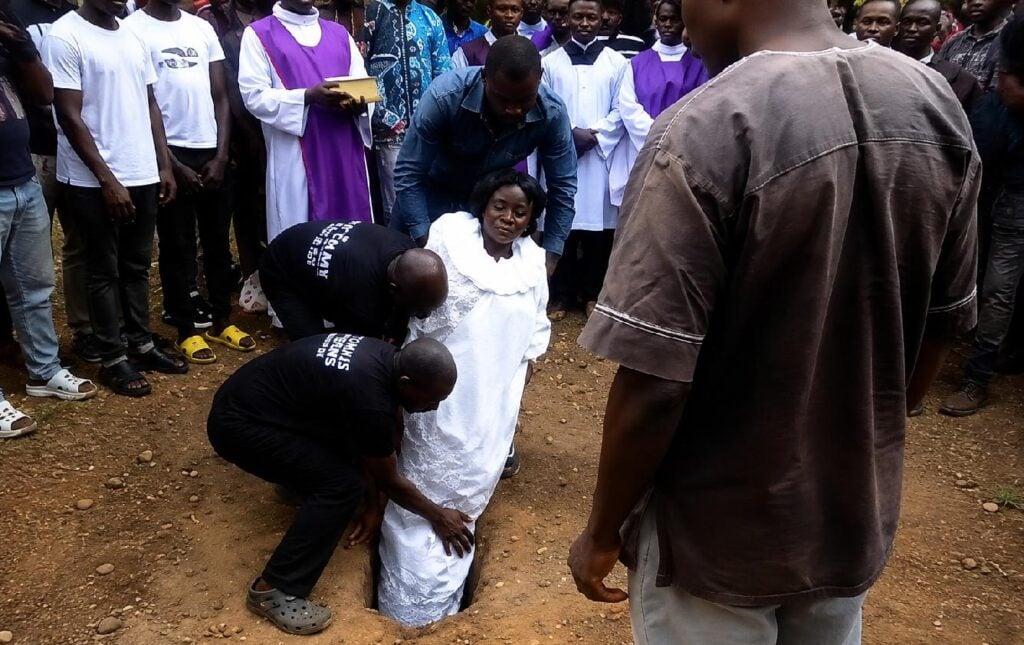
*A striking video circulating on social media shows a woman being lowered into a grave completely upright — not lying horizontally and not positioned in the seated posture associated with some other documented burial traditions.
The X footage shows the deceased in a fully vertical position as mourners gather around the grave during the ceremony. It’s an image that immediately challenges what many viewers consider a conventional burial, but the unusual sight also requires some cultural caution.
The precise location, community and circumstances behind the circulating video have not been independently established by EURweb. That means the woman’s burial should not automatically be assigned to a particular African ethnic group or explained through another community’s traditions simply because those customs also involve an upright body.
What can be established is that burial practices across Africa are extraordinarily diverse — and that vertical burial itself is not an imaginary concept.
Vertical is Not the Same as Seated
That distinction matters with this video.
Scroll to continue reading






Some documented African burial traditions involve a deceased person being placed seated in the grave. The woman shown in the circulating footage, however, appears to be fully vertical.
Those positions should not be treated as interchangeable.
Seated burial has been documented among particular communities in Nigeria and Kenya, including traditions in which the posture is associated with elders, status, ancestral authority or continued vigilance.
But those customs cannot, by themselves, explain the ceremony in this video.
Without confirmation of where the footage was recorded or the community conducting the funeral, claims that the woman is a chief, priestess or another high-ranking figure would go beyond what the available evidence establishes.
Vertical burial ceremony, a distinct cultural funeral rite practiced in parts of Africa. pic.twitter.com/Qen86CaNPD
— Imtiaz Mahmood (@ImtiazMadmood) August 29, 2026
Upright Burial Does Exist
There are independently documented examples of people being intentionally buried vertically.
In Uganda, for example, political commentator Joseph Tamale Mirundi reportedly requested before his 2024 death that he be buried standing upright so he could continue watching over his family.
His family ultimately did not fulfill the request.
Pulse Uganda reported that a representative of Uganda Funeral Service said the family’s ancestral burial ground made the request incompatible with Kiganda tradition because Mirundi’s father was already buried there. The representative said an upright burial could have been possible under different circumstances.
That example illustrates something the circulating video alone cannot tell us: the position of a body can carry a highly specific meaning within a particular family or culture.
Vertical burial can also mean something entirely different elsewhere.
In South Africa, upright burial has been discussed as a practical way to conserve cemetery space. A cemetery feasibility study describes vertical burial as placing caskets designed to support the deceased in a standing position into deeper, smaller graves.
In other words, an upright burial isn’t automatically evidence of one ancient religious practice.
Africa Doesn’t Have One Burial Tradition
That’s especially important when interpreting a visually dramatic clip from somewhere on the continent.
Africa is home to thousands of ethnic communities with distinct religious beliefs, funeral customs and relationships with ancestors. Practices can vary not only between countries but between neighboring communities and even clans.
Some traditions position particular deceased people in ways that communicate authority or respect. Others have incorporated Christian practices alongside older customs. Modern vertical burial systems can also be motivated by something as practical as limited cemetery land.
So while the video is visually remarkable, its deeper meaning can’t responsibly be determined from the woman’s position alone.
What viewers can say with confidence is much simpler: this woman is being buried vertically.
Why she is being buried that way — and what the position means to the people surrounding her — belongs to the community performing the rite.
Until that provenance is established, preserving that distinction is more respectful than turning one extraordinary funeral into a sweeping explanation of how “Africans” bury their dead.
The vertical burial ceremony is a rare and traditional cultural rite reserved for high-ranking figures, such as traditional chiefs, kings, or priests, in specific West and East African communities.
— Massimo (@Rainmaker1973) August 29, 2026
This posture signifies that the leader remains watchful, strong, and… pic.twitter.com/cVakLe7RVs
(If You Like/Appreciate This EURweb Story, Please SHARE it!)
MORE NEWS ON EURWEB.COM: Netflix’s ‘The Polygamist’ Is Challenging How the World Sees Black African Families – The Reactions are Wild! | WATCH
We Publish Breaking News 24/7. Don’t Miss Out! Sign up for our Free daily newsletter HERE.