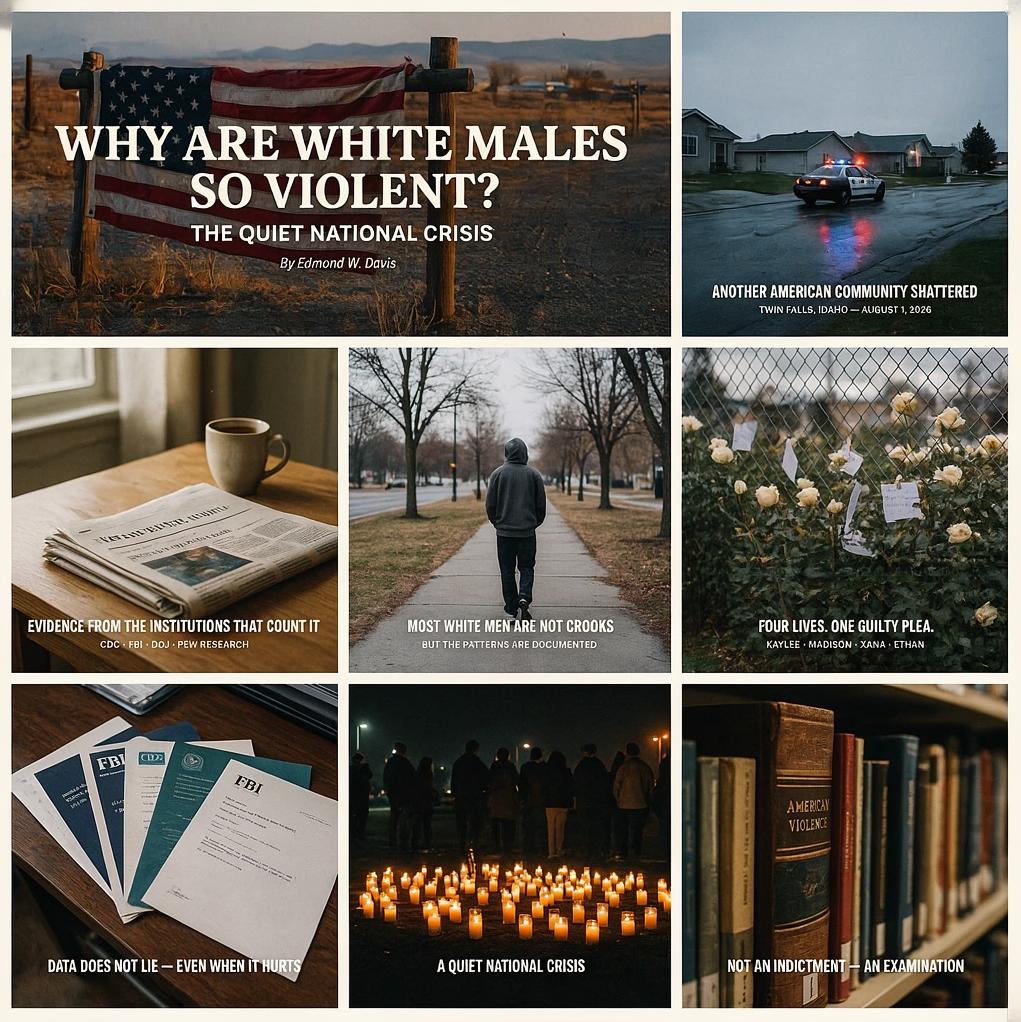
*This commentary does not assert that every white man is violent or that white males have the highest per-capita rate in every category of crime. They do not. Most white men are not criminals, extremists, mass shooters, or murderers.
This article examines documented patterns in public mass shootings, extremist violence, hate-motivated killings, gun ownership and institutional power. Its evidence comes largely from the Centers for Disease Control and Prevention, Federal Bureau of Investigation, National Institute of Justice, U.S. Department of Justice, U.S. Secret Service and Pew Research Center—institutions that historically have been governed, administered or substantially led by white men.
Therefore, this is not an emotional indictment masquerading as research, it’s a quiet national crisis. It is an evidence-based examination of data collected and published by some of America’s most established institutions.
Another American community has been shattered by gunfire.
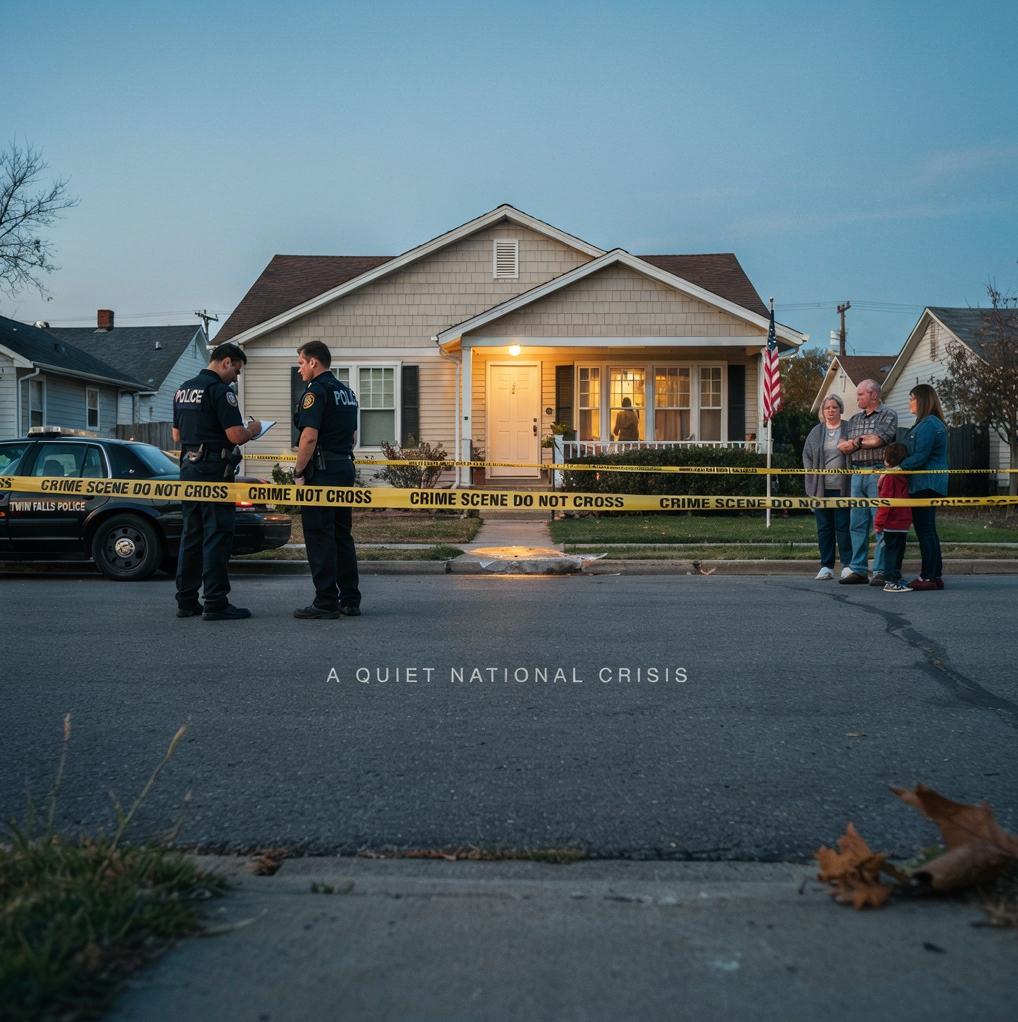
On August 1, 2026, a gunman opened fire near a newly opened In-N-Out Burger in Twin Falls, Idaho. Three people, including the suspected shooter, were reported dead, and seven others were injured. At the time of this writing, authorities had not publicly confirmed the shooter’s identity, race or motive. The Twin Falls attack should not be assigned a racial explanation before investigators establish the facts.
Scroll to continue reading









Bryan Kohberger pleaded guilty to killing all four students and was sentenced in July 2025 to four consecutive life sentences without the possibility of parole. His case represents a particularly terrifying form of violence: an apparently calculated attack against unsuspecting young people inside their home.
Together, these events return me to the question I raised in my September 2025 AFRO commentary, “Dear White Men, Why Are You So Angry?” In that article, I challenged white men to confront the contradiction between their collective social power and the rage expressed by a violent minority among them. It’s a year later, still a national crisis.

Today, the question must become even more direct:
Why are white males so violent?
Again, the word “all” does not appear in that question.
Millions of white men are loving fathers, responsible husbands, pastors, teachers, coaches, employers, public servants and peaceful citizens. They should not be assigned collective guilt for crimes they did not commit.
But America has never extended that same demographic courtesy to Black men. That is the loud national crisis.
When individual Black men commit crimes, the country routinely places Black masculinity itself on trial. Black boys are perceived as older, more threatening and less innocent than white boys. Black men are followed in stores, stopped in traffic, overpoliced in their communities and displayed in mug shots long before all the evidence has been presented.
The suspicion frequently arrives before the crime.
When white men commit spectacular acts of violence, however, the public is invited to consider their loneliness, mental condition, childhood trauma, romantic rejection, job loss, social alienation or online radicalization.
When a Black man commits violence, society searches for a cultural indictment.
When a white man commits violence, society often searches for an individual explanation.
That is the double standard.
What the Data Actually Show
The most important and consistent demographic factor in public mass violence is not race alone. It is sex.
A National Institute of Justice-supported database examined 172 people who committed public mass shootings. It found that 97.7 percent were male. White shooters constituted 52.3 percent, the largest racial category in the database. Black shooters accounted for 20.9 percent, Latino shooters 8.1 percent and Asian shooters 6.4 percent.
That finding does not establish that white males commit every form of violence at the highest per-capita rate. It does establish that public mass shootings are overwhelmingly male violence and that white perpetrators comprise the largest racial share within that prominent national database.
The FBI’s review of active-shooter incidents from 2000 through 2019 identified 333 incidents. In its subsequent review of 2023 incidents, the FBI reported that 222 of 235 identified shooters across the covered data were male—approximately 94 percent. In 2021 alone, 60 of the 61 active shooters were men.
The U.S. Secret Service reached a comparable conclusion in its study of mass attacks in public spaces. Its examination of 173 attacks involving 180 attackers found that approximately 96 percent of the attackers were male.
The CDC also documents the broader gender imbalance in lethal violence. In 2021, the age-adjusted firearm-homicide death rate was 11.1 per 100,000 males, compared with 2.1 per 100,000 females. That means the male rate was more than five times the female rate.
CDC research into intimate-partner homicides of women found an even more dramatic gender pattern. In the studied cases in which suspect information was available, 98.5 percent of suspects were male, and firearms were used in approximately two-thirds of the killings.
These findings do not make every man dangerous. They demonstrate that discussions of extreme violence that ignore male socialization, male grievance, male entitlement and male access to weapons are scientifically and sociologically incomplete.
Guns, Race and Power
Pew Research Center found that gun ownership is not evenly distributed across the population.
In its 2023 findings, Pew reported that four in ten men said they personally owned a gun, compared with approximately one-quarter of women. White adults were substantially more likely than Black, Hispanic or Asian adults to report personally owning firearms.
Earlier Pew research found that approximately 48 percent of white men personally owned guns, compared with about 24 percent of white women and nonwhite men. Another Pew analysis found that white men represented approximately 61 percent of adult gun owners at the time, although they comprised only about 32 percent of the adult population.
Gun ownership is not itself proof of criminality. The overwhelming majority of legal gun owners will never commit a mass shooting.
But when one demographic possesses unusually high access to firearms, holds enormous institutional influence and appears prominently in public mass-shooting statistics, asking difficult questions about that intersection is not racism.
It is research.
Ten Major Mass Killings America Cannot Ignore
Not every major American mass shooter has been white. The Virginia Tech killer was Asian American. The Pulse nightclub attacker was the American-born son of Afghan immigrants. The Uvalde attacker was Latino. A truthful analysis must acknowledge those facts.
Nevertheless, the record includes a long and devastating list of major mass killings carried out by white men. These are not obscure incidents. They are among the attacks that have defined modern American mass violence:
- Las Vegas, Nevada, 2017: Stephen Paddock killed 60 people and wounded hundreds during an outdoor music festival.
- Sandy Hook, Connecticut, 2012: Adam Lanza killed his mother and then murdered 20 children and six educators at Sandy Hook Elementary School.
- Sutherland Springs, Texas, 2017: Devin Patrick Kelley murdered 26 worshippers at First Baptist Church.
- Luby’s Cafeteria, Texas, 1991: George Hennard killed 23 people before taking his own life.
- El Paso, Texas, 2019: Patrick Crusius murdered 23 people in a racially motivated attack targeting Hispanic shoppers.
- Lewiston, Maine, 2023: Robert Card killed 18 people at a bowling alley and restaurant.
- University of Texas Tower, 1966: Charles Whitman murdered his wife and mother before killing people from a university tower, leaving 16 victims dead during the overall killing spree.
- Thousand Oaks, California, 2018: Ian David Long murdered 12 people at the Borderline Bar and Grill.
- Aurora, Colorado, 2012: James Holmes murdered 12 people inside a movie theater.
- Pittsburgh, Pennsylvania, 2018: Robert Bowers murdered 11 Jewish worshippers at the Tree of Life synagogue.
Other major examples include the racist murders of nine Black worshippers at Emanuel AME Church in Charleston, South Carolina; the murder of 10 Black shoppers and workers in Buffalo, New York; the killing of 10 people at Santa Fe High School in Texas; and the racist murder of nine people at a historically Black church in Charleston.
The Department of Justice has explicitly identified the Charleston massacre as a white-supremacist attack and has cited Pittsburgh, Buffalo and El Paso as examples of hate-driven massacres.
These cases do not prove that violence belongs exclusively to white men. They prove that America’s picture of dangerousness is incomplete when it focuses obsessively on Black men while treating recurring white male mass violence as a collection of unrelated abnormalities.
Extremist Violence Cannot Be Racially Sanitized
The contradiction becomes even sharper when extremist violence is examined.
The Anti-Defamation League reported that all 13 identified extremist-related murders in the United States during 2024 were connected to right-wing extremists. Eight involved white supremacists, while five were associated with far-right anti-government extremism. It was the third consecutive year in which all identified extremist-related killings were tied to right-wing extremism.
Over a longer period, ADL research found that white supremacists were responsible for 244 of 443 extremist-related killings during the preceding decade covered by its report—approximately 55 percent.
That does not mean every conservative is an extremist. It does not mean every Republican is violent. It does not mean every white man supports white supremacy.
It means America cannot honestly discuss domestic extremism without examining the racial and gender identities of many of the people organizing, financing, promoting and committing extremist violence.
America readily publishes racial statistics when discussing street crime.
Why does it become uncomfortable with demographics when the subject changes to white-supremacist murders, anti-government violence, attacks on houses of worship or ideologically motivated mass killings?
Perhaps the discomfort exists because white men have historically possessed the institutional power to define what America considers dangerous.
White men have held enormous influence within the legislatures that write laws, the police departments that enforce them, the prosecutors’ offices that bring charges, the courts that determine guilt, the banks that distribute capital, the corporations that control employment and the technology companies that regulate modern communication.
The group historically empowered to define criminality has rarely been required to see itself as a criminal demographic.
Privilege Does Not Always Produce Peace
White men are not economically uniform. Millions live in poverty, struggle with unemployment, experience depression, lose businesses, endure divorce and feel abandoned by the institutions they once trusted.
Race does not erase suffering.
But individual suffering must not be confused with collective systemic exclusion.
White men, as a demographic group, were not enslaved because they were white. They were not systematically prohibited from voting because they were white. They were not legally segregated because they were white. They were not collectively excluded from property ownership, government authority, policing protection, business financing or full American citizenship because they were white.
That historical distinction matters.
Some men have been taught to interpret equality as dispossession, diversity as replacement, criticism as persecution and the loss of automatic authority as oppression.
Privilege does not always produce gratitude.
Sometimes it produces entitlement.
Frustrated entitlement can become resentment. Resentment can become radicalization. Radicalization, combined with isolation, misogyny, racism, grievance and easy access to powerful weapons, can become mass violence.
What Scripture Says About Rage
The Bible does not excuse uncontrolled anger merely because the angry person possesses social authority.
James warns:
“The wrath of man worketh not the righteousness of God.”
—James 1:20, KJV
Human rage should never be confused with divine justice.
Proverbs teaches:
“He that is slow to anger is better than the mighty.”
—Proverbs 16:32, KJV
Biblical strength is not demonstrated through domination, intimidation or gunfire. Strength is demonstrated through self-control.
Jesus also warned against the destructive cycle of weaponized vengeance:
“All they that take the sword shall perish with the sword.”
—Matthew 26:52, KJV
A society that glorifies weapons, excuses rage and mistakes domination for masculinity should not be surprised when unstable men use violence to make themselves feel powerful.
Churches must address this.
Families must address this.
Schools must address this.
Law-enforcement agencies must address this.
White fathers, pastors, coaches, teachers, veterans, executives and community leaders must address this with younger white males before online extremists, racial propagandists and grievance entrepreneurs reach them first.

The Same Standard for Everyone
Available national data do not justify calling white men the most violent demographic in every crime category. CDC data, for example, show that Black males experience the highest firearm-homicide victimization rate among racial and ethnic groups. That disparity is real and should never be concealed.
But victimization rates, general homicide rates, arrest statistics, active-shooter data, public mass-shooting databases and extremist-violence statistics measure different phenomena.
They should not be irresponsibly combined to create a predetermined racial conclusion.
The central issue is America’s selective use of demographics.
Black men should not be treated as a collective criminal class because some Black men commit homicide.
White men should not be treated as collectively guilty because some white men become mass murderers or extremists.
But white male violence should not receive demographic protection that Black male conduct is routinely denied.
When the media identify race while reporting Black criminal suspects, they must be equally willing to examine race and gender in public mass shootings and white-supremacist violence.
When politicians cite crime statistics to justify aggressive policing in Black neighborhoods, they must also confront the demographics of mass attacks, intimate-partner killings and domestic extremism.
When society investigates fatherlessness, anger and culture in Black communities, it must also examine alienation, entitlement, misogyny, racial resentment, gun fixation and online radicalization among white men.
The objective is not to replace one racial stereotype with another.
The objective is to end selective truth.
The honest question is not, “Which race is naturally criminal?”
No race is naturally criminal.
The honest questions are:
Who commits which forms of violence?
Who has the greatest access to weapons?
Whose violence is individualized?
Whose violence is racialized?
Who receives a psychological explanation?
Who receives a racial indictment?
Who is presumed innocent?
Who is treated as dangerous before committing any crime?
America does not become safer by pretending that Black men represent its only criminal threat. It also does not become safer by treating every white male mass attacker as an isolated and inexplicable anomaly.
Why are white males so violent?
The question is not an indictment of every white man.
It is a demand that America apply the same demographic scrutiny to the violence of its most historically powerful group that it has applied for generations to Black men.
And the final question belongs to the nation itself:
Why is America still more comfortable fearing Black men than fully examining the recurring mass violence produced by some of the men who have historically held the greatest share of its power? This is the real domestic terror issue destroying the U.S.
ABOUT THE AUTHOR
Edmond W. Davis is a Social Historian, Speaker, Collegiate Professor, International Journalist, and former Director of the Derek Olivier Research Institute. He is an expert on various historical and emotional intelligence topics. He’s globally known for his work as a researcher regarding the history of the Tuskegee Airmen and Airwomen. He’s the Founder and Executive Director of America’s first & only National HBCU Black Wall Street Career Fest. @edmondwdavis
(If You Like/Appreciate This EURweb Story, Please SHARE it!)
MORE NEWS ON EURWEB.COM: When Black Males Die Twice: The Double Standard of Justice in America
We Publish Breaking News 24/7. Don’t Miss Out! Sign up for our Free daily newsletter HERE.