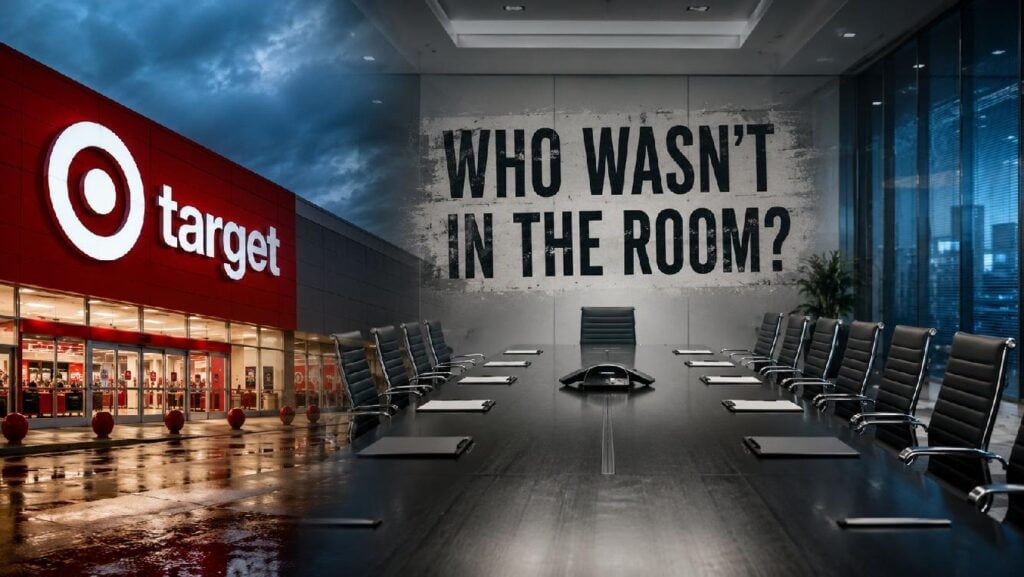
*Target says it wants to know how an offensive children’s Halloween costume ever made it through its approval process.
That’s a good question. But it may not be the most important one.
After pulling back key diversity, equity and inclusion initiatives, Target should also be asking whether changes inside the company made it easier for a glaring cultural blind spot to go unnoticed.
In other words: Who was in the room — and who wasn’t?
After pulling the children’s Halloween costume widely condemned for evoking racist blackface and minstrel imagery, the retail giant apologized and acknowledged that the costume was offensive and should never have been part of its assortment.
Scroll to continue reading






Target also said it is examining how this happened and what needs to change so it doesn’t happen again.
That brings us to an uncomfortable question:
Would it have happened if Target hadn’t pulled back some of its diversity, equity and inclusion initiatives?
Nobody can honestly answer that question with certainty.
DEI programs are not magical shields against stupidity. Companies with diverse workforces and elaborate inclusion programs still make offensive products, run tone-deaf advertisements and occasionally produce the kind of corporate disaster that leaves everybody wondering how something survived five meetings, three committees and somebody’s final approval.
But that’s not really the point.
One reason for having people with different backgrounds and experiences involved in decision-making is remarkably simple:
Somebody in the room may see what everybody else misses.
Somebody Should Have Seen This
Target sold the item as a children’s circus clown costume.
It featured an orange-and-black outfit, black gloves and a hooded mask with an exaggerated toothy grin and small top hat. A Black child was used to model it.
Critics immediately saw something considerably uglier: imagery reminiscent of the grotesque caricatures of Black Americans that populated minstrel shows, advertisements and popular culture for generations.
Target eventually saw it, too.
“As a company, we know we got this wrong, and we are deeply sorry,” the retailer said in its August 24 apology. Target acknowledged that the costume was particularly hurtful to its Black customers, employees and partners.
But before Target could apologize for it, somebody had to conceive it.
Somebody had to design it.
Somebody had to approve it.
Somebody had to merchandise it.
Somebody had to photograph a Black child wearing it.
Somebody had to put the photograph online.
And apparently, at no point during that journey did somebody with enough authority say:
Hold up. Does anybody else see a problem here?
That’s what makes this controversy about considerably more than one ugly Halloween costume.
Target Changed Its Approach to DEI
In January 2025, Target announced significant changes to its diversity efforts.
The company said it was concluding its three-year diversity, equity and inclusion goals, concluding its Racial Equity Action and Change initiatives, ending participation in external diversity-focused surveys and changing its “Supplier Diversity” operation to “Supplier Engagement.”
To be precise, Target did not eliminate everything related to inclusion. Some programs continued, and the company subsequently said it fulfilled a commitment to invest $2 billion in Black-owned businesses.
But there is no disputing that Target deliberately retreated from prominent pieces of the DEI strategy it had previously championed.
The decision generated protests and boycotts.
Target itself later acknowledged the business risk. In its annual regulatory filing, the company said its changes to DEI initiatives had produced adverse reactions from customers, employees, shareholders and others, along with organized consumer boycotts.
Now, roughly a year and a half after announcing those changes, Target finds itself explaining how a children’s costume carrying unmistakable racial baggage managed to get through its system.
That doesn’t prove cause and effect.
It does make the timing impossible to ignore.
Maybe We’ve Been Having the Wrong DEI Argument
For years, America’s DEI debate has been framed as a battle over fairness, hiring, quotas, political correctness and whether corporations have become too “woke.”
Perhaps that’s an incomplete way of looking at it.
What if diversity is also quality control?
What if having Black people, Latinos, women, LGBTQ employees, people with disabilities and people from different economic and cultural backgrounds involved in meaningful corporate decisions isn’t merely about giving those people opportunities?
What if their presence also helps companies avoid making expensive mistakes?
A Black executive isn’t automatically an expert on every racist image in American history.
Nor should Black employees be expected to serve as their company’s permanent racial alarm system.
But diverse organizations increase the likelihood that someone recognizes a cultural land mine before the company steps squarely on it.
The value isn’t simply having a different face sitting at the conference table.
The value is having different experiences, different histories and different questions represented there — and giving those people enough authority to be heard.
That’s the part of the DEI conversation corporate America may want to reconsider.
Who Wasn’t in the Room?
Target says it is investigating how the costume made it through its process.
Good.
The company should examine the designers, buyers, vendors, merchandising teams, marketing personnel and executives who touched the product along the way.
But it should examine something else, too.
Who wasn’t there?
Were people with knowledge of Black history and racial imagery involved in reviewing the product?
Did Target previously have cultural review mechanisms that have since changed?
Did anybody object?
If somebody objected, were they ignored?
And after Target restructured its diversity efforts, did the company unintentionally remove voices, processes or institutional knowledge that might have caught something like this earlier?
Those are questions, not accusations.
But they’re questions Target has earned.
Diversity Isn’t Just Charity
There’s an irony here that deserves attention.
For decades, corporate diversity programs have often been presented as something companies are doing for minorities.
Maybe that’s backwards.
Sometimes corporations need diversity for themselves.
They need people capable of recognizing markets they don’t understand.
They need employees who understand communities executives don’t live in.
They need people who recognize historical imagery others have never encountered.
They need somebody willing to look across a conference table and say:
“You really don’t want to do this.”
Target cannot know whether its former DEI structure would have stopped this costume from reaching consumers.
Neither can we.
But after watching an offensive children’s costume travel through enough corporate checkpoints to wind up on one of America’s largest retail platforms, Target shouldn’t merely ask how the product got through.
It should ask whether someone who might have stopped it was missing from the room.
Because sometimes diversity isn’t about being politically correct.
Sometimes it’s about having enough different people in the building to prevent your company from doing something spectacularly wrong.
(If You Like/Appreciate This EURweb Story, Please SHARE it!)
MORE NEWS ON EURWEB.COM: Target Halloween Costume Sparks Racist Imagery Backlash
We Publish Breaking News 24/7. Don’t Miss Out! Sign up for our Free daily newsletter HERE.