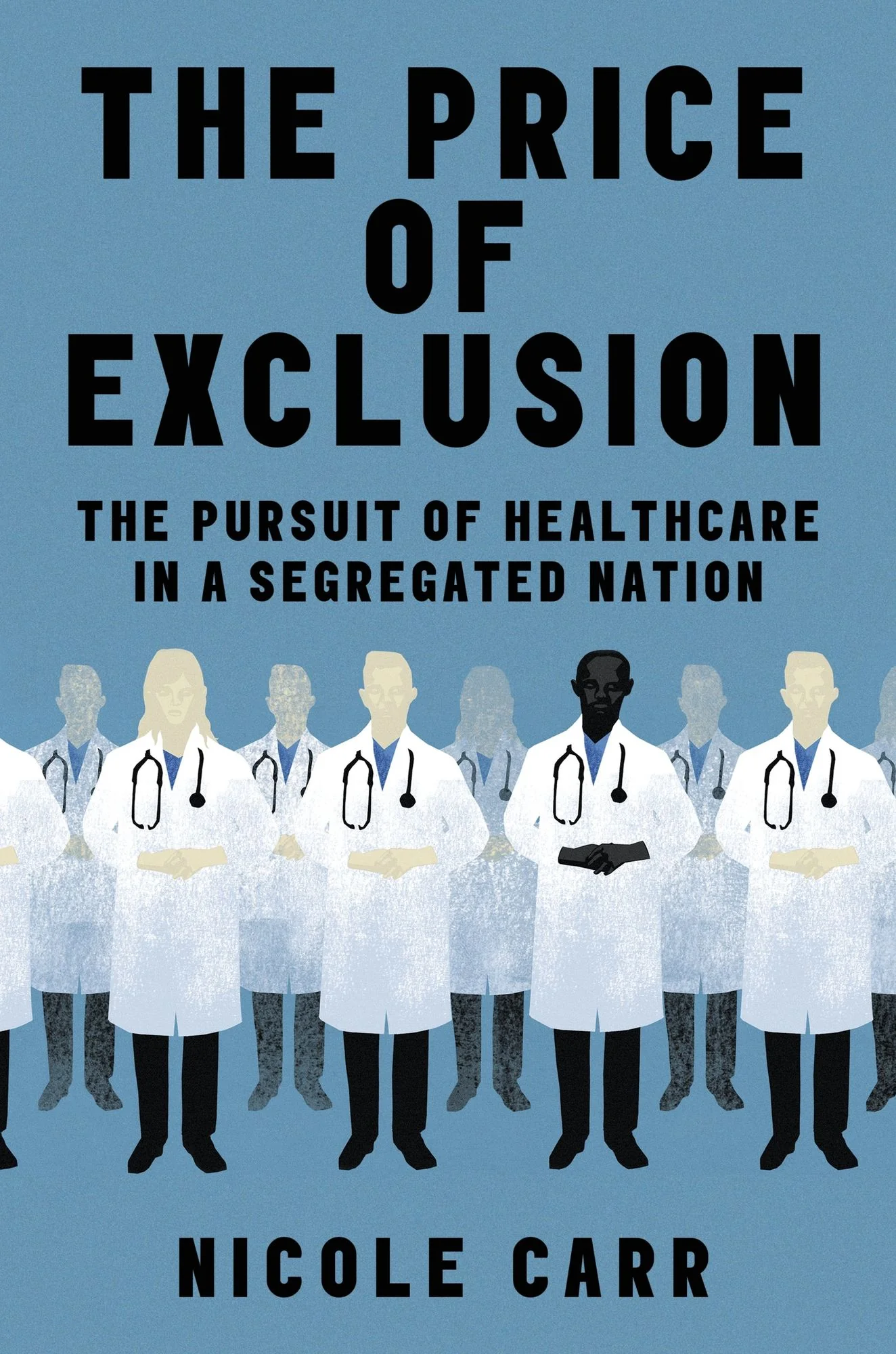
*Most Americans learned that institutions like Harvard, Johns Hopkins, and the University of Pennsylvania helped shape modern medicine. But according to four-time Emmy Award-winning investigative journalist Nicole Carr, one of the profession’s most influential chapters has been left out of the story.
In her new book, “The Price of Exclusion: The Pursuit of Healthcare in a Segregated Nation,” Carr shines a light on generations of Black physicians whose groundbreaking contributions have largely disappeared from public memory. Among them are formerly enslaved people whose knowledge helped establish early vaccination practices in America, the nation’s first four-year medical school, which she says was founded at a historically Black institution, and doctors who created their own national medical organization after being shut out of the American Medical Association.
Speaking with us about the book, Carr explained that she never intended to write it.
“I did not plan on writing a book,” she said. “It was really an ancestor who led me to the story.”
Scroll to continue reading







The project began during the COVID-19 pandemic, when Carr found herself wondering how earlier generations survived public health crises. That curiosity led her to research her great-grandfather, Dr. Lawrence St. Clair Ferguson, a physician whose life had rarely been discussed within her family.
After discovering newly digitized Howard University records, Carr uncovered a remarkable journey that took Ferguson from colonial Jamaica to Howard University, then to Harlem and Scotland before he returned home to oversee a hospital system in Jamaica.
“That’s kind of where it took off,” she said.
Following Ferguson’s path opened the door to even bigger discoveries.
While talking with relatives in North Carolina, Carr learned that Shaw University once operated Leonard Medical School. She said she was stunned to discover that the institution had established a four-year medical curriculum decades before many of America’s best-known universities embraced the model.
As she dug through archival records, Carr found language revealing that Black students were often expected to complete longer medical training because they had to “prove” they possessed the same intellectual ability as white students.
“The language that really captured me was this idea of merit,” Carr said, adding that she was struck by how familiar those arguments sounded amid today’s debates surrounding diversity, equity and inclusion.
The deeper Carr looked, the broader the story became.
Her research revisits overlooked milestones that challenge conventional accounts of American medicine, including Onesimus, an enslaved West African man whose knowledge of smallpox inoculation helped lay the foundation for vaccination in colonial America. The book also explores how Black physicians responded after being excluded from the American Medical Association by founding the National Medical Association in 1895. Carr also profiles trailblazers such as Dr. Nathan Mossell, Dr. C.R. Alexander, and Chicago surgeon Dr. Daniel Hale Williams, whose achievements helped transform American medicine despite systemic barriers.
Rather than relying only on archival documents, Carr said she wanted to experience many of these places firsthand. She credited Clint Smith’s “How the Word Is Passed” with inspiring her to combine historical research with field reporting.
“What I appreciate about that work is this field reporting, this getting on the ground and touching and feeling and talking to people in the space that ancestors have touched,” Carr said.
Carr believes these stories faded from public consciousness because preserving history requires more than books. “We don’t have monuments built to our histories,” she said. “It’s easy to forget where we’ve been because we don’t have huge monuments to our stories.”
She said today’s journalists and storytellers have an opportunity to help change that.
“It will live beyond the newsrooms,” Carr said. “It will live in the books, in the museum exhibits, in whatever media we’re creating in this time.”
For Carr, recovering forgotten history isn’t simply about giving overdue recognition to pioneering Black physicians. She believes the consequences of those lost institutions continue to shape healthcare today.
She pointed to the closure of Black medical schools following the Flexner Report, leaving Howard University and Meharry Medical College to educate the overwhelming share of Black physicians for generations. Carr noted that the American Medical Association later acknowledged its role in dismantling those institutions.
“If we’d left these places alone,” she said, “we would have far more Black physicians, and we wouldn’t be talking about healthcare trust and mistrust in the same way that we’re talking about it today.”

Carr argues that while segregation may no longer look the way it did generations ago, barriers can still emerge through public policy. “The medical school door is not closed to Black people,” she said. “But Black people’s intellect is being challenged in this anti-DEI argument.”
She also emphasized that many of the physicians featured in her book understood that healthcare extended far beyond hospitals and examination rooms. They ran for office, served on school boards, built businesses and created institutions that strengthened Black communities.
“They have a political agency and power that is beyond the examination room,” Carr said.
“The Price of Exclusion” uncovers a history many Americans were never taught, while asking readers to reconsider who helped build the nation’s healthcare system—and whose stories have been left out along the way.
Watch our full interview with Nicole Carr to hear more about the forgotten pioneers featured in the book and the investigative journey that brought their stories back into the light.
MORE NEWS ON EURWEB.COM: Muni Long Reveals Double Lung Transplant After Doctors Gave Her One Week to Live
We Publish Breaking News 24/7. Don’t Miss Out! Sign up for our Free daily newsletter HERE.