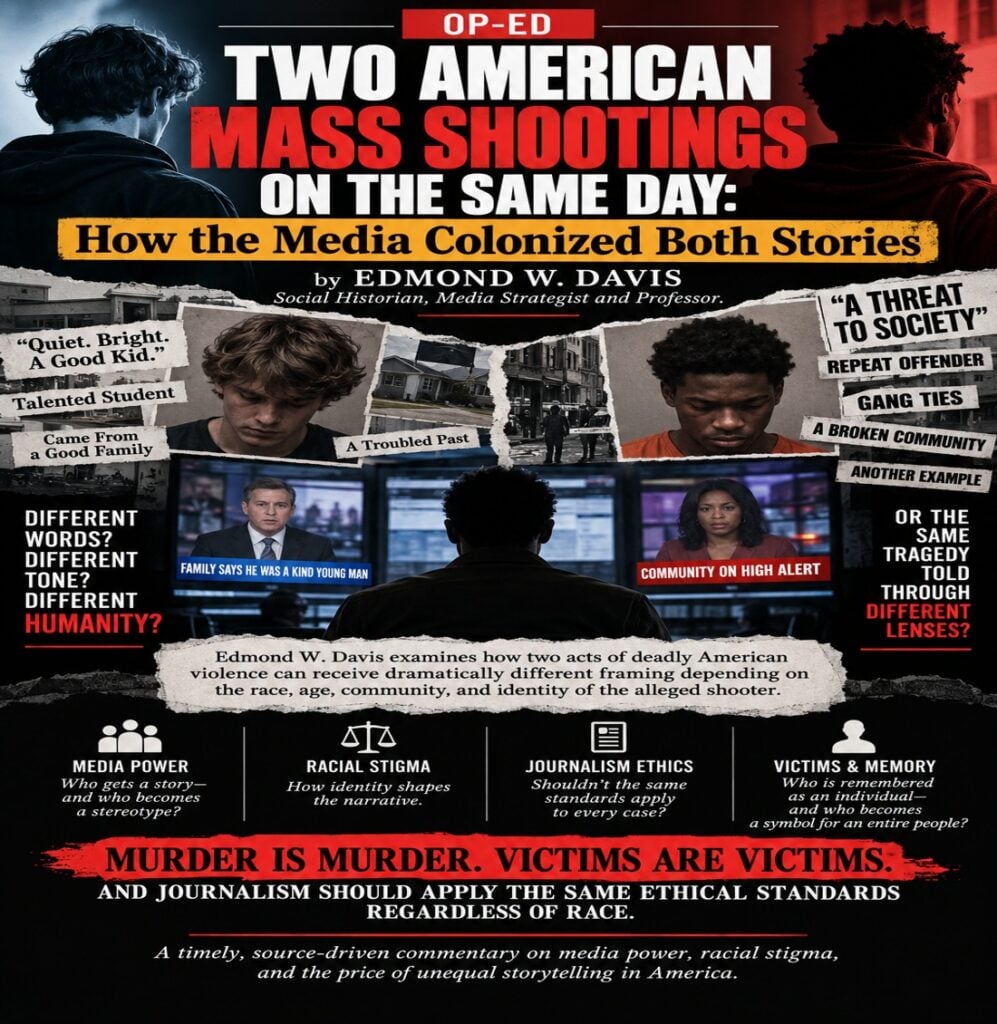
*Two American communities are grieving. Two shootings, thousands of miles apart, have forced families to confront the unthinkable.
One occurred at an elementary school in Bend, Oregon; the other at a convenience store in Little Rock, Arkansas, both on Thursday, October 15, 2026. I was thinking about my first trip to Washington, D.C., 31 years ago today, when I attended the Million-Man March on October 16, 1995. That was on my mind until I drove by the Circle K gas station on University Avenue in Little Rock, Arkansas.
Children, educators, parents, spouses, and neighbors are now connected by a national epidemic of gun violence. But these tragedies also raise an uncomfortable question: Does America tell the same story when a suspected shooter is Black as when a suspected shooter is white?
The answer requires more than comparing photographs, headlines, or television airtime. It requires examining the language journalists use, the information police release, the identities emphasized, and the assumptions audiences are encouraged to make. Murder is murder. Wrong is wrong.
The victims deserve equal humanity, and suspects deserve consistent standards of reporting regardless of race. Yet American journalism has a documented history of treating racial identity differently depending on who is accused, who is victimized, and which communities are affected. That history makes these two cases worthy of serious examination—not racial speculation, but evidence-based accountability.
Scroll to continue reading


THE BURDEN OF REPRESENTATION: WHEN ONE SUSPECT BECOMES AN ENTIRE RACE
On October 15, 2026, a 16-year-old gunman entered Silver Rail Elementary School in Bend, Oregon. According to Reuters and the Associated Press, three children, ages 5, 8, and 11, and a teacher were killed. A seven-year-old student and another teacher suffered critical injuries. An armed community member fatally shot the attacker.
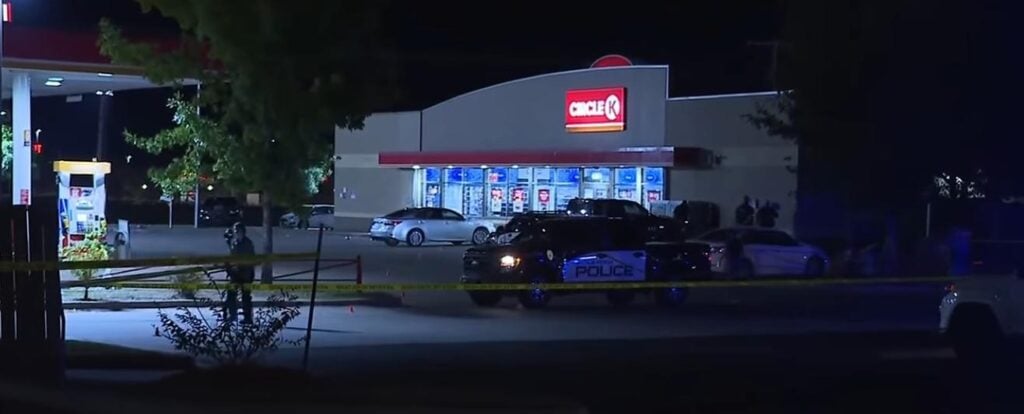
That same day, a little later in the afternoon, Little Rock police responded to gunfire at a Circle K convenience store near Colonel Glenn Road and University Avenue. Two people were killed and three critically injured. Authorities subsequently announced the arrest of 19-year-old Kevontae Wilburn in connection with the shooting.
In the Little Rock case, police publicly identified a suspect and circulated his image. In Bend, early reporting withheld the 16-year-old suspect’s identity. I wonder why?
Those differences warrant examination, but they do not alone establish discrimination. One suspect was an adult in custody; the other was a deceased minor. Juvenile privacy considerations and investigative decisions can explain differences in identification. Nor has the Bend suspect’s racial identity been established in the reliable reporting reviewed for this article. I wonder why not?
Nevertheless, a broader question remains: Why does American journalism sometimes make a melanated indigenous American (Black) suspect’s identity central to a story while exploring a white suspect’s circumstances as an individual tragedy?
THE RESEARCH: THIS IS NOT JUST AN OPINION
A groundbreaking January 2026 study published in the Proceedings of the National Academy of Sciences examined more than 35,000 news articles about gun violence. Researchers from Northwestern University, the University of California, Davis, and the University of Washington identified significant disparities in the amount and nature of coverage associated with neighborhood racial composition.
According to UC Davis’s summary of the research, mass shootings in majority-white neighborhoods received approximately twice the news coverage of those in majority-people-of-color neighborhoods. That finding challenges the assumption that newsworthiness depends solely on lives lost or injuries suffered. A separate 2018 study in the Journal of Research in Crime and Delinquency analyzed 433 news documents involving 219 mass shootings. Researchers found that crimes committed by white and Latino shooters were more likely to be attributed to mental illness than those committed by Black shooters.
Another 2022 peer-reviewed study, drawing on thousands of news documents, found that white mass shooters were more likely to receive compassionate descriptions but also more likely to receive explicitly negative descriptions. The important finding was that their portrayals were often more complex than those of shooters of color. In other words, the double standard is not necessarily that white suspects receive favorable coverage. It is that they may receive more individualized explanations.
A Black suspect can become a symbol of supposed community dysfunction. A white suspect can become an investigation into one person’s psychology, family history, or isolation. Neither approach should substitute for the facts.

TWO TRAGEDIES, BUT WHO GETS TO BE HUMAN?
Little Rock Mayor Frank Scott Jr. described the pain of praying with a woman whose husband of 44 years had been killed. His remarks, reported by Little Rock Public Radio, remind us that the people lost in these shootings were more than crime statistics. Consider the young people whose names have entered America’s history of violence and injustice: George Stinney, Jr., Nathaniel Brazill, Austin Lyle, Solomon Henderson, and Lee Boyd Malvo to name a few.
Their circumstances were profoundly different. Stinney was a 14-year-old Black child executed in 1944 after a trial whose conviction was later vacated; he must not be presented as a proven murderer. The others were involved in distinct criminal cases or shootings, with different evidence and legal outcomes. They should never be reduced to interchangeable examples of Black criminality. The same principle must apply to white suspects. Their crimes should not condemn every white family, teenager, or community. The burden of representation becomes unjust when one person’s actions are used to prosecute an entire racial population in the court of public opinion.
THREE SCRIPTURES FOR JUSTICE, ACCOUNTABILITY, AND HEALING
The Bible offers a moral framework that challenges both violence and selective judgment.
Micah 6:8: God calls humanity to act justly, love mercy, and walk humbly. Justice cannot depend on the racial identity of the accused or the neighborhood where victims die. James 2:1: Believers are warned against favoritism. That principle should challenge journalists, prosecutors, police departments, religious leaders, and ordinary citizens who apply unequal standards.
Matthew 5:9: Jesus blesses the peacemakers. Peace requires more than prayers after another shooting. It demands prevention, intervention, responsible firearm practices, meaningful youth mentorship, trauma support, and sustained community involvement.
THE MEDIA MUST STOP PUTTING RACE ON TRIAL
Five credible peer-reviewed research and reporting sources establish the foundation of this argument: the 2026 PNAS study, the 2018 study of racial framing and mental illness, the 2022 analysis of mass-shooter portrayals, Reuters’ Bend reporting, and KARK’s reporting on the Little Rock arrest.
These sources support scrutiny of racial disparities in reporting. They do not establish that the two October 15 shootings received unequal coverage specifically because of the suspects’ races. That distinction is essential.
A responsible newsroom should ask whether it publishes suspect photographs consistently, whether it humanizes victims equally, whether it invokes mental illness without evidence, and whether it allows one person’s alleged crime to stigmatize an entire community.
Bend, Oregon Police Department, and the Little Rock Police Department did two different things, but the question is, are they working on the same agenda? America cannot heal while treating one community’s tragedy as a national emergency and another’s as routine neighborhood violence. From Bend to Little Rock, the standard must remain the same: equal grief for victims, equal scrutiny of violence, equal accountability under the law, and equal humanity in the headlines. I’ll wait.
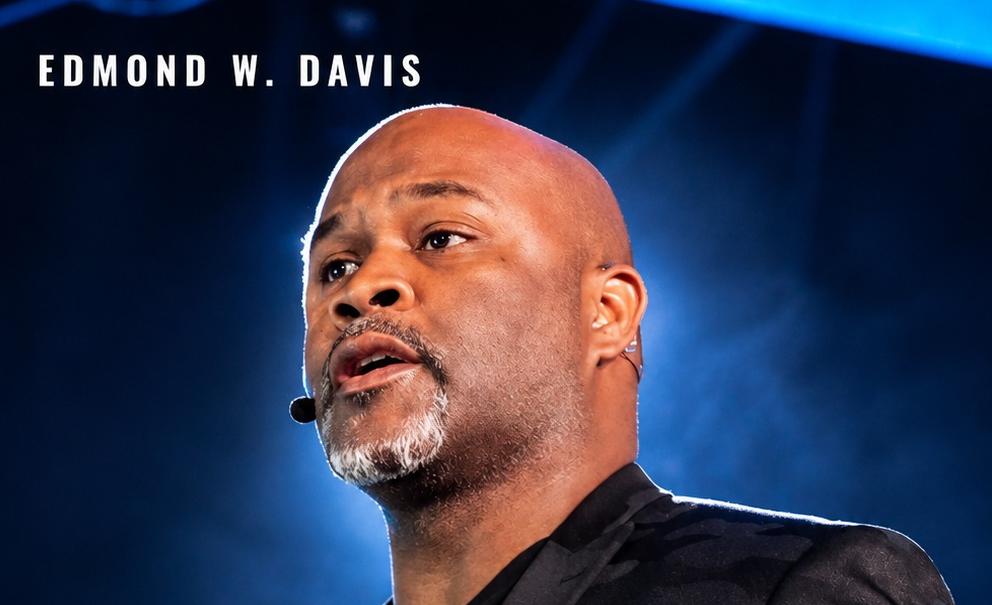
ABOUT THE AUTHOR
Edmond W. Davis is a social historian and one of the world’s top Tuskegee Airmen authorities. Davis is a media strategist and professor. Davis founded the country’s only National HBCU Black Wall Street Career Fest. A native of Philadelphia, PA, Davis is committed to cultural empowerment and educational equity through storytelling and civic engagement. In 2026, Davis was a grand marshal at the 38th Annual African American History Month Celebration Parade. His life is told in the award-winning 2023 short documentary ‘FROM GRIND TO GROWTH: The Edmond W. Davis Story. Davis played the courthouse jailroom deputy on the NBC TV miniseries Bluff City Law.
(If You Like/Appreciate This EURweb Story, Please SHARE it!)
RELATED NEWS ON EURWEB.COM: Neil deGrasse Tyson Slammed for Insensitive Reaction to Mass Shootings
We Publish Breaking News 24/7. Don’t Miss Out! Sign up for our Free daily newsletter HERE.