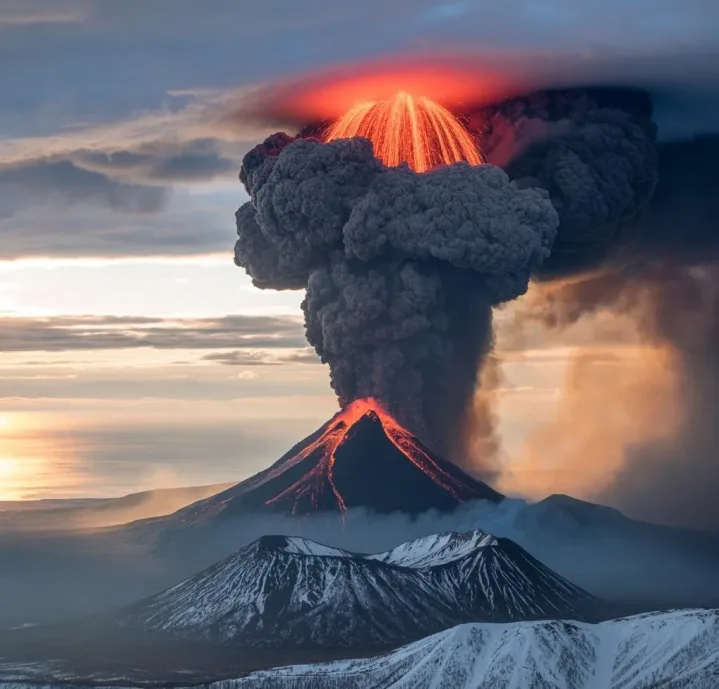
*Last weekend’s seismic upheaval in Russia’s Far East has rewritten geological expectations: the Krasheninnikov volcano, dormant for centuries, has roared back to life.
Located deep within the Kronotsky Nature Reserve on the Kamchatka Peninsula, atop a segment of the Pacific Ring of Fire, this stratovolcano erupted on August 3, 2025, roughly 475 to 600 years after its last confirmed activity—depending on whether you trust the Smithsonian Institution’s Global Volcanism Program (dating back to 1550 CE) or local Russian sources suggesting a six‑century hiatus. (Associated Press News)
What triggered this awakening so many centuries later? There’s compelling evidence linking it to the massive magnitude 8.8 earthquake that struck off Kamchatka on July 29, 2025, unleashing tsunami waves across the Pacific and rattling global tectonic plates. (Reuters) Within days, Krasheninnikov erupted, flinging ash as high as 3.7 to 6 kilometers into the sky. A secondary magnitude 7.0 quake accompanied the eruption, prompting tsunami warnings that were later lifted. (ABC7 News Los Angeles)
As an op‑ed for a broader audience, it’s worth situating this eruption within the larger tapestry of Kamchatka’s volcanic network and the Ring of Fire—a region of intense subduction, seismic unrest, and frequent eruptions.
Scroll to continue reading









Five Little‑Known Facts About Krasheninnikov Volcano
- A Twin‑Cone Giant in an Ancient Caldera
Krasheninnikov comprises two overlapping stratovolcanoes nested inside a 9 × 11 km Pleistocene caldera. The southern cone began forming ~11,000 years ago, while the northern cone emerged ~6,500 years ago, each within large summit craters (Smithsonian Global Volcanism+1Wikipedia+1) - A Meager Eruption Record
Although this volcano now erupts, its current Holocene eruptive cycle began around 600 years ago—with only two documented eruptions: the one around 1550 CE, and now. Compared to its neighboring giants like Klyuchevskaya Sopka (almost continuously active), Krasheninnikov is truly grand Fox News, Los Angeles Times & Smithsonian Global VolcanismLos Angeles Times, Smithsonian Global Volcanism, The Times. - Tectonic Setting Along the Ring of Fire
It forms part of the Eastern Volcanic Belt of Kamchatka—where the Pacific Plate plunges beneath the Eurasian Plate. This subduction zone is responsible for nearly 300 volcanoes in the region, of which around 29 are active. Krasheninnikov lies near several others, including Kliuchevskoy and Koryaksky, Wikipedia, Smithsonian Global Volcanism & The Sunday Times. - Historical Influence in Pre‑Industrial Times
Though its previous eruption was centuries ago, deposits of ash and lava flows within the caldera and adjacent regions have shaped the broader landscape. The 1550 eruption produced lava flows and tephra deposits, evidence that the volcano can deliver both explosive ash and effusive lava—even on a small scale, Smithsonian Global Volcanism Volcano World. - Ecological Neighbor to the Valley of Geysers
Krasheninnikov sits downstream of the famed Kronotsky wildlife refuges. The recent eruption’s ash may spread toward ecologically sensitive zones like the Valley of Geysers, where thermal anomalies and unique ecosystems could be buried or disrupted (The Sun & Cadena).
A Wake‑Up Call for the Ring of Fire
The linkage between the late July tremor and the Krasheninnikov eruption underscores a broader truth: seismic and volcanic systems in the Pacific Rim are deeply interconnected. The July 8.8 quake wasn’t just a headline‑grabbing tremor—it likely perturbed subterranean magma chambers, destabilizing pressure enough to trigger eruptions at both Krasheninnikov and Klyuchevskaya Sopka, which also erupted in close succession. (Yahoo News, The Times, & People.com).
Kamchatka is sparsely populated: only a few thousand people live within 30 km of Krasheninnikov. Still, the eruption sent ash drifting east toward the Pacific Ocean, and aviation authorities issued warnings for overflights. While no populated areas have reported ashfall yet, authorities remain vigilant—especially given the potential for continued “moderate explosive activity.”(The Times, ABC 7 Los Angeles, & Los Angeles Times)
Potential Impacts: Past, Present, Future
- Past: The volcano’s last eruption centuries ago likely went undocumented in European‑language sources. But sedimentary tephra layers suggest it contributed to landscape change and perhaps short‑term climate or ecological shifts regionally.
- Present: The eruption covers nearby ecosystems and could deposit ash in the Valley of Geysers, altering water chemistry, visibility, and wildlife habitat. Aviation safety is another immediate concern—with ash plumes potentially reaching flight corridors across the North Pacific.
- Future: As seismic aftershocks—dozens recorded within 24 hours, some up to magnitude 6.8—continue to rattle the region, further eruptions are possible. Authorities must monitor thermal cracks, gas emissions, and ash production closely. (The Sun).
Why This Matters—and What Must Be Done
For policymakers, disaster planners, and the international aviation community, this event is a sharp reminder: Ring of Fire dynamics involve both earthquakes and volcanoes—and one can trigger the other. Preparedness cannot remain siloed.
Russia should:
- Accelerate scientific monitoring, deploy additional seismic and gas sensors on Krasheninnikov and its neighbors, and share data with international agencies.
- Maintain and update aviation alerts: ash dispersion models and flight path rerouting must be coordinated swiftly.
- Support ecological response: park managers and scientists should assess and model the ash’s impact on fragile ecosystems like the Valley of Geysers.
- Educate and equip nearby communities, even sparsely populated ones, regarding ash inhalation risks and clean‑up protocols.
As the plume drifts toward open waters, few lives are in immediate danger.
Nevertheless, the eruption of Krasheninnikov after centuries of silence occurs in a region synonymous with tectonic volatility.
The Ring of Fire does not rest. Rather, it occasionally reminds us—often abruptly—that ancient systems remain powerful, unpredictable, and interconnected.
At this moment, as Krasheninnikov’s smoke still curls upward, we can only hope that authorities in Russia take necessary measures—seismic monitoring, ashfall warnings, ecological safeguards, and aviation coordination—to mitigate risks. For a volcano that slumbered for half a millennium, its reawakening is not just geology: it is a clarion call for preparedness in a perilous theatre of Earth’s motion.

Edmond W. Davis is a social historian, journalist, retired history professor, socioemotional intelligence expert, author of multiple historical texts, Arkansas’s first and only Tuskegee Airmen history textbook, and an international speaker. Davis had a role as a Shelby County Courtroom Jail Deputy on the NBC TV series Bluff City Law. He is a former director of the Derek Olivier Research Institute for the Prevention of Gun Violence. Davis is also the founder of the National HBCU Black Wall Street Career Fest and an Amazon #1 author. Contact him via www.edmondwdavis.com.
MORE NEWS ON EURWEB.COM: Southwest Flyers Are PACKING Like Sardines – The Genius Trick to Avoid $45 Bag Fees! | WATCH
We Publish Breaking News 24/7. Don’t Miss Out! Sign up for our Free daily newsletter HERE.