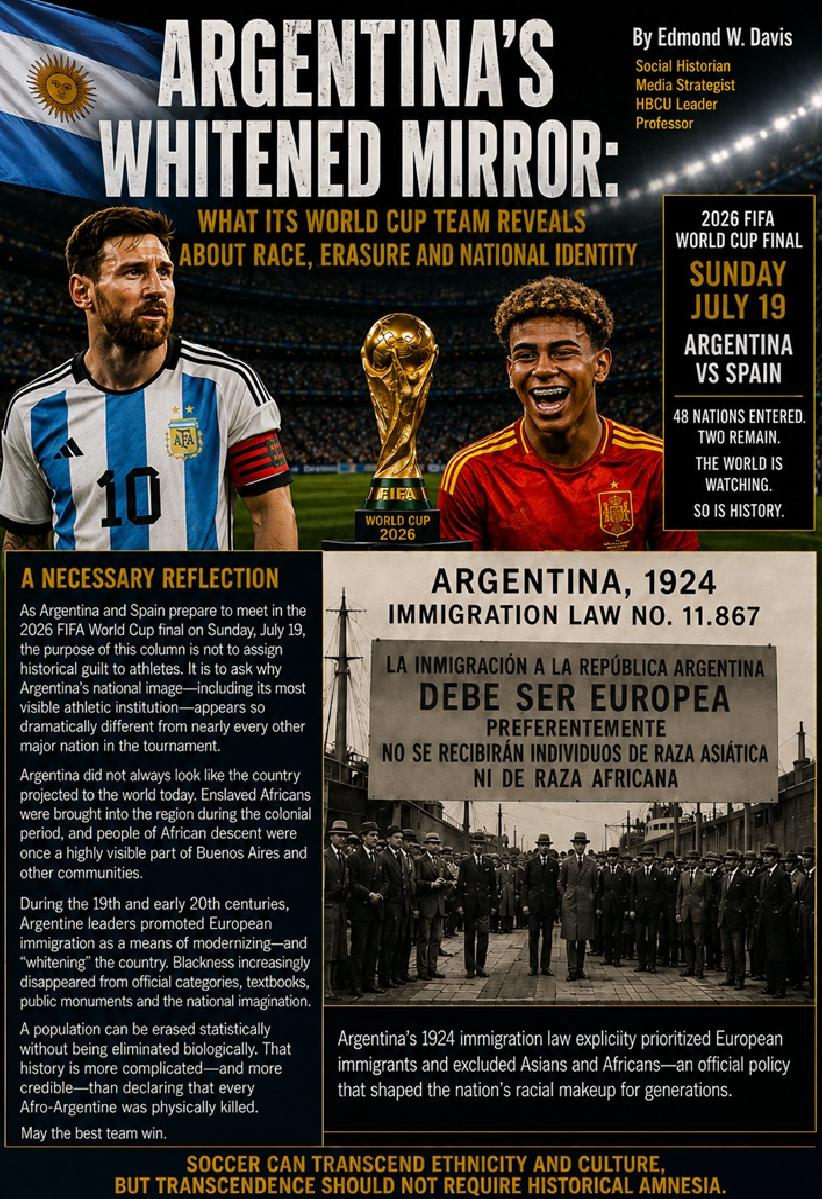
A Necessary Opening Disclaimer: This is not an attack on Argentina’s soccer players, its supporters, or Lionel Messi. Messi belongs on soccer’s Mount Rushmore and has been the defining player of the world’s most popular sport for nearly two decades. I admire his brilliance. I also admire the excellence of Spain and its star player, Lamine Yamal, who nearly 20 years ago was an infant in the hands of Messi in an iconic photograph, shared around the world. But the question must be asked: “Would Lamine be able to play for Argentina, given its history of racism in the country, not on the soccer team?”
In the wake of Spain’s 1-0 defeat of Argentina in the 2026 FIFA World Cup final on Sunday (07-19-26), the purpose of this column is not to assign historical guilt to athletes. It is to ask why Argentina’s national image—including its most visible athletic institution—appears so dramatically different from nearly every other major nation in the tournament.
The question is not whether Argentina can win without Black players. It obviously can. The deeper question is how a South American nation with a documented African history came to imagine and present itself as almost exclusively European.
That story did not begin with soccer.
Scroll to continue reading








The Myth of a White Argentina
Argentina did not always look like the country projected to the world today. Enslaved Africans were brought into the region during the colonial period, and people of African descent were once a highly visible part of Buenos Aires and other communities.
Their descendants did not simply vanish.
Wars, disease, economic inequality, racial classification, intermarriage and migration all affected the population. But historians also point to a deliberate national project that privileged European identity and minimized African and Indigenous ancestry.
During the 19th and early 20th centuries, Argentine leaders promoted European immigration as a means of modernizing—and “whitening”—the country. Blackness increasingly disappeared not necessarily from bloodlines, but from official categories, textbooks, public monuments and the national imagination.
That distinction matters.
A population can be erased statistically without being eliminated biologically. People can be encouraged to identify as white, mixed or simply Argentine while African ancestry becomes socially undesirable or publicly invisible.
Argentina’s modern identity was therefore not produced by one extermination order or a single conspiracy. It emerged through generations of warfare, demographic policies, racial ideology, selective immigration and cultural denial.
That history is more complicated—and more credible—than declaring that every Afro-Argentine was physically killed.
Soccer Becomes the World’s Mirror
Forty-eight nations entered the 2026 World Cup. Argentina and Spain were the last two standing. Spain’s roster visibly reflects the African, Caribbean, and immigrant communities that have reshaped modern Europe. Argentina’s roster projects a far more uniformly European image.
Appearance alone cannot establish ancestry. We should never assign a person’s racial identity merely by looking at a photograph. Nor should anyone claim, without players’ own family histories, that no Argentine player possesses African ancestry.
However, it is fair to observe that Argentina has no prominently self-identified Black or Afro-Argentine player occupying the international spotlight. That absence is especially striking in a nation located on a continent deeply shaped by Africa and the transatlantic slave trade.
It does not prove discrimination within team selection. Argentina may simply be choosing the best players produced by its current development system.
Yet soccer academies do not exist outside society. They reflect who has access to clubs, scouting, training, nutrition, transportation, visibility and social acceptance. When an entire national institution repeatedly presents one racial image, scholars should be permitted to ask how history helped create it.
The soccer team is not the cause. It is the world’s most visible mirror.
Perón, Fascism and the Europeanization Project
Argentina’s racial history also intersects with its complicated relationship with European nationalism and fascism.
After World War II, the government of President Juan Perón facilitated or tolerated escape networks that allowed Nazi fugitives and European collaborators to enter Argentina. Adolf Eichmann, Josef Mengele and Erich Priebke were among the notorious war criminals who found refuge there.
The Wiener Holocaust Library describes Latin America as both a refuge for Jews escaping persecution and a later haven for Nazis fleeing prosecution. Those two populations must never be morally equated: one group fled attempted extermination; the other included perpetrators escaping justice.
Perón viewed some European migrants, military specialists and technicians as useful to Argentina’s development. His government’s conduct strengthened the country’s association with authoritarian European movements and its preference for a European national identity.
Still, evidence does not support the claim that Nazi fugitives arrived in Argentina and systematically murdered Afro-Argentines in the same manner that Jews were murdered in Europe. That comparison would exceed the historical record and diminish the specific horror of the Holocaust.
The more defensible argument is that Argentina had already developed a whitening ideology before the fugitives arrived. Nazi migration entered a country whose elites had long admired Europe and marginalized Black and Indigenous identities.
There is another disturbing connection. Scholars have documented how Nazi lawyers studied American racial legislation, including segregation and citizenship laws, while designing portions of their own legal regime. America therefore cannot point at Argentina or Germany without confronting its own history of slavery, Jim Crow, racial terror and exclusion.
As Jesus cautioned, “First cast out the beam out of thine own eye; and then shalt thou see clearly.” — Matthew 7:5
A Racist’s Dream Team—or a Warning?
Calling Argentina a “racist’s dream team” may capture justified anger, but it risks placing the burden on players who did not create two centuries of policy.
The stronger indictment belongs to the national myth.
Argentina demonstrates how successfully a society can bury Black history while celebrating itself as modern, European and culturally sophisticated. Erasure does not always require burning records or physically removing every person. Sometimes it works by controlling census categories, school curricula, media representation and the boundaries of respectable identity.
Afro-Argentine activists have spent years challenging the familiar declaration that “there are no Black people in Argentina.” Their work forces the nation to acknowledge that African descendants remain present, even when society has trained itself not to see them.
That may be the most important lesson of Sunday’s final.
If Argentina wins, its victory will not prove that Black athletes are unnecessary. One championship cannot reverse the overwhelming impact of African and Afro-diasporic athletes across international soccer. Nor should another country conclude that racial exclusion is a competitive strategy.
If Spain wins, commentators will understandably focus on a passing of the torch—from Messi, the established legend, to a new generation of global stars.
Either way, melanin has already won.
African nations reached the expanded tournament in greater numbers, while players of African and Caribbean descent represented countries throughout Europe, the Americas and beyond. Their presence reflects migration, empire, colonialism, opportunity, exploitation and extraordinary athletic excellence.
Sports can transcend ethnicity and culture, but transcendence should not require historical amnesia.
Argentina deserves to enjoy its soccer greatness. It must also confront the national choices that made Blackness so difficult to see.
The Bible declares, “And ye shall know the truth, and the truth shall make you free.” — John 8:32
The truth is that Argentina is not naturally or historically an all-white nation. It became identified that way through a long process of European immigration, racial hierarchy, political mythology and the public erasure of African descendants.
May the best team win.
On Monday morning, however, the rest of us should continue asking what Argentina’s celebrated national image reveals—and whose faces, histories and voices remain outside the frame.

Edmond W. Davis is a social historian, media strategist, professor, and documentary host. Davis is the founder of the National HBCU Black Wall Street Career Fest. This native of Philadelphia, PA, his wife, and his son currently live in the Little Rock, Arkansas, area. Davis is committed to cultural empowerment and educational equity through storytelling and civic engagement. In 2026, Davis was a grand marshal at the 38th Annual African American History Month Celebration Parade, the largest in the U.S. during Black History Month.
(If You Like/Appreciate This EURweb Story, Please SHARE it!)
MORE NEWS ON EURWEB.COM: Go African if You Want to Win: The Unspoken Reality of FIFA 2026
We Publish Breaking News 24/7. Don’t Miss Out! Sign up for our Free daily newsletter HERE.