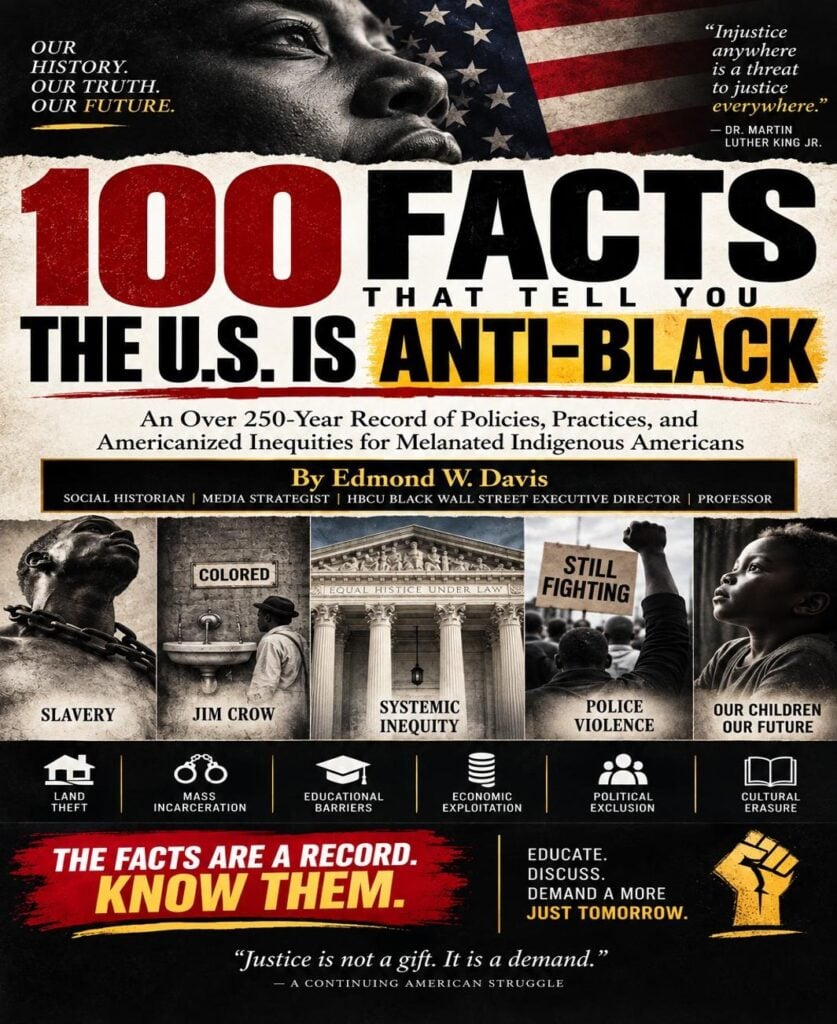
*America cannot measure its racial history merely by what it says about equality. We must examine what this nation did—permitted, financed, legislated, and enforced—and never repaired.
Consider the symbolism of a map. On September 4, 2026, the United States stood alone in opposing a United Nations resolution supporting the Equal Earth projection, which more accurately represents continents’ relative sizes. Africa is roughly 14 times larger than Greenland, despite the familiar Mercator projection making that relationship appear dramatically different.
Africa was never small. Its representation was. Black history has suffered a similar distortion. Here are 100 receipts—historical laws, policies, practices, institutions, and documented experiences America must confront.
THE 100 FACTS & TRUTHS—GROUPED BY THEME
I. SLAVERY, HUMAN PROPERTY & UNFINISHED REPARATIONS
- Racial chattel slavery.
- Human beings legally classified as property.
- Enslaved families separated by sale.
- Sexual exploitation of enslaved women.
- Profiting from children born into slavery.
- Slave patrols, now police
- Fugitive-slave laws.
- Kidnapping free Black people into slavery.
- Constitutional protections benefiting slaveholding interests.
- No comprehensive federal slavery reparations.
- Reversal of “40 acres and a mule.”
II. RECONSTRUCTION, FORCED LABOR & JIM CROW
- Violent destruction of Reconstruction.
- Black Codes.
- Racialized vagrancy laws.
- The 13th Amendment’s punishment exception.
- Convict leasing.
- Prisoners leased to private businesses.
- Forced Black prison labor and extended sentences for no reason.
- Arrests feeding coercive labor systems.
- Jim Crow segregation.
- “Separate but equal.”
- Segregated public accommodations.
- Racially dangerous travel requiring the Green Book.
Scroll to continue reading








III. VOTER SUPPRESSION, LYNCHING & RACIAL TERROR
- Poll taxes.
- Literacy tests.
- Grandfather clauses.
- White primaries and redistricting of areas to minimize Black votes
- Racial terror suppressing voting.
- Thousands of racial-terror lynchings.
- No federal anti-lynching law until 2022.
- Mass racial violence against Black communities.
IV. BLACK WALL STREET & DESTROYED BLACK WEALTH
- Destruction of Tulsa’s Black Wall Street: Decades spent seeking Tulsa restitution.
- Elaine, Arkansas’s Black town, destroyed
- 200 Black towns in the U.S. were flooded to build lakes.
- Generational wealth destroyed after the Union forces left the South
- Funding overlooked Black businesses for Latinos, Asians, and Middle Easterners
V. HOUSING, LAND & THE RACIAL WEALTH GAP
- Federal housing redlining.
- Racially restrictive housing covenants.
- Black exclusion from wealth-building neighborhoods.
- Highways cutting through Black communities.
- “Urban renewal” displacing Black neighborhoods.
- Mortgage discrimination.
- Housing discrimination feeding the racial wealth gap.
- Continuing consequences of historic redlining.
- Persistent Black-white household wealth disparities.
VI. BANKING, FARMING & ECONOMIC DISCRIMINATION
- Collapse of the Freedman’s Savings Bank.
- Black depositors losing hard-earned savings.
- USDA discrimination against Black farmers.
- Pigford exposing agricultural discrimination.
VII. MILITARY SERVICE WITHOUT EQUAL CITIZENSHIP
- Discrimination against Black veterans.
- A segregated U.S. military.
- Fighting America’s wars without equality at home.
- Disproportionate Black burdens during periods of Vietnam.
- Black military contributions historically marginalized.
- Tuskegee Airmen fighting abroad while segregated at home.
VIII. MEDICINE, EXPERIMENTATION & HEALTH
- Medical racial pseudoscience.
- Exploitation of Black bodies in medicine.
- Tuskegee syphilis study deception.
- Treatment withheld from Tuskegee participants.
- Tuskegee continued for approximately 40 years.
- Medical mistrust produced by institutional betrayal.
- Unequal medical treatment.
- Black maternal-health disparities.
- Environmental and neighborhood health inequality.
IX. MASS INCARCERATION, SENTENCING & POLICING
- Disproportionate Black incarceration.
- Racial disparities in drug enforcement.
- Mandatory-minimum sentencing.
- Crack-versus-powder cocaine sentencing disparity.
- Habitual offender and “three strikes” laws.
- Unequal burdens of cash bail.
- Ferguson’s policing-for-revenue practices and ‘Goon Squads’ that target Blacks.
- DOJ findings of racial discrimination in Ferguson.
- Disproportionate stops of Black motorists.
- Disproportionate searches of Black motorists.
- Lower contraband-hit rates despite those searches.
X. EDUCATION, SCHOOL DISCIPLINE & HBCUs
- Disproportionate Black school suspensions.
- Disproportionate Black school expulsions.
- Discipline disparities not explained simply by behavior.
- Severe discipline disparities affecting Black girls.
- School exclusion feeding educational inequality.
- Persistent school segregation after Brown.
- HBCUs emerging amid educational exclusion.
- Documented HBCU funding inequities.
- Historical exclusion of Black scholars.
XI. HISTORY, AFRICA & CONTROL OF THE NARRATIVE
- Black history is marginalized in textbooks.
- African and melanated indigenous American civilizations, minimized in curricula.
- Eurocentric narratives marginalize Black and Indigenous history.
The issue extends beyond textbooks. When Africa itself is visually diminished on familiar maps, we should ask how representation shapes perception. Africa’s geography did not change when cartographers adopted different projections. The picture changed. So, too, must America’s picture of Black history.
XII. ENTERTAINMENT, BLACKFACE, MUSIC & CULTURAL OWNERSHIP
- Commercial Blackface.
- Profitable minstrel stereotypes.
- Racial barriers within the music industry and how whites stole genres of music
- Black innovation becoming America’s popular culture.
- Black music shaping rock ’n’ roll and modern music.
- Black artists fighting for royalties and ownership.
America has repeatedly celebrated Black creativity while Black creators fought for control, compensation, and recognition.
XIII. CAPITAL PUNISHMENT, WRONGFUL CONVICTIONS & UNEQUAL JUSTICE
- Fourteen-year-old George Stinney Jr.’s execution.
- Racial vulnerabilities exposed by wrongful convictions.
- Unequal access to expert legal and psychiatric resources.
- Latarsha Sanders receiving two life-without-parole sentences.
- Sanders’ convictions were later vacated over excluded psychiatric evidence.
- Lindsay Clancy’s 2026 mistrial intensifying questions about mental illness, punishment, race, and mercy.
These cases are not identical, and comparison does not by itself prove racial causation. But differences in punishment, resources, mental-health evidence, and public narratives are legitimate subjects for examining how race, class, gender, and discretion intersect within American justice.
XIV. THE UNFINISHED BUSINESS: REPAIR
- No comprehensive repair for the accumulated economic injuries of slavery and subsequent government discrimination.
100 COULD HAVE BEEN 250 OR EVEN 400 TRUTHS THAT EQUATE THAT THE U.S. IS ANTI-BLACK
A disclaimer is necessary.
These 100 examples are not exhaustive. The list could have contained 250 anti-Black measures, protocols, policies, procedures, and experiences—written and unwritten, governmental and institutional, on paper and in practice—that have disproportionately burdened Black Americans across generations.
This argument does not declare every white American racist. Nor does it deny the suffering of other populations.
Native Americans experienced catastrophic dispossession, broken treaties, and forced assimilation. Asian Americans endured exclusion and Japanese-American incarceration. Latinos experienced segregation and discrimination. Jewish Americans confronted antisemitism. Arab and Muslim Americans have experienced profiling and prejudice. Indian Americans and other immigrant populations encountered exclusionary barriers. LGBTQ+ Americans, veterans, and Americans with disabilities fought consequential battles for dignity and equal protection.
Those histories deserve recognition on their own terms.
But another historical reality deserves recognition: Black Americans paid an extraordinary price while helping expand America’s civil-rights architecture.
The Reconstruction Amendments, NAACP litigation, Brown v. Board of Education, the Montgomery Bus Boycott, sit-ins, Freedom Rides, Birmingham, Selma, the Civil Rights Act of 1964, the Voting Rights Act of 1965, and the Fair Housing Act of 1968 transformed American citizenship.
The resulting legal principles, protections, and enforcement mechanisms subsequently strengthened the ability of Asian Americans, Latinos, Native Americans, Jewish Americans, Arab Americans, Indian Americans, LGBTQ+ Americans, people with disabilities, veterans, and other communities to pursue their own claims for equal treatment. That does not mean these communities did not wage their own courageous struggles. They did.
It means the Black freedom struggle was one of the central engines that forced the United States to broaden the legal meaning of equality. Black Americans paid for that struggle through lost employment, arrests, imprisonment, beatings, bombings—and lives. Acknowledging that fact does not require ranking human suffering. It requires remembering who paid some of the bills for American democracy.
America abolished slavery without comprehensively repairing slavery. It dismantled Jim Crow without eliminating everything Jim Crow helped create. It celebrates Black music, military service, athletics, scholarship, and entrepreneurship while substantial racial disparities remain.
And that brings us back to the map. Africa was never small. Black history was never small. Black contributions were never small. Sometimes the representation was. America does not have to write “ANTI-BLACK” across a statute for a law, policy, or institutional practice to disproportionately burden Black people. Institutions have policies. Policies create practices. Practices create outcomes. Outcomes create history. And history leaves receipts.
Correct the map. Correct the textbooks. Correct the historical record. Correct the policies. Correct the inequalities. Then America can finally confront the question these 100 truths leave behind:
WHAT DOES REPAIR LOOK LIKE?
Selected References
- Library of Congress — Emancipation and Reconstruction
- Library of Congress — Tulsa Race Massacre / Black Wall Street
- National Park Service — Civil Rights, Housing and Redlining
- Federal Reserve Board — Changes in Racial Wealth Inequality
- National Archives — Freedman’s Savings and Trust Company
- U.S. Department of Agriculture — Pigford Settlement and Black Farmers
- Centers for Disease Control and Prevention — Untreated Syphilis Study at Tuskegee
- U.S. Department of Justice — United States v. City of Ferguson
- U.S. Department of Education — School Discipline and Civil Rights Data
- Smithsonian NMAAHC — Blackface: The Birth of an American Stereotype

ABOUT THE AUTHOR
Edmond W. Davis is one of America’s top social historians, media strategists, and professors. Davis founded the National HBCU Black Wall Street Career Fest. A native of Philadelphia, PA, he, his wife, and his son currently live in Little Rock, Arkansas. area. Davis is committed to cultural empowerment and educational equity through storytelling and civic engagement. In 2026, Davis was a grand marshal at the 38th Annual African American History Month Celebration Parade, the largest in the U.S. during Black History Month. His life is told in the 2023 ‘Short Documentary of the Year’ at the Black Excellence Awards, titled ‘FROM GRIND TO GROWTH: The Edmond W. Davis Story. Davis was also the courthouse jailroom deputy on the NBC TV miniseries Bluff City Law.
(If You Like/Appreciate This EURweb Story, Please SHARE it!)
MORE NEWS ON EURWEB.COM: Study Finds Anti-Black Bias is Rooted in Fear of Black Males
We Publish Breaking News 24/7. Don’t Miss Out! Sign up for our Free daily newsletter HERE.