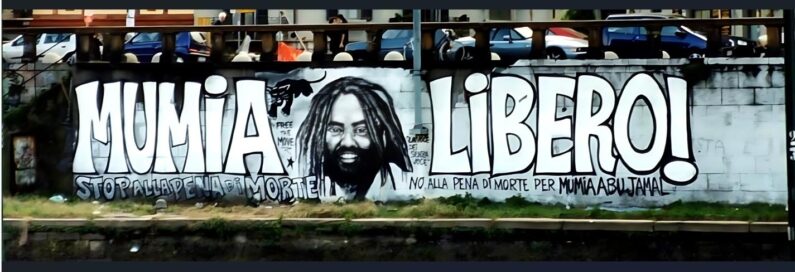
Disclaimer: The most globally recognized political prisoner in the American criminal justice system and the world is Mumia Abu Jamal. He’s been locked up for the death of a Philly cop who died 44 years ago on this early morning in downtown Philly’s Center City, on Locust Street.
*Each December 9th, in Philadelphia, two memorials stand on the same street, in different worlds. On Locust Street in Center City, only a few hundred feet separate the Pennsylvania Boxing Hall of Fame—an institution historically connected to figures like attorney and boxing advocate George Bochetto, the prosecutor for Jamal—from the site of arguably the city’s most infamous and famous murders of the 20th century, if not ever.
The Hall of Fame is not there to honor that crime, nor does it claim any connection to it. Yet its quiet, stoic presence stands just down the block from the solemn marker honoring fallen Philly Police Officer Daniel Faulkner (25), murdered in the early morning hours of December 9, 1981. As I recently walked that corridor, I felt how Philadelphia holds two histories in the same physical space—two narratives, two truths, two emotional universes.
And each year, as the anniversary returns, so does the seismic debate over the man convicted of Faulkner’s murder: journalist, activist, and global symbol of police accountability, Mumia Abu-Jamal.
Scroll to continue reading



“For the LORD loves justice and will not forsake his faithful ones.” — Psalm 37:28
Danny Faulkner was newly married, studying part-time, and respected by fellow officers. Mumia Abu-Jamal (25) was a former Black Panther, award-winning journalist, cab driver, and outspoken critic of police brutality in the post-Rizzo era. Both were sons of the same city but shaped by vastly different experiences of it. Just after 3:50 a.m., Faulkner pulled over a Volkswagen driven by Abu-Jamal’s brother, William Cook. What followed was chaos: a struggle, gunfire, and two men shot—one fatally, one critically. These are the only uncontested facts. Everything else splinters into competing narratives, layered by stress, politics, race, and the distortions of time.
Supporters of Faulkner’s family—especially the Fraternal Order of Police—believe the evidence is conclusive. To them, Abu-Jamal is a convicted murderer who has exhausted every legal avenue. The anniversary is a reaffirmation of a verdict they view as settled and just.
Abu-Jamal’s supporters, ranging from West Philadelphia organizers to global human-rights groups, argue the opposite. They point to judicial misconduct, COINTELPRO surveillance, the explosive MOVE conflict, unreliable or conflicting eyewitness testimony, ballistics questions, and witnesses who later alleged coercion or recanted. They also note that Philadelphia’s Conviction Integrity Unit has exonerated more than 25 men—nearly all Black—in the last decade, often due to planted evidence, suppressed documents, or coerced confessions. Abu-Jamal’s case is not identical to those, but it rhymes with them.
Historians from Boston to Little Rock describe Abu-Jamal’s case as part of a broader tradition of “political policing,” where courts were used to neutralize Black dissent. International observers raised concerns about jury selection, judicial temperament, and the controversial “hospital confession” testimony. Yet even with these red flags, U.S. courts have repeatedly upheld the conviction, signaling that within the narrow confines of U.S. law, the evidence met the threshold of legal sufficiency.
But legal sufficiency is not moral sufficiency. It is not complete. It is not true.
“Woe to those who call evil good and good evil… who justify the wicked for a bribe.” — Isaiah 5:20–23
Forty-four years later, Philadelphia still wrestles with one haunting question: Would Mumia Abu-Jamal—a journalist with no history of violence—really sprint across the street and execute a police officer in cold blood? And if he did not, why has the system fought so hard against a transparent review?
As a historian of African American justice, I can say plainly: the system is not broken. It is functioning exactly as it was designed to function for some—and against others. This is larger than MOVE, larger than COINTELPRO, larger than the Rizzo era. It is about a long national history of policing Black communities as a population to control rather than a community to serve.
Criminologists remind us that Locust Street’s conditions—darkness, adrenaline, motion, gunfire—are exactly the conditions under which eyewitness accuracy collapses. Modern policing has implemented improved training, de-escalation models, and body-camera standards precisely because past cases like this revealed fatal flaws. But we cannot rewrite 1981. We can only refuse to treat unanswered questions as settled truth.
Seeking truth does not require choosing between honoring Officer Faulkner and acknowledging potential injustice toward Abu-Jamal. Philadelphia must choose a principle: the pursuit of truth, even when inconvenient, even when uncomfortable, even when it disrupts long-held narratives.
“You shall know the truth, and the truth shall make you free.” — John 8:32
Officer Faulkner deserves the truth.
Mumia Abu-Jamal deserves the truth.
Philadelphia deserves the truth.
Forty-four years later, Locust Street stands as a mirror—reflecting not only what happened that night but what America has long been: a nation whose justice system is unbroken in operation but deeply broken in design. Until we confront that design honestly, the city will continue to live with two memorials, two histories, and two truths—divided not by distance, but by the truth still waiting to be fully told.

ABOUT THE AUTHOR (Edmond W. Davis, Social Historian, Journalist, Professor, and West Philly native)
Edmond W. Davis is an American social historian, international speaker, and Amazon #1 author. He is a nationally recognized authority on the Tuskegee Airmen. He serves as Founder and Executive Director of America’s only National HBCU Black Wall Street Career Fest, based in Little Rock, Arkansas. A Philadelphia native and former homeless youth, Davis has dedicated his career to education, social impact, and the empowerment of underrepresented communities.
(If You Like/Appreciate This EURweb Story, Please SHARE it!)
MORE NEWS ON EURWEB.COM: BLM Oklahoma City Leader Accused of Embezzling $3.15M in Bail Funds | WATCH
Sign up for our Free daily newsletter HERE.