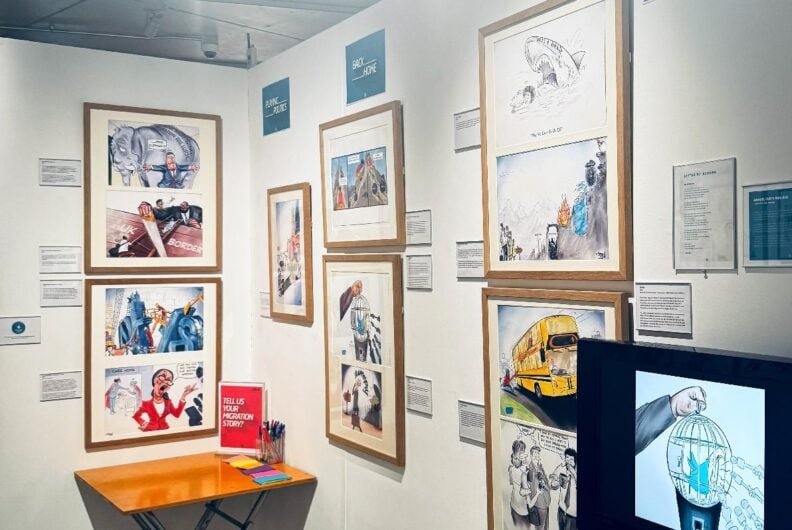
*When the Ìrìn Àjò (“Journey / Sojourn”) solo cartoon exhibition by Samuel Ojo came to an end at the Cartoon Museum in London, it left behind more than a series of strong images. It left a record, one that treats editorial cartooning not just as commentary on the news cycle, but as a form capable of holding lived experience and political pressure at the same time.
It also arrived at a moment when “immigration” in Britain is not merely a policy topic but an argument about who gets to belong, who gets to contribute, and who is asked to keep proving their worth. Across twelve works on display, Samuel Ojo maps the immigrant experience in the UK from a Black, diasporic perspective, moving between humour and unease, satire and quiet indictment.
What distinguishes Ìrìn Àjò from more conventional political cartooning is its point of view. Ojo does not observe migration from a distance; he draws from within it. His cartoons are shaped by lived encounters with paperwork, language, work culture, and public rhetoric, and this proximity gives the work a particular authority. The images do not argue abstract positions about immigration policy; they show how policy settles into daily life.
The exhibition saw Ojo merge Nigerian and British visual realities: a double-decker bus rendered in the colours of a Lagos danfo. A passenger stretches out in vain to buy a Gala sausage roll as the bus speeds through Birmingham in the Midlands, England. It is a small, almost throwaway moment, but it carries emotional weight. The cartoon captured a familiar migrant feeling: the desire to carry home with you, even as the vehicle you’re on refuses to slow down.
Scroll to continue reading







Fulfilment, the cartoon suggests, is always just out of reach, glimpsed through motion.
That attention to everyday friction continues in “Drugs v Medicine”, one of the exhibition’s most understated pieces. Inspired by a linguistic misunderstanding, the cartoon shows a Nigerian man casually telling British colleagues he plans to buy “drugs” for the flu. The raised eyebrows and awkward reactions that follow are quietly comic, but the point is serious. Ojo uses the moment to highlight how even shared language can be misinterpreted, leaving migrants perpetually aware of how they are being read. It’s one of the exhibition’s gentlest works, and also one of its sharpest.
Where Ìrìn Àjò grows sharper is in its treatment of institutional power. In “Erasure,” Ojo depicts immigration systems quite literally wiping away migrant stories before they can be told. The violence in the image is not physical; it is a narrative. Migrants are welcomed when labour is required, then quietly scrubbed from the story once their presence becomes politically inconvenient. The cartoon succeeds because it makes absence visible, showing erasure as an act, not an accident.
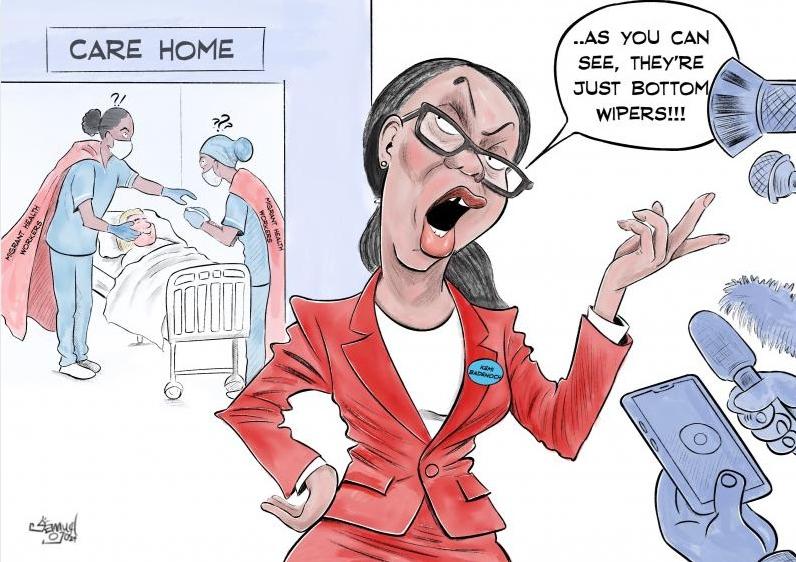
A similar clarity drives “Saving the NHS, One Bottom at a Time,” which responds directly to dismissive rhetoric aimed at migrant healthcare workers. By depicting them as literal superheroes holding the system together, Ojo flipped insult into indictment. The satire cut both ways: mocking the language used to belittle migrants while quietly reminding tourists and visitors to the museum that the NHS’s survival has depended heavily on the very people being derided. The cartoon did not ask for sympathy; it demanded recognition.
One of the exhibition’s strengths was its refusal to isolate the United Kingdom from a broader global context. Works such as “Twitter Ban” and “The Sad Reality of Creatives in Nigeria” widened the lens to include the political and economic pressures that push people to leave in the first place. In Twitter Ban, Ojo’s cartoons reflect on Nigeria’s suspension of the platform following the #EndSARS protests, connecting state repression to the growing sense of betrayal felt by young people. Migration here is shown not as opportunism, but as a consequence. In The Sad Reality of Creatives in Nigeria, the uphill struggle of Nigerian artists working from a stigmatised location is rendered as a physical burden, reinforcing the idea that leaving is often less a choice than a response to constraint.

Stylistically, Ojo’s drawing remains accessible without becoming simplistic. His line is expressive but controlled; exaggeration is used strategically rather than gratuitously. Importantly, caricature is rarely directed at migrants themselves. When distortion appears, it is usually the system — policy, rhetoric, bureaucracy — that becomes grotesque. This choice signals a clear ethical position: the absurdity lies in the structures governing migration, not in those navigating them.
If there is a limitation to Ìrìn Àjò, it lies in its scope. The exhibition presented a strong and coherent set of ideas, but it sometimes felt like an opening statement rather than a fully developed arc. Themes like the long-term emotional toll of immigration and the afterlife of policy decisions were introduced but not explored in depth. This may have been a deliberate attempt not to resolve the immigrant experience into a neat moral ending. However, the work invited further expansion, and the exhibition ended just as some of its most compelling questions began to surface.
Nevertheless, Ìrìn Àjò stands as a significant moment in Ojo’s practice. Shown at the Cartoon Museum, it places editorial cartooning firmly within the space of cultural documentation, rather than fleeting commentary. Ojo demonstrated that cartoons can do more than respond to headlines; they can record experience, preserve memory, and challenge official narratives.
In an environment where migration is often reduced to slogans and numbers, Ìrìn Àjò insists on something quieter but more durable: attention. Through humour, irony, and restraint, Ojo offered a body of work that asked viewers not just to look, but to recognise what is already present.

TAYO Fatunla is a British Nigerian comic artist, editorial cartoonist, writer, and illustrator whose work has featured on MSN.com via EURweb.com. He created the “OUR ROOTS” series highlighting Black history figures, earning the 2018 ECBACC Pioneer Lifetime Achievement Award. A former cartoonist for Nigerian newspapers, he was named Professional Creative Cartoonist of the Year at the 2024 Annual Achievement Recognition Awards (The Building Blocks Initiative, UK). He also illustrated Camberwell’s public Black history walk map. https://www.instagram.com/tfatunla123
(If You Like/Appreciate This EURweb Story, Please SHARE it!)
MORE NEWS ON EURWEB.COM: Teen Who Threw Rocks at Mom’s Car Now Cries ‘Mama’ in DHS Custody | WATCH
Sign up for our Free daily newsletter HERE.