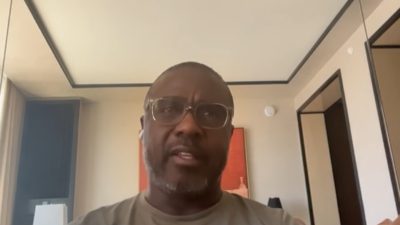
David Banner calls out Christianity’s role in Black oppression
*During a bold appearance on “The Jamal Bryant Podcast: Let’s Be Clear” on Jan. 22, David Banner didn’t hold back. He argued that Christianity was historically used by slave owners to justify dehumanization. “Christianity was used by slave owners who didn’t want Black people on earth,” he said, framing the religion as a weapon against African identity and liberation.
Banner also reinterpreted the story of Jesus, saying it’s not about comfort but about bearing one’s own cross. His statements sparked immediate reactions—from praise for his honesty to strong defenses of Christianity’s spiritual roots and deeper purpose. Bryant framed the moment as “raw dialogue on Black trauma.”
Banner’s theology echoes James Cone’s liberation message
Though his tone was confrontational, David Banner’s core points align closely with Black Liberation Theology. This tradition, developed by theologian James Cone, teaches that Christianity must be reclaimed from white supremacy and used to empower the oppressed. Banner’s podcast remarks mirror Cone’s central beliefs.
In particular, Banner’s reinterpretation of Jesus’s suffering mirrors Cone’s powerful image of the cross as a “lynching tree.” Cone taught that the crucifixion is not just a symbol of salvation but also a symbol of Black suffering under white Christian violence. It’s a call for liberation, not just redemption.
Scroll to continue reading









Internalized oppression and the struggle for identity
Banner also addressed internalized racism, claiming many Black Americans “see themselves as white” due to deep cultural conditioning. He suggested that this stems from a long history of religious and political manipulation meant to suppress Black identity.
James Cone explored this same theme, calling out the conflict of being “both Black and Christian” in a society where Jesus is usually depicted as white. Cone argued that reclaiming a “Black Jesus” is not about historical revision, but about resisting cultural erasure and embracing divine solidarity with the oppressed.
He calls politicians ‘prostitutes’, failing the people
Banner didn’t limit his critique to religion—he also aimed at political leaders. He described many Black politicians as “prostitutes,” accusing them of selling out their communities for personal gain or status within a broken system.
This criticism echoes Cone’s view that the church must stand up against injustice and reject the power structures of domination. Both thinkers demand action from spiritual and political leaders alike, not just symbolic support.
How Black theology redefines the meaning of the cross
One of the most powerful ideas from Cone—and now reflected in Banner’s remarks—is that the cross should be viewed through the lens of Black suffering. Cone called Jesus the “first lynchee,” directly linking his death to the lynching of thousands of Black Americans by white Christians.
In this view, the cross is not only a religious symbol but a protest against injustice. Banner’s language may be modern and blunt, but it taps into this long-standing idea that true Christianity sides with the oppressed and demands action in the face of evil.
Mixed reactions: bold truth or unfair attack?
Banner’s comments quickly drew reactions online. Some applauded his raw honesty and saw his words as part of a necessary reckoning. Others defended Christianity as a faith with ancient roots, claiming that its misuse by slave owners doesn’t erase its true spiritual power.
Many in the Black church tradition say Christianity also served as a source of resilience, identity, and resistance during slavery and segregation. Spirituals, sermons, and sacred community spaces helped Black people survive and fight back. For them, the faith is part of the healing, not the harm.

Banner’s challenge continues a larger conversation
Whether you agree with David Banner or not, his remarks open the door to important questions about history, faith, and truth. He’s not the first to raise these issues—and he won’t be the last. His critique fits into a much broader debate on how religion can both oppress and liberate.
By voicing his thoughts on a major platform like Jamal Bryant’s podcast, Banner pushes listeners to examine their own views. It’s an invitation to look deeper, challenge assumptions, and ask who your faith really serves—and how it shows up in real life.
How to explore the roots of this theological debate
For those who want to dig deeper, there are many ways to learn more about this conversation. Listening to the full episode of “The Jamal Bryant Podcast” with David Banner is a good starting point to hear his full argument in context.
- Read James Cone’s books: “The Cross and the Lynching Tree” and “God of the Oppressed” offer deep insight into these ideas.
- Study Black church history: Learn how faith served as both a spiritual guide and a political tool for Black communities.
- Reflect personally: Consider how religion, history, and justice intersect in your own community or tradition.
At the heart of it all, Banner’s critique isn’t just about religion—it’s about liberation. And that makes it a conversation worth having.

(If You Like/Appreciate This EURweb Story, Please SHARE it!)
MORE NEWS ON EURWEB.COM: Pray the Power Doesn’t Go Out – 12 Cities Expected to be Hardest Hit by Winter Storm Fern | VIDEO
We Publish Breaking News 24/7. Don’t Miss Out! Sign up for our Free daily newsletter HERE.