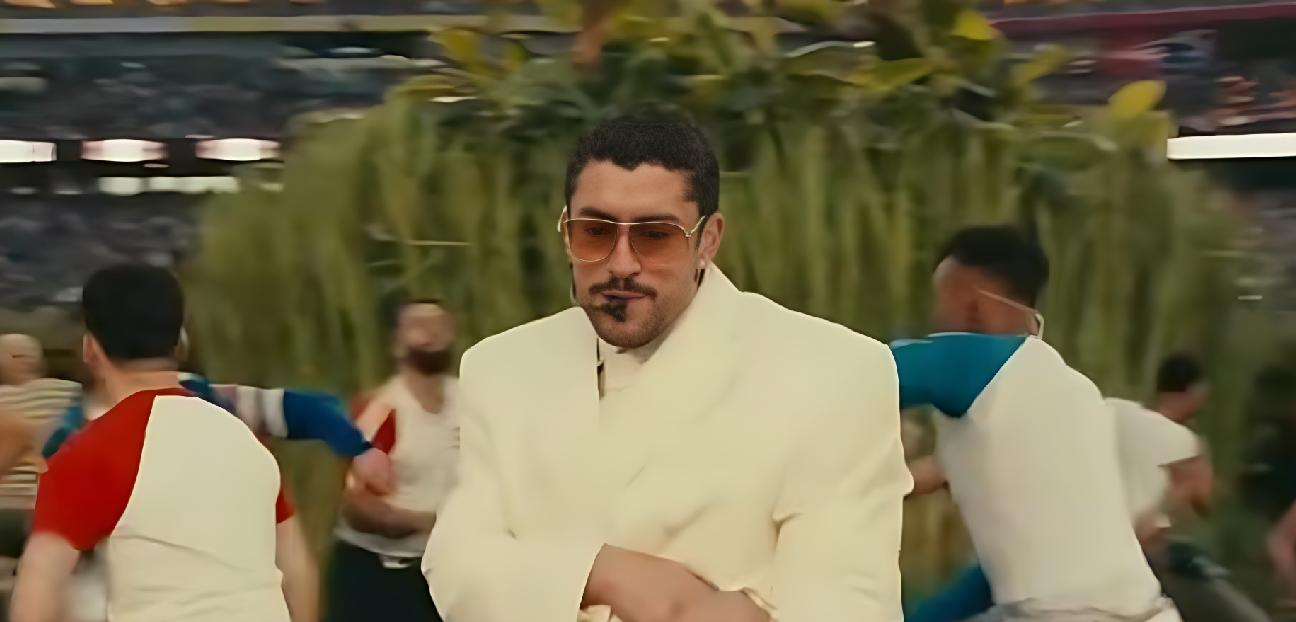
*When the Super Bowl halftime stage centered on Grammy-winner Bad Bunny, Spanish was not a provocation—it was a translation of reality. What unfolded was not controversy but clarity: a portrait of the United States as it actually exists, a multilingual, multiracial, hemispheric nation whose culture has always traveled across borders, rhythms, and labor lines. A fully Spanish-language performance, accompanied by English translation, did not divide America. It reflected it.
Spanish is not foreign to the United States. There is no official language of this country. Millions of Americans are bilingual or multilingual, and in countless school districts, Spanish-speaking students make up the majority. They are not visitors. They are citizens. They are Americans. When Bad Bunny delivered messages of Puerto Rican pride, family love, and collective dignity in Spanish, translation did not dilute meaning—it expanded it. We love differently, but it is the same love. That message resonated because it was unmistakably American.
Bad Bunny’s biography matters. Born in Puerto Rico—a U.S. territory—his Americanness is not debatable; it is constitutional. The halftime show leaned fully into that truth with a cast that looked like the nation itself: Black and brown bodies, Afro-Latino hairstyles, blue-collar workers, women on the job, elders and children, old-school flavor dancing alongside new-school sound. Entrepreneurship meets labor. Salsa met reggaetón. Hip-hop braided with Afro-Caribbean rhythm. This was culture as a continuum, not culture war.
Family imagery anchored the performance. A wedding scene—bride and groom surrounded by kin, cake, music, and children underfoot—reclaimed joy as inheritance. Culture survives this way: at tables, on dance floors, and in celebrations where generations overlap. When a child was symbolically handed a Grammy on screen, the moment captured how America watches itself through living rooms and living history—how aspiration is passed forward, not hoarded.
“TOGETHER WE ARE AMERICA”
Bad Bunny held out a football with this message written on it at the end of his Super Bowl halftime show ? pic.twitter.com/oqHwO70zBl
— SportsCenter (@SportsCenter) February 9, 2026
Scroll to continue reading








What made that moment even more powerful is that the couple featured during the performance were actually married in real life during the halftime show. After declining to attend their private wedding, Bad Bunny instead invited them to be married on the biggest stage in American sports. In a nation accustomed to spectacle without substance, this was substance elevated to spectacle. Love was not hidden. It was centered.
The visuals widened the frame further. Sugarcane fields appeared not as an aesthetic flourish, but as a memory. For centuries, sugar fueled the Atlantic economy—harvested through the exploited labor of Afro-Latinos and Africans across the New World. To place that crop behind a modern pop performance was to insist that American prosperity has roots, and those roots run through the Caribbean and Latin America. Acknowledging that history does not weaken the nation, it matures it.
Flags rippled across the stage—Puerto Rico and the United States, Brazil and Colombia, Mexico and Guatemala, Costa Rica and Venezuela, Canada and beyond—mapping the Americas as a shared story. The Western Hemisphere is not a collection of strangers; it is a family of intertwined histories. When Bad Bunny leapt into the crowd like a fútbol hero, he reminded viewers that participation—not permission—is how culture moves.
Even the collaborations spoke volumes. Cameo moments evoked Latin pop history and honored artists who crossed linguistic borders long before it was fashionable. Translation, the show reminded us, has always been part of the American songbook. The production—backed by Roc Nation under Shawn Carter, also known as Jay-Z’s leadership—underscored another truth: Black and Latino creative leadership shaping America’s biggest stage together. That partnership is not new. It is simply too often marginalized.
Some asked whether Spanish “belonged” at halftime. The better question is why we ever doubted it. From San Francisco to New York, Spanish is spoken, sung, prayed, and hustled every day. It lives in blue-collar labor—electric lines, construction crews, service economies—and in the dreams of women and men who build families while building the country. When the performance climbed a towering light structure as a metaphor for success through labor, it honored dignity earned, not bestowed.
“The only thing more powerful than hate is love.”
The jumbotron during Bad Bunny’s Super Bowl performance. pic.twitter.com/q8nyR9pM9E
— ESPN (@espn) February 9, 2026
Bad Bunny sends a message at the Super Bowl:
“God Bless America”
“The only thing more powerful than hate is love” pic.twitter.com/mJSsAZctE7
— Headquarters (@HQNewsNow) February 9, 2026
The finale—fireworks in red, white, and blue, a football slammed down like a mic drop—sealed the message. This was American pageantry with a Latin cadence. It arrived just after the close of Black History Month not as an afterthought, but as a continuation. Black history and Latino history are braided in the United States; Afro-Latinidad makes that truth impossible to ignore.
Three ancient texts help frame why this moment resonated so deeply. “Every nation, tribe, people, and language” gathered together (Revelation 7:9) describes unity without erasure. “There are different kinds of gifts, but the same Spirit” (1 Corinthians 12:4) reminds us that diversity strengthens the whole.
And “The laborer deserves his wages” (Luke 10:7) affirms the dignity of work—the hands in the fields and on the lines that this performance refused to hide.
The Super Bowl halftime show did not ask America to become something new. It asked America to recognize itself. Spanish did not replace English; it stood beside it. Latin or Afro-Latin culture did not overshadow anyone; it illuminated everyone. In a season hungry for honesty, Bad Bunny delivered the most American message of all: this country is big enough to tell the truth about who we are—and to dance while doing it.
And when two people said “I do” at midfield, in front of millions, the message became impossible to miss:
The only thing more powerful than hate is love.

Edmond W. Davis is a social historian, journalist, retired history professor, socioemotional intelligence expert, author of multiple historical texts, Arkansas’s first and only Tuskegee Airmen history textbook, and an international speaker. Davis had a role as a Shelby County Courtroom Jail Deputy on the NBC TV series Bluff City Law. He is a former director of the Derek Olivier Research Institute for the Prevention of Gun Violence. Davis is also the founder of the National HBCU Black Wall Street Career Fest and an Amazon #1 author. Contact him via www.edmondwdavis.com
Bad Bunny reacts to leaving it all out on the field after his epic Super Bowl halftime show. pic.twitter.com/q75Di7hxwG
— Entertainment Tonight (@etnow) February 9, 2026
(If You Like/Appreciate This EURweb Story, Please SHARE it!)
MORE NEWS ON EURWEB.COM: Bad Bunny’s Super Bowl Halftime Show Makes History Amid Kid Rock Counter-Show
We Publish Breaking News 24/7. Don’t Miss Out! Sign up for our Free daily newsletter HERE.