*Black clergy nationwide have addressed the death of Charlie Kirk in sermons emphasizing the need to publicly remember the slain Republican activist honestly. These sermons were delivered in response to public figures and media outlets seemingly manufacturing Kirk as a martyr or spiritual hero following his assassination. Kirk was known for his divisive political rhetoric. Was Charlie Kirk a martyr? The consensus among Black clergy is that the life Charlie Kirk led was not deserving of the distinction.
Martyrdom carries a deep meaning for Black Americans, given the historically racial context of Black leaders who were assassinated for pursuing equality in America, such as Martin Luther King, Jr., Medgar Evers, Malcolm X, and Fred Hampton. Many Black pastors rejected the idea that Kirk died “for the faith” like Black leaders died for freedom, yet conservative leaders have elevated him to near-saintly status.
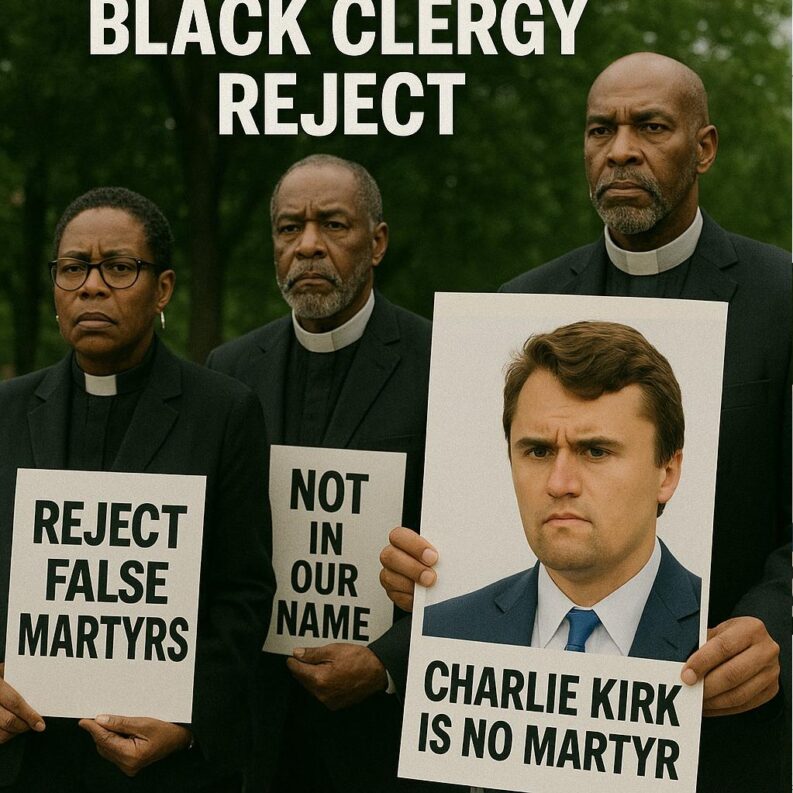
Kirk’s death comes amid the rise of white supremacist sentiment and white Christian Nationalism in American politics. This posthumous elevation of Kirk as a spiritual hero not only distorts the meaning of martyrdom but also appears to be related to religious and racial identity.
There have been white individuals in American history who are widely recognized as martyrs, particularly in the context of the abolitionist movement and the civil rights era. While the term “martyr” is most often associated with Black leaders like Dr. Martin Luther King Jr., some white allies also lost their lives in the struggle for racial justice. Notably, those figures were aligned with Democratic values. Conservative White America has not had a martyr.
Scroll to continue reading





Critics say that by casting Kirk as a spiritual hero despite his divisive rhetoric, proponents of this narrative are reinforcing a dangerous myth of white persecution and victimhood beyond Kirk’s tragic death. This may threaten to legitimize exclusionary ideologies and deepen societal polarization.

Kirk is associated with negative rhetoric about Black people. He verbalized many of the popular tropes repeated by young conservatives today. He once doubted the qualifications of Black pilots, saying, “If I see a Black pilot, I’m gonna be like ‘boy, I hope he is qualified.'” This offensive comment is a stain on his reputation among Blacks. Another example of his poor perception of Blacks was when he claimed that certain Black Democratic women “do not have the brain processing power to otherwise be taken really seriously.” This was cited by Wisconsin State Senator La Tonya Johnson during a debate over honoring Kirk posthumously. Kirk’s mourners appear to be appropriating the language of civil rights to serve a very different agenda.
In the United States, the sacrificed blood of Black Americans has too often been the price of progress that benefits society as a whole. The honor that has been given to Kirk disproportionally appeals to White comfort and White respectability politics.
The current impact of the exponential surge of Turning Point USA chapters being established on predominantly white college campuses. This is an example of how the martyr message resonates more with whites.
Based on the sentiment of Black clergy, it appears that rather than being a national hero for the entire nation, the white response to Kirk’s death is a symbolic inversion that seeks to recast white conservative identity as persecuted and heroic.
The pastors emphasized that while violence is never justified, truth-telling about racism and accountability in death are essential to moral clarity. Furthermore, the opinion that Kirk was a racist with character flaws was a consistent thread among Black pastors who echoed the sentiments of their parishioners.
Excerpts from several prominent pastors who grappled with what they perceived as an attempt to rewrite history follow:
Bishop Paul S. Morton
Head of the Full Gospel Baptist Church Fellowship
Morton used his voice to strongly condemn the notion that Charlie Kirk was honorable.
“It was wrong how Charlie Kirk died, but to get the Medal of Honor, to have the flag lowered in his honor when his message was about degrading Black people?” Morton listed Kirk calling MLK a “bad man” as one of several offensive statements he made related to Black people.
Additionally, the Bishop condemned White Evangelicals for saying the Southern Baptist Church had apologized for slavery in 1995 saying, “I thought they’d broken that racist generational curse. Why did they change their mind?”
He added:
“America is not a Christian nation, but it’s a nation with Christians in it.”
Rev. Dr. Otis Moss III
Trinity United Church of Christ – Chicago, IL
“We must not confuse martyrdom with manipulation. Charlie Kirk was not a prophet—he was a provocateur. His death is tragic, but tragedy does not erase truth. And the truth is, he spent his life undermining the dignity of Black people, immigrants, and anyone who didn’t fit his narrow vision of America.”
Moss went on to say:
“In this moment, we are being asked to mourn without memory, to grieve without context. But prophetic grief demands that we tell the whole story—not just the part that fits the politics of the moment.”
Pastor Rudy McKissick
Bethel Church, Jacksonville, FL
“The act itself was despicable. While we grieve, we must also be honest. Youi should be able to walk in sympathy over the loss of a life without having to sanitize the reality of that life.”
Pastor Jamal Bryant
New Birth Missionary Baptist Church, Atlanta, GA
“America and the media are trying to remix a life of racism and white supremacy that went forth unchecked.”
“Charlie Kirk disparaged Justice Ketanji Brown Jackson, blasted the Civil Rights Act, and declared Martin Luther King Jr. undeserving of our nation’s honor. That is not a legacy to sanitize.”
Rev. Frederick Haynes
Friendship-West Baptist Church, Dallas, TX
“Charlie Kirk was killed by a white Christian. And yet, some want to call him a martyr. I’m not here to rewrite history—I’m here to tell the truth.”
“Mocking Black intelligence and pushing replacement theory is not Christian apologetics—it’s hate speech dressed in scripture.”
Rev. F. Bruce Williams
Bates Memorial Baptist Church in Louisville, Kentucky
Pastor Williams acknowledged that Kirk’s “life was tragically taken by violence,” but found it equally tragic that “they’re trying to make him a martyr of the faith.”
“Now, he did violently die, but he did not die for the faith. Not the faith that I know. Not for the Jesus I know.”
Patrick L. Wooden Sr., a pastor based in Raleigh, North Carolina, expressed support for Charlie Kirk’s advocacy of conservative Christian principles..
- However, the majority of Black clergy have lamented White Christians embracing what they see as Charlie Kirk’s racist legacy.
(If You Like/Appreciate This EURweb Story, Please SHARE it!)
MORE NEWS ON EURWEB.COM: ‘I Am Not Done!’ Kamala Harris Teases 2028 Run in Candid BBC Interview | VIDEO
We Publish Breaking News 24/7. Don’t Miss Out! Sign up for our Free daily newsletter HERE.