*Sometimes the most revealing part of a news story is not simply what happened. It is whom the media allows to explain what happened first.
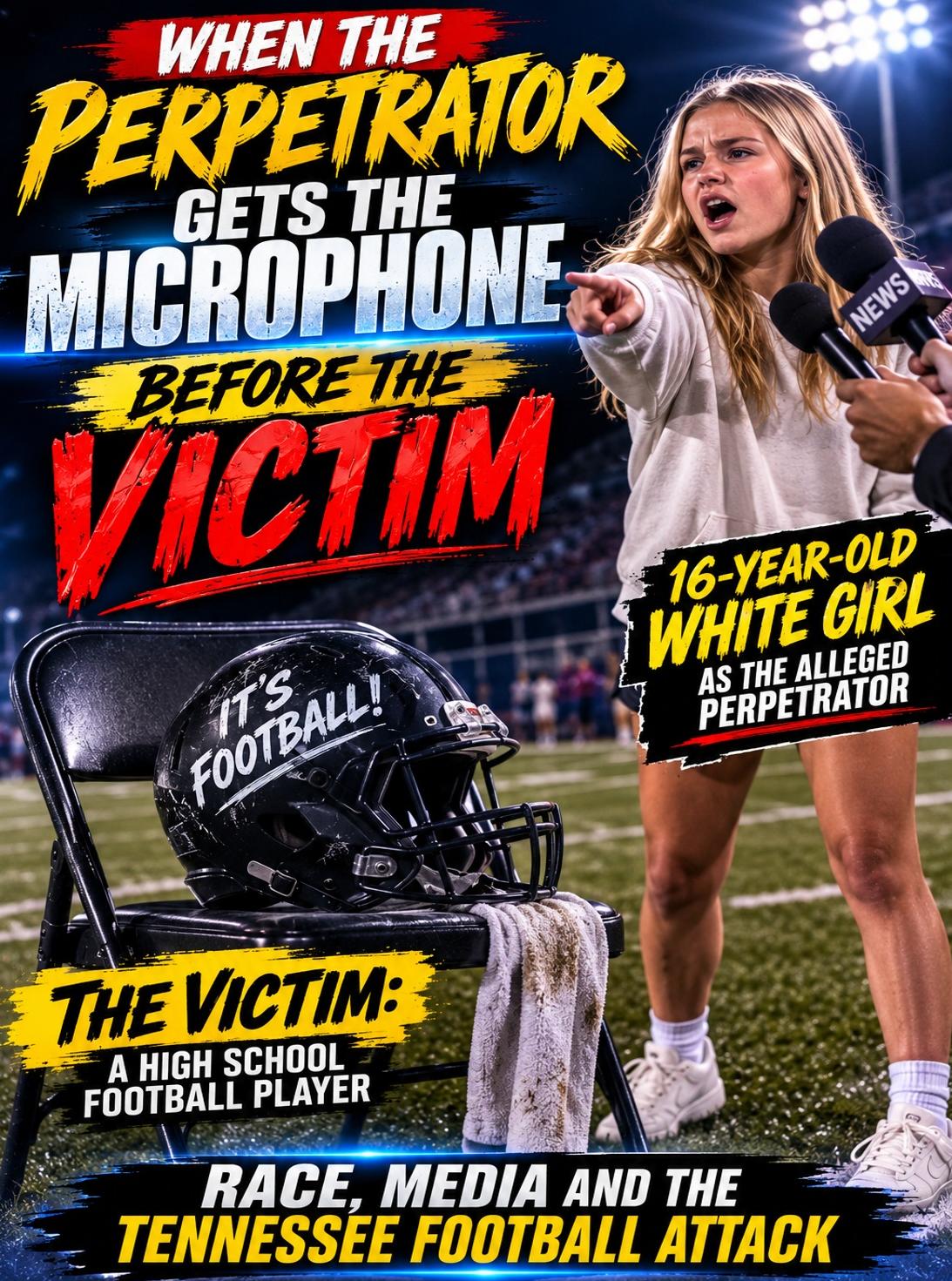
During a middle-school football game in Tennessee, a 16-year-old girl crossed the boundary separating spectators from participants, ran onto the field and tackled a 13-year-old football player. Authorities subsequently charged her with assault and disorderly conduct.
Those are the facts.
But then came another story: the narrative.
News coverage gave the teenager, her mother and her attorney substantial opportunity to explain why she acted. She said she believed the player was hurting her younger brother and that somebody needed to intervene. Her mother acknowledged that her daughter should not have entered the field while arguing that she was trying to protect her brother.
Scroll to continue reading








Their perspective deserves to be reported.
But where was the equivalent national fascination with the 13-year-old child who was actually tackled?
When White Girls Get the Check and Black Males Get Checked
When white girls get the check of sympathy while Black males on the football field get checked, scrutinized and stereotyped, we have moved beyond the normal double standard into the uncomfortable territory of privilege.
This isn’t about attacking a 16-year-old white girl. She is a minor and deserves due process. It is about asking why America’s machinery of empathy can sometimes move faster for the alleged perpetrator than for the victim.
And there is a much larger issue here.
Since when does being a spectator give someone the right to become a participant?
If spectators believe a referee missed a call, can they jump the fence?
If a parent believes his son was unnecessarily tackled, can he run onto the field and tackle the opposing player?
Can spectators become referees, security officers and enforcers based upon their race, color, gender, social status or personal interpretation of what happened during a play?
Of course not.
Football has boundaries for a reason.
History provides an extraordinary comparison. In the 1978 Gator Bowl, legendary Ohio State University head coach Woody Hayes struck Clemson player Charlie Bauman after Bauman intercepted an Ohio State pass near the Buckeyes’ sideline. Hayes was fired the following day.
Think about that.
Woody Hayes was not an unknown spectator. He was one of the most powerful and accomplished coaches in college football history. Yet his status did not create a special category allowing him to put his hands on an opposing player because he was angry about what happened during a football game.
If Woody Hayes couldn’t do it, why should any spectator be allowed to do it?
That principle should transcend race, gender and economic status.
Now Reverse the Picture
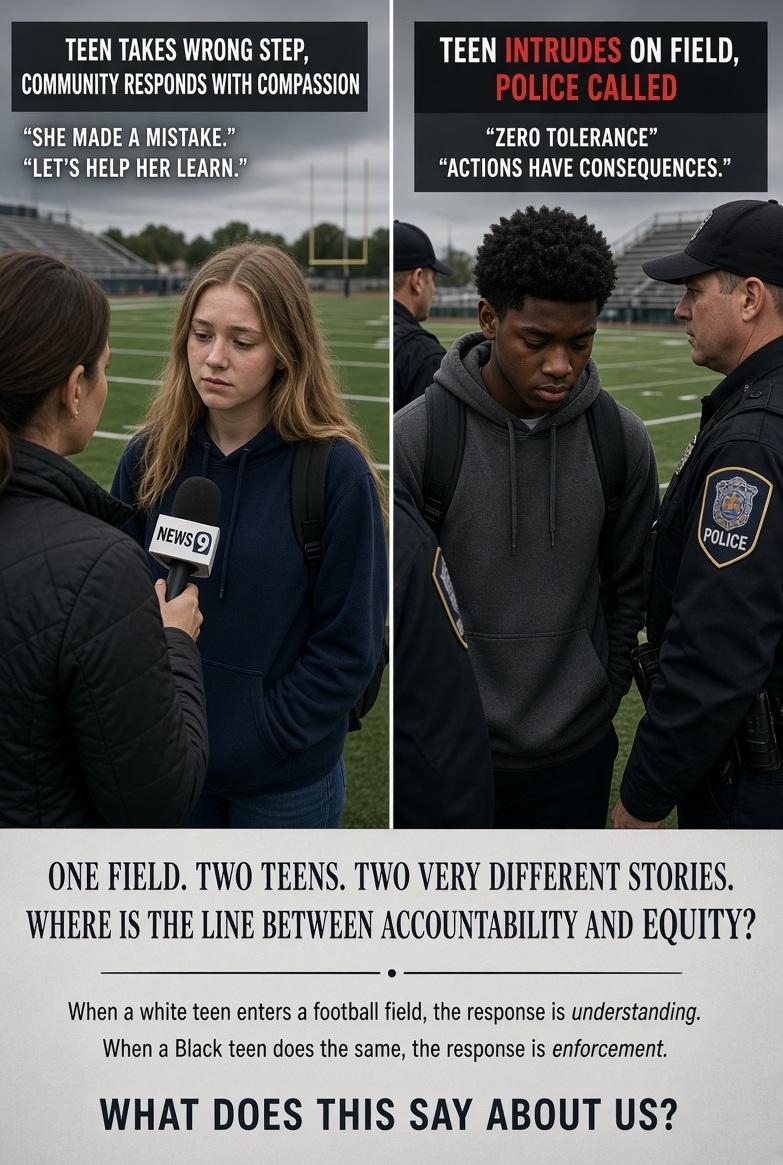
Imagine a 16-year-old Black boy jumping a fence, sprinting onto a predominantly white team’s football field and tackling a 13-year-old white player.
Would America’s first question be:
Why did he do it?
Would television cameras quickly introduce his mother and attorney so audiences could understand his emotions?
Would headlines emphasize that he was simply trying to protect his younger brother?
Or would words such as violent, dangerous, out of control and criminal quickly define him?
We cannot know exactly how every newsroom or prosecutor would respond to that hypothetical. But we can examine what the data already tell us.
The Sentencing Project has documented substantial racial disparities throughout America’s juvenile justice system, including disparities involving arrests, detention and transfer into adult courts.
Therefore, the question should not be whether this particular 16-year-old white girl deserves unusually harsh treatment.
The question is whether Black children receive the same presumption of childhood, context, rehabilitation and second chances.
If adolescent judgment matters here, it should matter everywhere.
If family circumstances matter here, they should matter everywhere.
If rehabilitation matters here, it should matter everywhere.
And if accountability matters for Black teenagers, it must matter here too.
What About the Football Team?
There is another uncomfortable question.
Where is the institutional defense of the football player?
Where are the adults responsible for establishing clearly that no child wearing a football uniform should have to wonder whether someone from the stands might suddenly run onto the field and attack him?
A football team is more than helmets, jerseys and Friday-night entertainment. Coaches, schools, athletic associations and administrators assume responsibility for creating a controlled environment in which young athletes can compete safely.
If someone can leave the spectator area, enter the playing field and physically confront a child, the conversation cannot end with why the spectator was upset.
The conversation must also become:
How did this happen?
How will we prevent it from happening again?
And most importantly:
Who is standing up for the 13-year-old player?
Journalism has enormous power over those questions.
The order of interviews matters.
Headlines matter.
Whose tears audiences see matters.
Whose mother gets the microphone matters.
And whether the person accused of committing the act gets to explain herself before America meaningfully hears from the child on the ground matters.
Privilege is not always an acquittal. Sometimes privilege is receiving the microphone before the person you hurt receives a voice.
Justice does not require destroying a 16-year-old girl’s future.
It requires something much simpler and much harder:
one standard.
One standard for the Black boy.
One standard for the white girl.
One standard for the famous coach.
One standard for the anonymous spectator.
Because once spectators are permitted to transform themselves into referees, security officers and enforcers whenever they dislike what happens on a football field, we no longer have organized athletics.
We have sanctioned chaos.
And if race or gender determines who receives punishment and who receives understanding, then the biggest contest taking place isn’t between two football teams.
It is between accountability and privilege.

ABOUT THE AUTHOR
Edmond W. Davis is a Social Historian, Speaker, Collegiate Professor, International Journalist, and former Director of the Derek Olivier Research Institute. He is an expert on various historical and emotional intelligence topics. He’s globally known for his work as a researcher regarding the history of the Tuskegee Airmen and Airwomen. He’s the Founder and Executive Director of America’s first & only National HBCU Black Wall Street Career Fest. @edmondwdavis
(If You Like/Appreciate This EURweb Story, Please SHARE it!)
MORE NEWS ON EURWEB.COM: When Black Males Die Twice: The Double Standard of Justice in America
We Publish Breaking News 24/7. Don’t Miss Out! Sign up for our Free daily newsletter HERE.