*This article contains spoilers
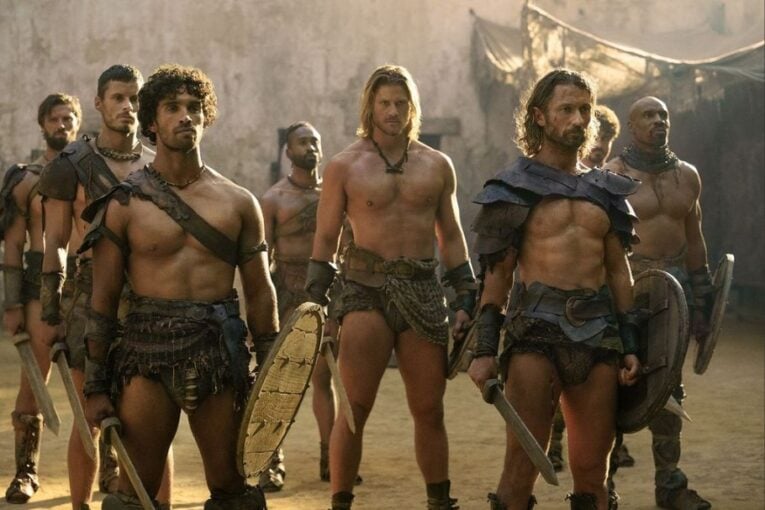
*“Spartacus: House of Ashur” concludes its first season with bloodshed, power plays, and a decisive break from history. The finale delivers on the series’ alternate-timeline premise in spectacular fashion, from Achillia’s hard-won triumph in the arena to Ashur’s assassination of Julius Caesar. All episodes of the season are now streaming on STARZ.
The episode crowns Achillia’s brutal ascent. After enduring a punishing journey that nearly killed her, she triumphantly kills the Scythian, cementing her place in the arena and proving she belongs among the deadliest fighters in Rome. Later, consumed by grief over Celadus, Achillia and Tarchon find solace in one another, their shared loss culminating in an intimate moment that underscores the cost of survival.
For Ashur, the finale marks a line he cannot uncross. His calculated murder of Julius Caesar detonates the political order and signals that this reimagined Roman world will not adhere to recorded history. The act is both a culmination and a beginning, according to series creator, writer, and executive producer Steven S. DeKnight.
Scroll to continue reading









“When I called Nick Tarabay, when I had this idea and I said, Nick, you know, what are you doing for the next five or six years? You want to do this show? One of my pitches was: And at the end of this first season, you kill Julius Caesar. And the last line is hail Caesar,” he explained.
“I want it to show the introduction of the gladiatrix changing history. And then with Pompey on the run, changing history, leading to a big historical change that really shakes things up,” DeKnight added. “Throughout the season, fans have been asking me are we going to see the triumvirate? Are we going to see Crassus, Pompey and Caesar basically take over? I had to be a little coy because I knew what was coming up.”
The decision was not a shock twist for shock’s sake. DeKnight explains that it serves a broader creative roadmap. “It’s part of a bigger plan I have, not just for this show, but hopefully other spinoffs about where this alternate timeline is going. Killing Caesar was the first big event to change things. I wanted to let the audience know that you don’t know what’s going to happen. Anyone can get murdered at any time in this world.”
That unpredictability extends to Achillia, the franchise’s first gladiatrix. Her presence reshapes both the arena and Roman society, but DeKnight is clear that her introduction was born from Ashur’s desperation rather than idealism. “Ashur is a combination of shrewd and desperate. His introduction of a female gladiator, it wasn’t a great statement of feminism. His back was up against the wall. He had to have a gimmick. He wasn’t even convinced she was going to survive in the arena, but it got his foot in the door.”
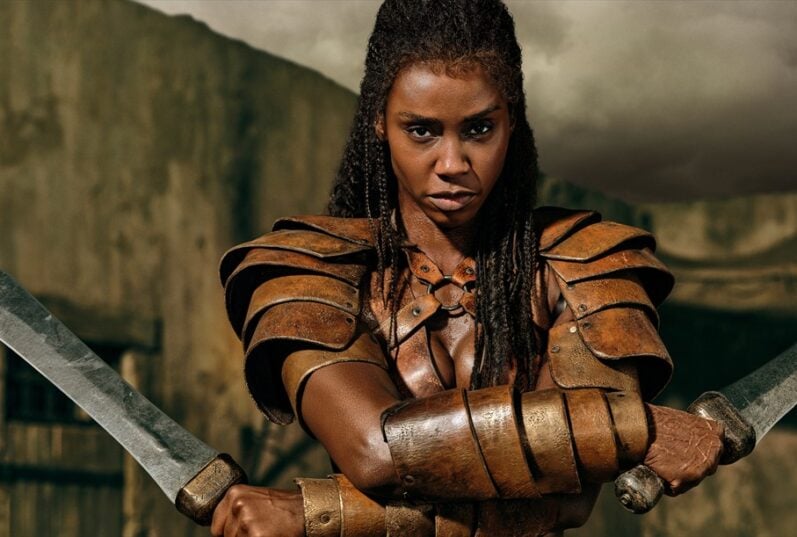
Achillia’s path was intentionally grueling. “When we announced the female gladiator, there were some people who were skeptical, who were worried that she would just come in and be a Mary Sue and kick everybody’s ass. It was tough at the time because I couldn’t reveal what would happen. But you see her journey. She has a very rough time,” DeKnight explained.
“And then when she finally gets in the arena, she thinks she’s going to fight the brothers Ferox. Instead, she fights the champion Ammonius. And she wins, but barely, almost dies, goes into a coma. So it’s not an easy journey,” he continued. “And that’s something we wanted to make as realistic as possible, that she is determined. She’s a great fighter, but it’s not easy.”
The seeds for Achillia’s inclusion were planted during the original “Spartacus” run. “When Rob Tappert and I were doing the original show, we really wanted to introduce the gladiatrix, but we were sticking much closer to history,” said DeKnight. “Historically they didn’t appear until 70, 80 years later. It was way too early. They had first appeared in the Roman empire, not the Roman Republic. So we decided the best we could do is when the war broke out to have women fighting in the war.”
DeKnight noted that this time around, for his what if concept, he wanted “the first historical domino that Ashur knocks over and changes is introducing the gladiatrix about 70, 80 years earlier.”
“I wanted to give legacy fans of the original show something new, something different, a different spin on what they had seen before. And by the end of the season, you see that there are now other gladiatrixes because it’s catching on and it’s becoming popular.”
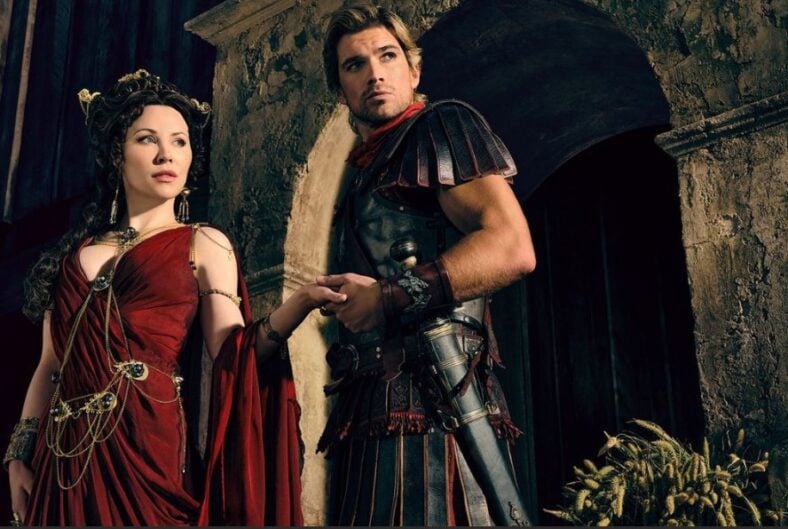
Ashur himself remains at the center of the storm. A former slave now ruling the very ludus where he once bled, he walks a narrow line between brutality and empathy. “You know, with Ashur, it’s kind of two-pronged. He understands what it’s like to be a slave. That doesn’t mean that he’s going to be a more gentle, kinder dominus. He can be quite brutal. But also you start to see these moments where he does understand what it’s like, and he does relate to them,” DeKnight said. “There’s a scene in the finale where he gifts Achillia the champion’s cell. And you see that he kind of straddles that world between dominus and slave. Sometimes it’s very difficult for him.”
The finale also represents a philosophical shift for the character. “We’ve already got the broad strokes for the next three or four seasons. This one event has serious repercussions for Ashur. Obviously, he’s done something that if he ever gets caught, he’s a dead man, many times over,” DeKnight explained.
“But also, I wanted to show with this one action, the entirety of season one, Ashur has been trying to play within these Roman rules… he wants to be accepted by the Romans. That’s his main goal. So he has to do a little more maneuvering and a little less murdering. By the end of the season, and you’ll see this at the beginning of the next season, he’s decided, screw that. I don’t care if they accept me. I’m not going to bow to the Romans anymore. They’re going to bow to me.”
Fan response to Ashur’s resurrection has evolved over the course of the season. At its core, DeKnight says the mission remains simple. “I just want them to be entertained. That’s our job one with this show. We want to suck people in with the drama, with the action, the intrigue, the romance. So that’s really my goal here is just to try to tell a story that sucks you in and can transport you to a different time in a different world for an hour, which I think everybody needs in this day and age.”
And if viewers think they’ve caught every detail, DeKnight suggests another pass may reveal more. “There’s a lot of subtle setup leading up to events,” he said.
“Spartacus: House of Ashur” builds on the legacy of “Spartacus,” which debuted on STARZ in 2010 with “Spartacus: Blood and Sand,” followed by “Spartacus: Gods of the Arena,” “Spartacus: Vengeance,” and “Spartacus: War of the Damned.” The original series and all subsequent chapters are available on the STARZ app.
MORE NEWS ON EURWEB.COM: Jackson Gallagher Talks Julius Caesar’s Brutal End in ‘Spartacus: House of Ashur’ Finale | EUR Exclusive
Sign up for our Free daily newsletter HERE.