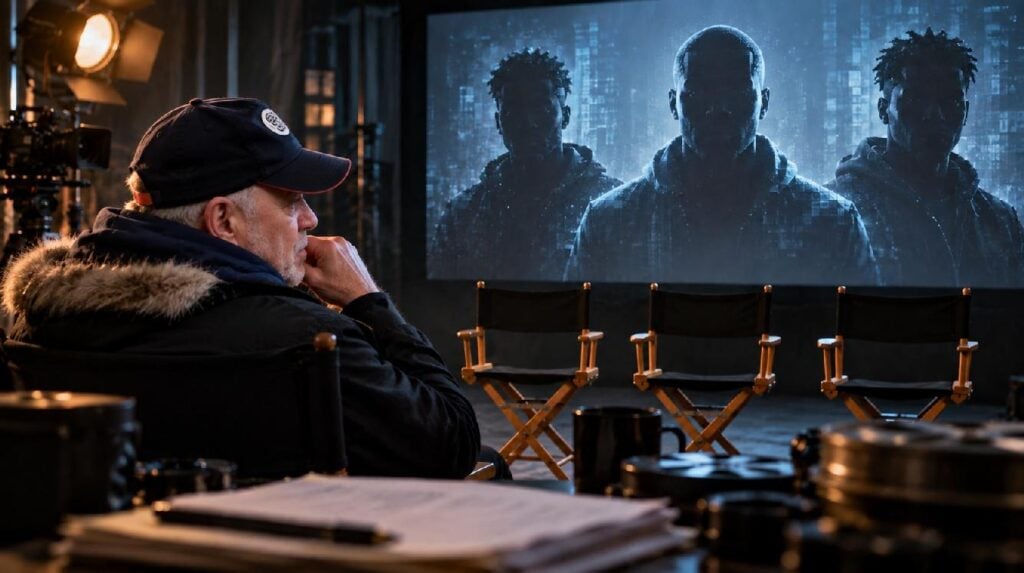
*Paul Schrader, the veteran filmmaker and “Taxi Driver” screenwriter, says Black actors rejected his crime noir because it contained no positive Black characters. Now he plans to make the project with AI-generated performers instead.
That sequence, described by Schrader himself, turns “Three Guns at Dawn” into something bigger than another Hollywood experiment with artificial intelligence. It raises a question about representation that didn’t exist quite this way before generative AI: What happens when human performers decline to portray their community a certain way, but technology allows a filmmaker to create synthetic versions of them anyway?
Why Black Actors Said No
Schrader originally wrote “Three Guns at Dawn” around three Black brothers in South Central Los Angeles. Speaking with The Playlist, he described them as “a corrupt cop, a drug dealer, and a sexual criminal” who were trying to kill one another.
Antoine Fuqua, the Black filmmaker behind “Training Day,” was originally attached to produce.
Then came the casting problem.
Scroll to continue reading




“We sent it out to actors, and no Black actors wanted to play in a movie where there are no good Black people,” Schrader told The Playlist.
The project stalled.
“But then AI came along, and I didn’t need Black actors,” he said.
Asked whether he was creating the performers, Schrader answered: “We’re making them!” He also confirmed that the project is intended to be generated entirely with AI.
Schrader Had Already Questioned the Racial Optics
In 2024, while discussing “Three Guns at Dawn,” Schrader openly questioned whether he was the right filmmaker to tell a South Central story centered on Black men.
“Is this cultural appropriation?” he asked at the time, The Playlist reported.
Schrader said Fuqua reassured him and wanted him to direct. Still conflicted, Schrader considered co-directing with a Black filmmaker. Fuqua eventually left the project, and Schrader later reconfigured it around AI-generated characters.
That chronology matters. The concern about who should tell this particular Black story existed before the actors reportedly rejected it — and Schrader himself recognized it.
AI Changes What Saying No Means
The racial-representation issue didn’t suddenly emerge after Schrader embraced AI.
Actors have always had one fundamental form of control over a role: they can refuse it.
Schrader’s account suggests Black performers did exactly that. They were presented with a story whose principal Black characters were all criminals and decided they didn’t want to participate.
AI changes that equation.
Synthetic Black characters don’t have opinions about the screenplay. They can’t reject a role because of its portrayal of Black life, question the filmmaker’s perspective or insist that a character be reconsidered.
That doesn’t establish that Schrader adopted AI with the intention of silencing Black performers. He hasn’t said that. But his own explanation establishes something more concrete: after Black actors reportedly declined the project, AI provided a way to make it without them.
That’s the consequential second story.
Schrader Thinks AI Job Loss Is Coming Anyway
Schrader’s decision also fits his broader view of artificial intelligence.
Discussing creative workers threatened by the technology, he told The Playlist that musicians would be affected first and actors next. He compared their predicament to portrait painters facing the arrival of photography.
“And the answer is, ‘You are out of a job,'” Schrader said.
His position makes “Three Guns at Dawn” unusually literal: he’s not simply predicting that AI will displace performers. He’s planning a film built around “AI-generated human prototypes” instead of name actors, as he described the project in another recent interview.
Schrader’s history also prevents an overly simplistic reading that he simply doesn’t work with Black performers. EURweb previously reported on Cedric the Entertainer discussing his experience working with Schrader on “First Reformed.” Cedric recalled that Schrader deliberately wanted unconventional casting for his role as Reverend Jeffers.
The Bigger Question Goes Beyond One Film
Schrader is entitled to make provocative characters, and actors are entitled to reject them. Audiences will ultimately decide what they think of the finished work if “Three Guns at Dawn” reaches them.
But AI introduces a third participant into that traditional relationship.
When performers from a community say no to portraying that community in a particular way, filmmakers may increasingly possess technology capable of proceeding without their consent or participation.
That doesn’t automatically make the resulting art racist, unethical or illegitimate.
It does mean that “no” may no longer stop the production.
And in Schrader’s case, remarkably, that’s not speculation about some future Hollywood scenario. It’s essentially the story he just told about his own movie.
(If You Like/Appreciate This EURweb Story, Please SHARE it!)
RELATED NEWS ON EURWEB.COM: Hollywood Reacts to Unreal Realistic AI-Generated Tom Cruise and Brad Pitt Fight Clip | WATCH
We Publish Breaking News 24/7. Don’t Miss Out! Sign up for our Free daily newsletter HERE.