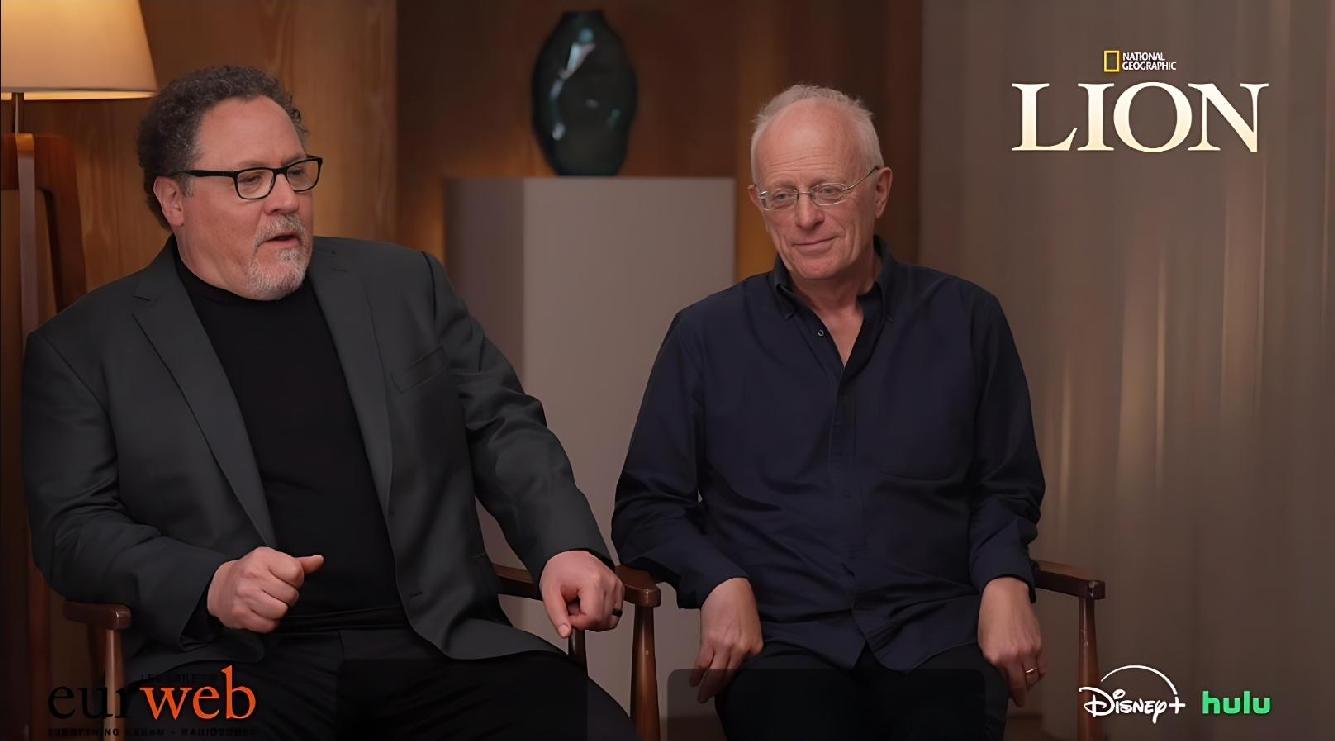
*Filmmaker Jon Favreau is accustomed to controlling what audiences see, but while making National Geographic’s four-part documentary event “LION,” now streaming on Disney+ and Hulu, the director behind Disney’s “The Lion King” had to surrender that power to nature — and then watch as a young lion named Kio delivered a story that felt almost scripted.
Favreau and BBC Studios Natural History Unit executive producer Mike Gunton spoke with me (EURweb associate Kenny Pettis Jr.) about the unconventional process behind the series, which follows Kio from vulnerable cub to adulthood in Kenya’s Maasai Mara.
The series represents another chapter in a collaboration that grew from the filmmakers’ previous work together, including “Prehistoric Planet.” Gunton said their different backgrounds eventually led them to “step into each other’s worlds,” combining Favreau’s character-driven cinematic instincts with Gunton’s decades of natural-history filmmaking. What neither man could bring to “LION,” however, was a script.
Favreau Had to Give Up Control
For Favreau, working with actual lions meant abandoning many of the filmmaking tools available on a conventional production.
“I’m not going to paint anything out,” Favreau told Pettis. “So the only tools I had were music and editing. Everything else had to come from nature and reality.”
Scroll to continue reading







That commitment became more consequential as the production continued. The filmmakers didn’t begin knowing that Kio would become their central character — or even knowing whether the young lion they were following would survive.
Season after season, however, Kio endured.
“And you fall in love with it when you’re spending so many years watching it,” Favreau said. “Because you have a relationship with them.”
National Geographic says the production followed the lions for more than four years. The network’s own account describes Kio as an unexpected protagonist: a smaller cub born out of cycle whose odds of survival initially weren’t promising.
When Reality Started Resembling ‘The Lion King’
As Kio’s journey unfolded, Favreau began noticing something familiar.
The filmmaker recalled reviewing footage and realizing that events were developing in a way that “really echoed something that you might see in a Disney animated film.”
“This is fate conspiring to actually unfold a story as one would have scripted it,” Favreau said.
The irony is difficult to miss. Favreau previously directed Disney’s photorealistic 2019 version of “The Lion King,” a production in which filmmakers could meticulously construct environments and performances. With “LION,” the animals weren’t taking direction, and nature wasn’t waiting for another take.
National Geographic’s four-part series ultimately became a coming-of-age story about Kio, but the filmmakers had no guarantee at the outset that he would be the one carrying it.
There Was No No. 1 on the Call Sheet
Favreau compared the uncertainty to something that would be unthinkable on a conventional feature.
If Robert Downey Jr. is playing Iron Man, he explained, “he gets the close-up, it’s his shot, he’s number one on the call sheet.”
Not so in the Maasai Mara.
The team was simultaneously documenting multiple lionesses, cubs and possible storylines, remaining open to whatever nature provided. Favreau said the production accumulated around 1,000 hours of footage before that material was narrowed into roughly two hours.
“You have to keep your mind open to what that story might be,” he said.
That process also meant the filmmakers could only recognize the larger narrative after spending years collecting the pieces. Instead of making reality conform to a predetermined protagonist, they had to discover which protagonist reality had given them.
Four Years Led Back to Kio
EURweb previously reported on the release of the “LION” trailer, detailing the extensive Maasai Mara production and the series’ cinematic approach to Kio’s journey. The documentary premiered Aug. 19 on National Geographic and began streaming Aug. 20 on Disney+ and Hulu.
The project also features music led by Academy Award-winning composer Hans Zimmer and Bleeding Fingers Music Group, adding one of the few elements filmmakers could deliberately use to shape the emotional experience without altering what happened in front of the cameras.
But Kio remains the remarkable variable.
Following a male lion from cubhood across years is difficult precisely because filmmakers cannot know where that animal’s life will lead. For Favreau and Gunton, that uncertainty wasn’t an obstacle to the story. It became the reason the story worked.
After a career spent helping fictional characters follow carefully constructed arcs, Favreau found himself facing something Hollywood cannot manufacture on command: a protagonist who didn’t know cameras were rolling, couldn’t read the script — and somehow gave the filmmakers the story they had been waiting for.
(If You Like/Appreciate This EURweb Story, Please SHARE it!)
MORE NEWS ON EURWEB.COM:
We Publish Breaking News 24/7. Don’t Miss Out! Sign up for our Free daily newsletter HERE.