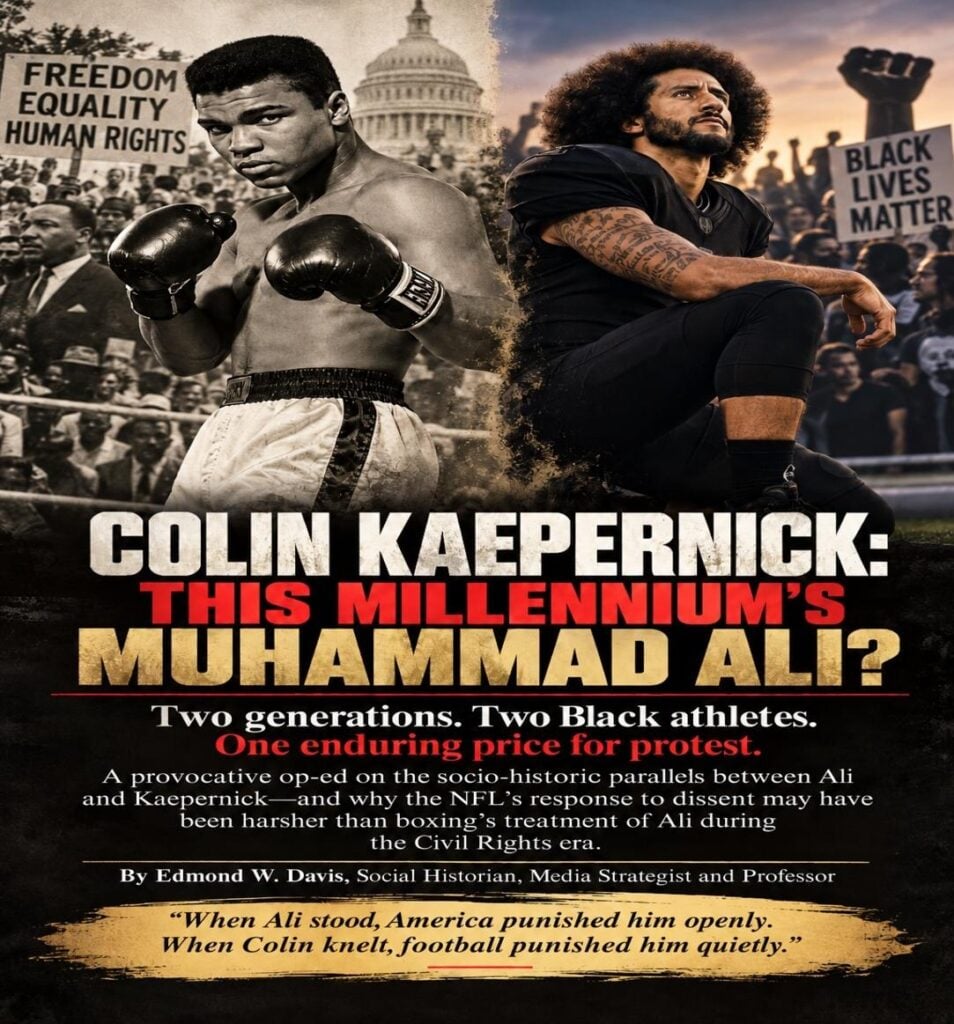
*Sometimes history doesn’t repeat itself. It changes uniforms.
Nearly 60 years after Muhammad Ali sacrificed the prime of his boxing career rather than compromise his convictions, former Super Bowl quarterback Colin Kaepernick arrived in Little Rock carrying a different weapon: a book.
His memoir, The Perilous Fight, published September 15, 2026, became a No. 1 New York Times bestseller.
At Saint Mark Baptist Church, during a conversation with sports commentator Chris Broussard, I witnessed something beyond a conventional book-tour appearance.
I witnessed a man whose professional sacrifices, commitment to racial justice, and refusal to surrender his convictions reminded me of Muhammad Ali.
Scroll to continue reading




Certainly, other Black athletes—including Tommie Smith, John Carlos, and Mahmoud Abdul Rauf—have risked their careers by challenging injustice.
But my observation, not Kaepernick’s declaration, is that he may be this millennium’s closest athletic and sociocultural parallel to Ali as a prominent advocate for Black civil rights. Ali wasn’t protesting boxing. He opposed participation in the Vietnam War and challenged America’s treatment of Black citizens. Kaepernick wasn’t protesting football itself. He was protesting police brutality, racial injustice, and the killing of Black Americans.
Both men forced America to confront a question it repeatedly attempts to avoid:
Why should Black athletes entertain a nation in silence while Black communities demand justice?
TWO ATHLETES. TWO GENERATIONS. ONE COSTLY CONVICTION.
In 1967, Muhammad Ali refused induction into the United States military during the Vietnam War. His position challenged a country asking Black Americans to fight overseas while denying them equal treatment at home. Ali lost his heavyweight championship and boxing licenses. He remained outside professional boxing for more than three years, returning in October 1970. His conviction was overturned by the Supreme Court in 1971. The Smithsonian Institution documents the historical relationship between Ali’s antiwar stand and later NFL protests.
Kaepernick’s moment came in 2016. He initially sat during the national anthem before transitioning to kneeling as a peaceful protest against police brutality and racial injustice. Critics characterized the protest as disrespectful toward the flag and military. Kaepernick consistently explained that his protest concerned the treatment of Black Americans.
He has not played in an NFL regular-season game since 2016. Unlike Ali, who eventually returned to boxing and reclaimed the heavyweight championship, Kaepernick never received another opportunity to demonstrate his abilities in an NFL regular-season game. That difference is historically significant.
Ali lost three critical years. Kaepernick lost the opportunity to complete his professional football story.
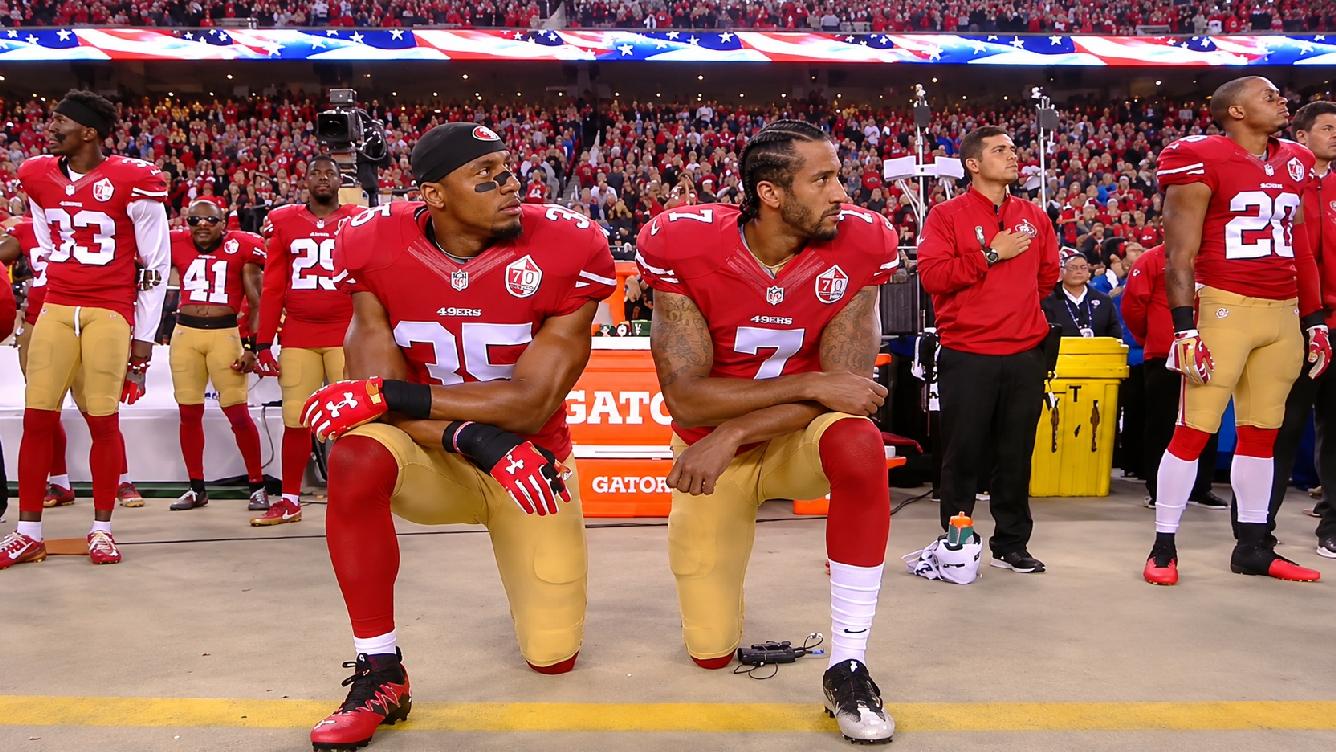
ERIC REID: THE BLACK TEAMMATE HISTORY ALMOST OVERLOOKED
Perhaps one of the most revealing developments in Kaepernick’s latest public conversations concerns the actual origins of taking a knee. For nearly a decade, much of the public narrative credited former Army Green Beret and NFL player Nate Boyer, a white military veteran, with suggesting that Kaepernick kneel rather than sit during the national anthem.
But according to Kaepernick’s September 2026 account, that familiar version omitted a critical participant: Eric Reid. Reid, Kaepernick’s Black teammate with the San Francisco 49ers, had approached him about joining the protest. Kaepernick credits Reid with suggesting they kneel together before their September 1, 2016, meeting with Boyer.
In NBC News’ September 2026 investigation, Colin Kaepernick’s Unfinished Business, Kaepernick explained that Reid deserved recognition for the idea. Boyer participated in the discussion and supported their decision. He acknowledged to NBC that the two players might have settled on kneeling before meeting him.
There is an important historical nuance: Reid’s own 2016 remarks described kneeling as something that emerged in their discussions with Boyer. Kaepernick’s 2026 recollection places Reid’s suggestion earlier. Kaepernick argues that the media found the protest easier to accept when the idea was associated with a white military veteran rather than a Black football player.
That is his interpretation of how the story was framed, but it raises a legitimate question about representation.
Why did a narrative about Black Americans demanding justice become so closely associated with the approval of a white veteran?
And perhaps an even more important question:
Why did the historical recognition of Eric Reid become secondary to the story Americans were more comfortable hearing?
For Kaepernick, this correction wasn’t about humiliating Boyer. It was about telling the truth. And that distinction strengthens the comparison with Muhammad Ali.
Both men understood that challenging injustice also means challenging the narratives powerful institutions construct around dissent. History is not merely about what happened. It is also about who gets credited, who gets heard and whose truth survives.
THE QUARTERBACK AMERICA NEVER FINISHED WATCHING
Let’s not pretend Colin Kaepernick was an ordinary quarterback. On January 12, 2013, he rushed for 181 yards against Green Bay, establishing an NFL single-game postseason rushing record for quarterbacks.
The NFL’s official account documents his extraordinary performance. He subsequently led San Francisco into Super Bowl XLVII against Baltimore. His postseason accomplishments included 264 rushing yards during the 2012 season’s playoffs and 130 rushing yards in the January 2014 NFC Championship Game.
In August 2013, former Philadelphia Eagles quarterback and ESPN analyst Ron Jaworski made an extraordinary prediction:
“I truly believe Colin Kaepernick could be one of the greatest quarterbacks ever.”
That assessment was reported by CBS News and ESPN.
Imagine the possibilities of an athlete combining elements of Randall Cunningham’s athleticism, Warren Moon’s passing ability, and the dual-threat innovation later associated with Lamar Jackson. That is speculation, not statistical certainty. But Kaepernick’s demonstrated talent made the question legitimate. We will never know what his complete NFL career might have become.
FROM RENO TO LITTLE ROCK
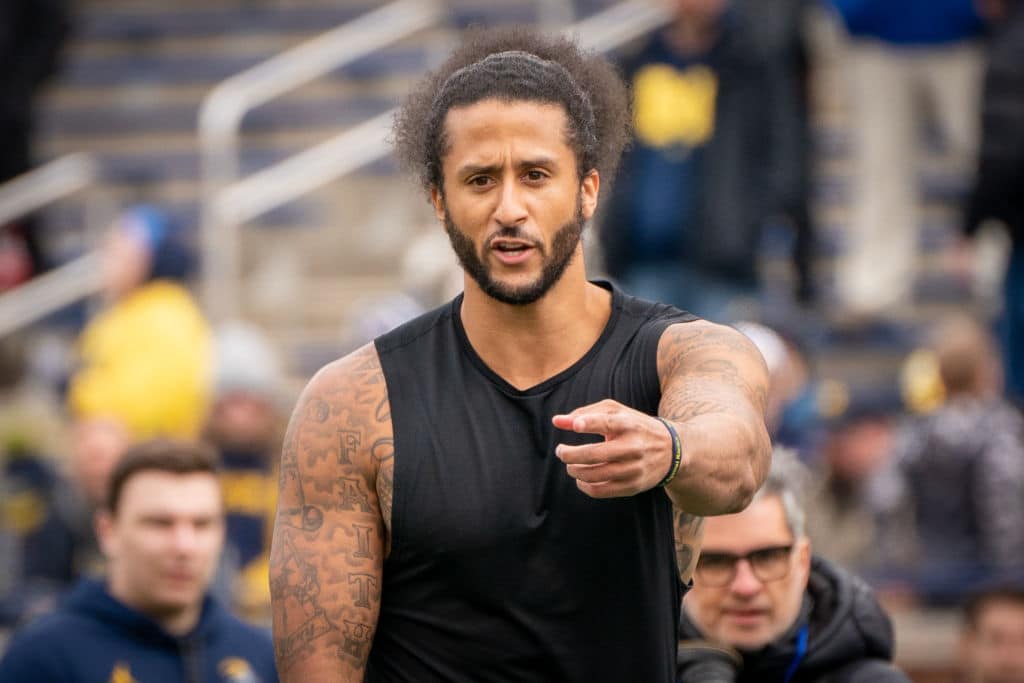
During his conversation with Broussard, Kaepernick reflected upon growing up as a Black child adopted by loving white parents. He spoke appreciatively of their protection and support while explaining that their experiences could not fully prepare him for navigating American society as a Black man. He recalled racial exclusion in Reno, Nevada, including a derogatory interpretation of the city’s name that he said he encountered from another person. He described Reno as the “Mississippi of the West.” In one recollection, he said there were only three Black players on a team on which he played.
His reflections illustrated an uncomfortable truth:
Parental love and racial understanding are not necessarily identical experiences.
Kaepernick also discussed the influence of civil-rights and athletic protest figures, including Muhammad Ali, Tommie Smith, and Mahmoud Abdul-Rauf, the former NBA guard whose national anthem protest produced professional consequences. These athletes differed in faith, methods, and historical circumstances. But each encountered institutional resistance after challenging prevailing expectations.
JUSTICE BEYOND THE FOOTBALL FIELD
Kaepernick’s advocacy has moved beyond symbolic protest. His Know Your Rights Camp provides resources and education for marginalized communities. Its independent-autopsy initiative offers free second autopsies to eligible families confronting deaths in custody or suspicious circumstances. The initiative addresses a serious question:
How can families obtain independent medical findings when they question an official death investigation?
That concern deserves investigation without presuming that every coroner, medical examiner, sheriff, or police officer is compromised.
Kaepernick and his wife, Nessa, have also supported community organizations through philanthropic initiatives, including a renewed $1 million commitment announced in 2026.
Scripture offers a moral framework for examining such service.
Proverbs 31:8–9 calls believers to speak for those unable to defend themselves and to judge righteously.
Isaiah 1:17 commands God’s people to seek justice and defend the oppressed.
And James 2:17 teaches that faith without corresponding action is dead.
These passages do not establish Kaepernick’s personal theology. They illuminate the biblical responsibilities of justice, compassion, and service.
A LIVING HISTORY LESSON FOR ARKANSAS BAPTIST COLLEGE
I attended the Little Rock gathering with students from my U.S. Government class at Arkansas Baptist College. Their participation was supported through collaboration with the Little Rock Central High School National Historic Site and its Superintendent Robin White, along with Agnolia B. Gay, Professor Dr. Cheryl Gittens, Interim President Dr. George Herts, and Vice President Phillips Rodgers.
I also recognize Phyllis Dickerson, chief executive officer of the Black Mayors Association and former Little Rock city employee, for her role in bringing this important conversation to Arkansas. For our students, the experience connected classroom discussions of constitutional rights, American government, racial inequality, and peaceful protest with a living participant in modern civil rights history.
Little Rock—the city of the 1957 Central High School integration crisis—provided an especially meaningful setting.
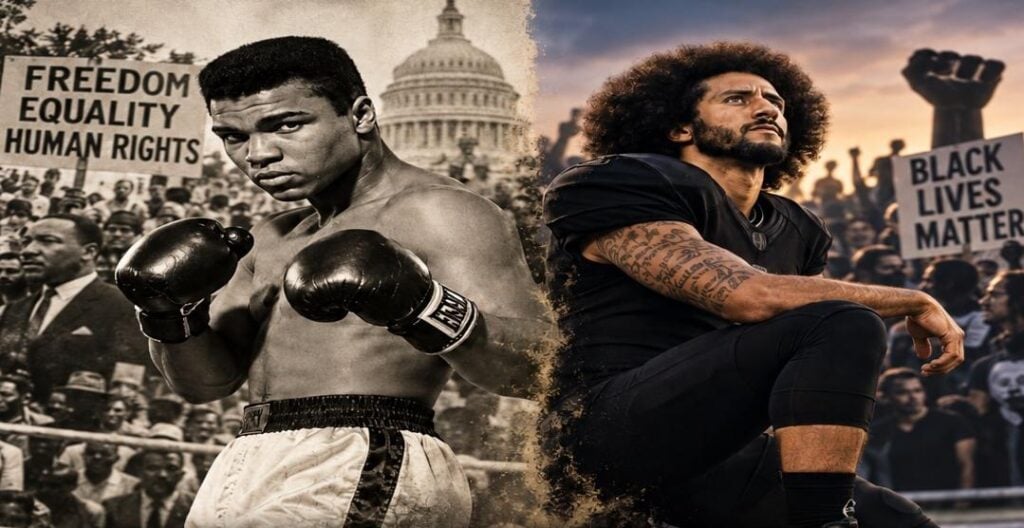
ALI FOUGHT. KAEPERNICK KNELT. HISTORY WILL REMEMBER BOTH.
Kaepernick discussed the relationships among professional sports, politics, ownership, and economics. He also addressed the controversial partnership between Jay-Z and the NFL without, in my observation, reducing the conversation to a personal attack.
Throughout the event, he remained composed, approachable, and willing to engage the audience. Afterward, he took photographs with attendees. Muhammad Ali was a heavyweight champion who became a worldwide symbol of resistance. Colin Kaepernick was a Super Bowl quarterback whose peaceful protest transformed his public identity and professional trajectory.
Ali’s career resumed. Kaepernick’s did not. Their circumstances were not identical, and neither man should be reduced to the other’s biography. Yet the parallel remains compelling: two Black athletes who challenged powerful institutions, endured extraordinary backlash, and insisted that human dignity mattered beyond athletic achievement. And now Kaepernick’s acknowledgment of Eric Reid adds another dimension to that comparison.
Ten years later, he is still challenging the accepted narrative—not simply about his career, but about how his protest began, who helped shape it, and why the original message became overshadowed. That is why his story cannot be measured solely in passing yards, touchdowns, endorsements, or NFL contracts. Ali will forever be the greatest in boxing. Kaepernick’s complete football legacy remains an unanswered question. But his civil-rights legacy is already part of American history. And perhaps that is the lesson I carried away from Saint Mark Baptist Church:
In closing, sometimes you must sacrifice the opportunity to stand beneath the stadium lights to stand for people whose suffering society refuses to see. Sometimes telling the truth means correcting the story—even when the world has repeated the wrong version for ten years.
Sometimes you have to take a knee to stand.
ABOUT THE AUTHOR
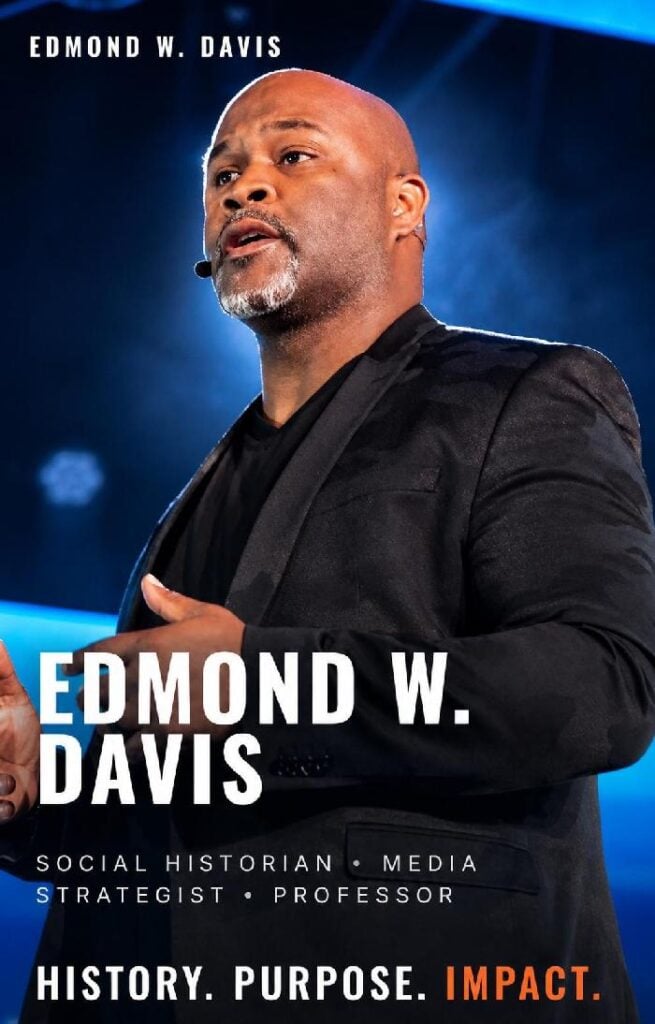
Edmond W. Davis is a leading social historian, media strategist, and professor. Davis is the founder of the National HBCU Black Wall Street Career Fest. A native of Philadelphia, PA, he, his wife, and his son currently live in Little Rock, Arkansas. area. Davis is committed to cultural empowerment and educational equity through storytelling and civic engagement. In 2026, Davis was a grand marshal at the 38th Annual African American History Month Celebration Parade, the largest in the U.S. during Black History Month. His life is told in the 2023 ‘Short Documentary of the Year’ at the Black Excellence Awards, titled ‘FROM GRIND TO GROWTH: The Edmond W. Davis Story. Davis was also the courthouse jailroom deputy on the NBC TV miniseries Bluff City Law.
(If You Like/Appreciate This EURweb Story, Please SHARE it!)
RELATED NEWS ON EURWEB.COM: Why Muhammad Ali Called His Birth Name a ‘Slave Name’ – The Untold Story!
We Publish Breaking News 24/7. Don’t Miss Out! Sign up for our Free daily newsletter HERE.