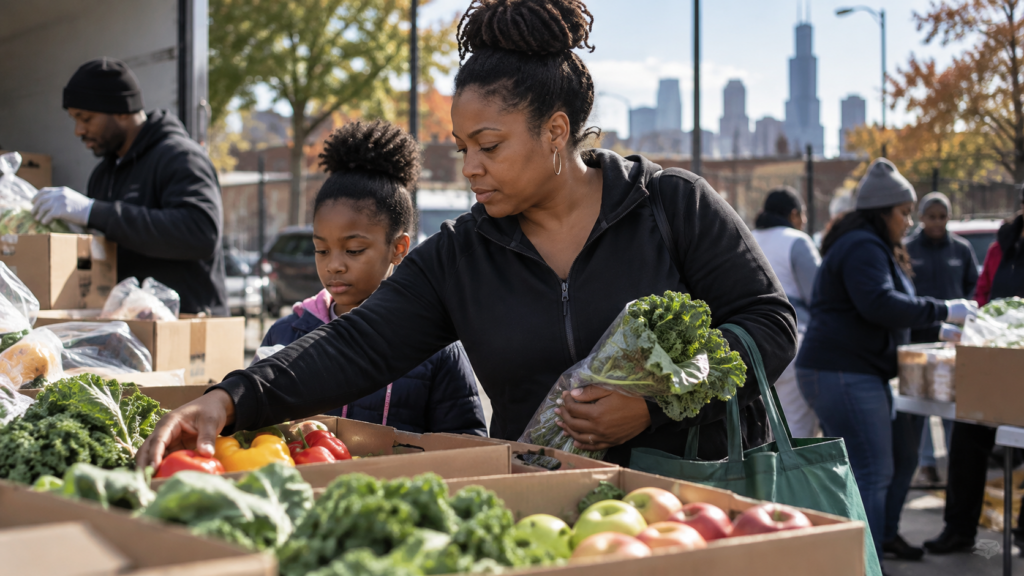
*Chicago’s hunger problem is reaching deeply into households that may have jobs, children to raise or retirement income — yet still can’t consistently afford enough food.
The 2026 “Hunger in Chicago Report,” produced by the Greater Chicago Food Depository in partnership with NORC at the University of Chicago, found that more than one-third of Chicago households experience food insecurity. The organization’s primary report puts the figure at 36%, or roughly 417,000 households, based on a June survey of 1,200 Chicago residents.
The findings become even more troubling when broken down by race and neighborhood. According to reporting by the Chicago Sun-Times, 61% of Black residents surveyed reported food insecurity, compared with 14% of white households.

Hunger Hits Families And The South Side Hard
Geography reveals another major divide. Food insecurity reached 51% on the South Side, according to the Greater Chicago Food Depository, compared with 45% on the West Side, 41% on the Southwest Side and 20% on the North Side.
Scroll to continue reading









Households raising children are also under substantial pressure. Nearly half — 47% — of Chicago households with children reported food insecurity, compared with 30% of households without children.
The problem isn’t confined to people without jobs. More than half of adults living in food-insecure households are employed, according to the Food Depository’s findings.
That distinction matters because the report portrays hunger as part of a broader affordability squeeze. Chicago-area food prices have risen 22% since 2021, while rents have climbed 31%. Thirty-one percent of Chicagoans surveyed said they had delayed, reduced or skipped payments for necessities such as utilities or medicine to afford food.
SNAP Declines As Families Face Higher Costs
The findings arrive as fewer residents receive assistance through the Supplemental Nutrition Assistance Program.
Since July 2025, SNAP enrollment in Cook County has fallen 23%, leaving nearly 196,000 fewer people connected to the program, according to the Food Depository. The organization says reductions in federal assistance are intensifying pressure on households already struggling with higher living expenses.
Food banks are attempting to fill the gap. The Greater Chicago Food Depository says it supplied 119 million pounds of food — equivalent to 99.3 million meals — through its network during its last fiscal year and supported more than 2.26 million household visits.
But CEO Kate Maehr cautioned that charitable organizations can’t carry the burden alone.
“Food banks alone cannot solve an affordability crisis of this scale,” Maehr said.
The numbers make the stakes particularly stark for Black Chicagoans and families with children. For hundreds of thousands of households, the financial calculation isn’t simply how much to spend at the grocery store. It’s increasingly which other basic necessity can wait so there’s enough food at home.
MORE NEWS ON EURWEB.COM: ‘Ready to Love’ Heads to Chicago for New Season | WATCH TRAILER
We Publish Breaking News 24/7. Don’t Miss Out! Sign up for our Free daily newsletter HERE.