

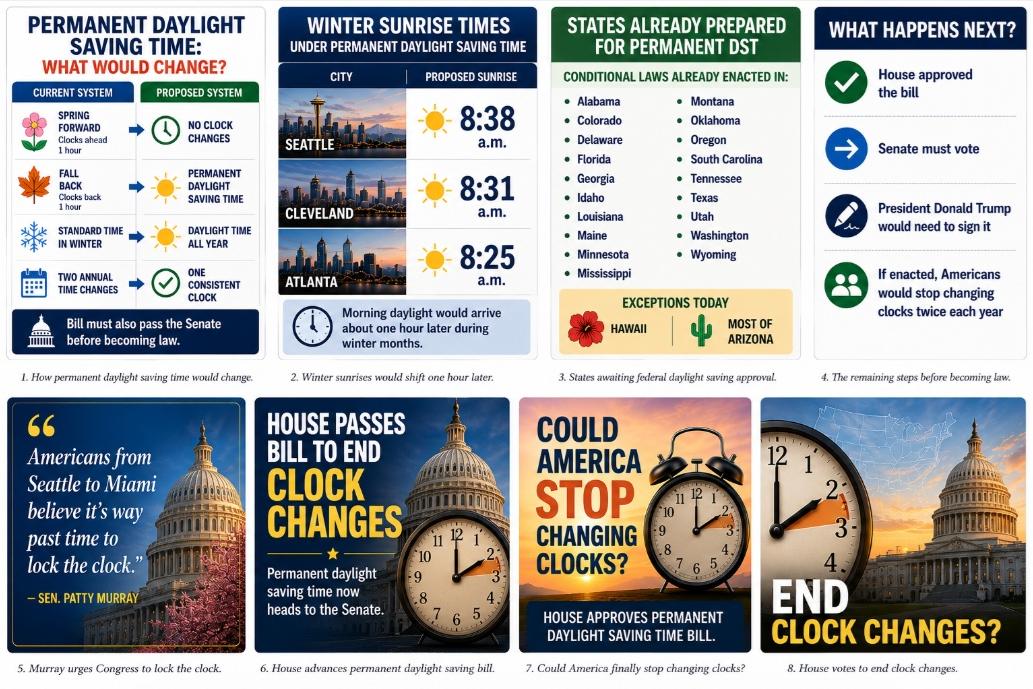
*The U.S. House has approved legislation that would end the twice-yearly clock change, advancing a proposal that would place most of the country on permanent daylight-saving time if it clears the Senate and receives President Donald Trump’s signature.
The Sunshine Protection Act of 2025, sponsored by Rep. Vern Buchanan, R-Fla., would eliminate the current seasonal switch between standard time and daylight-saving time by making daylight-saving time the permanent nationwide standard. Hawaii and most of Arizona, which already remain on standard time year-round, would continue to operate under their existing systems.
House Vote Gives Measure New Momentum
The House vote marks another major step for legislation that has gained bipartisan attention in recent years. The bill now heads to the Senate, where its future remains uncertain despite similar legislation passing that chamber by unanimous consent in 2022 before ultimately stalling.
Following the House vote, Sen. Patty Murray, D-Wash., urged Senate leaders to quickly bring the legislation to the floor. Murray said Americans are ready to end the twice-yearly clock changes and pointed to Washington state’s longstanding support for permanent daylight saving time.
She noted that winter sunsets in her home state can occur before 4 p.m. and argued that residents across the country want a more consistent schedule. Murray also highlighted that she helped guide a previous version of the Sunshine Protection Act through the Senate and has supported state-level efforts that would take effect only if federal law changes.
Scroll to continue reading









President Donald Trump has also voiced support for ending the clock changes, previously describing the current system as “inconvenient” and “very costly to our nation.” At the same time, Trump has acknowledged that public opinion remains divided over whether permanent daylight-saving time or permanent standard time is the better solution.
How Daily Life Would Change
If the legislation becomes law and takes effect in December, Americans would no longer set clocks back during the winter months.
The amount of daylight would remain the same, but the clock would shift so that sunrise arrives later while daylight extends further into the evening during winter.
That change would produce significantly later winter sunrises in many cities. According to the proposal’s projections, Seattle would not see sunrise until 8:38 a.m. on Dec. 1, while Cleveland would see sunrise at 8:31 a.m. and Atlanta at 8:25 a.m.
Eastern states would remain on Eastern Daylight Time year-round, while Central, Mountain and Pacific states would similarly remain on their daylight saving time schedules throughout the winter.
Supporters argue that eliminating clock changes would reduce disruption, encourage outdoor activity and potentially improve public health, reduce traffic accidents and lower crime.
Lawmakers Remain Divided Over the Best Approach
Despite bipartisan backing, lawmakers continue to disagree over whether permanent daylight saving time is the healthiest long-term solution.
Some House Democrats raised concerns about darker winter mornings, particularly for children traveling to school. Rep. Debbie Wasserman Schultz of Florida cited child safety concerns, while Rep. Nanette Barragán of California referenced medical research suggesting later winter mornings could negatively affect sleep patterns.
A 2025 Stanford Medicine analysis found that both permanent standard time and permanent daylight saving time would be healthier than changing clocks twice each year because seasonal clock shifts disrupt the body’s circadian rhythm.
The debate also recalls the nation’s experiment with year-round daylight-saving time during the 1970s energy crisis, which ended early after growing public concern over dark winter mornings.
Meanwhile, Congress is also considering a competing bipartisan proposal, the Sunshine for Our Kids Act of 2026, which would instead make standard time permanent. That approach would produce earlier sunrises and earlier sunsets throughout the year.
For now, the Sunshine Protection Act still must clear the Senate before reaching President Trump’s desk. Until then, Americans will continue following the current system of changing clocks each spring and fall.
(If You Like/Appreciate This EURweb Story, Please SHARE it!)
MORE NEWS ON EURWEB.COM: Why the US Kept Daylight Saving Time – Some Say it’s Unhealthy | WATCH
We Publish Breaking News 24/7. Don’t Miss Out! Sign up for our Free daily newsletter HERE.








Leave a Reply