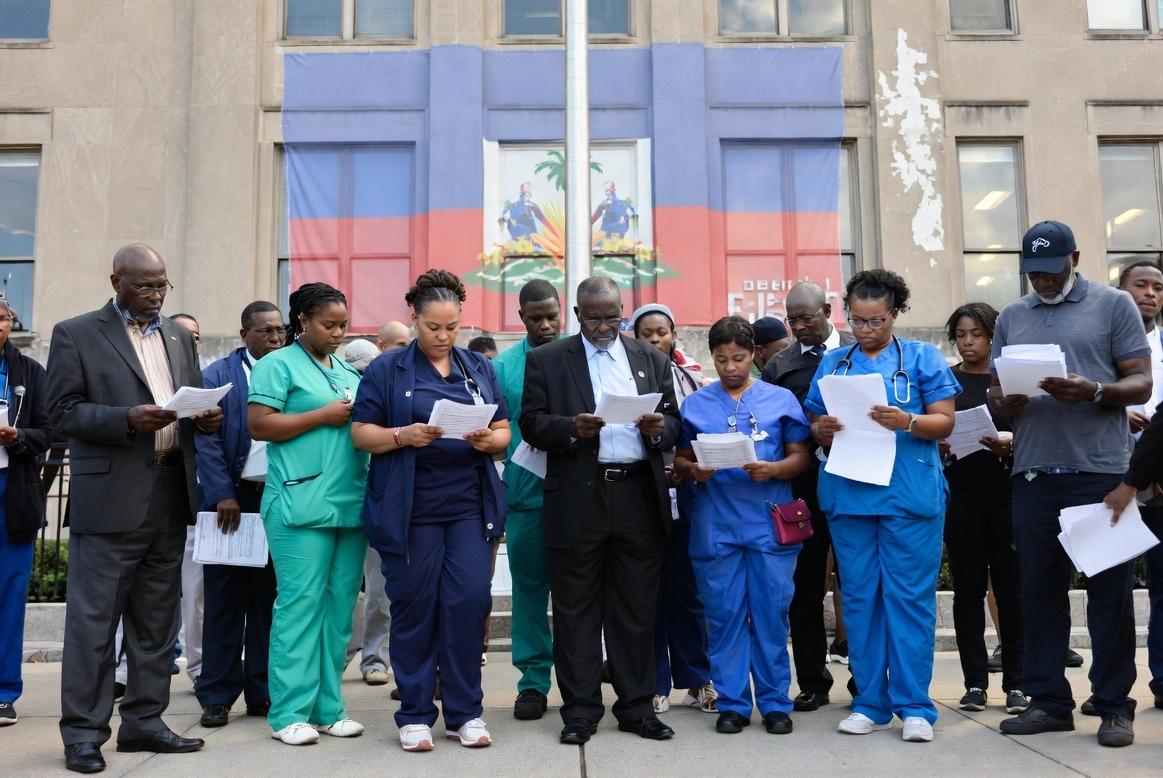
*Haitian immigrants who had been legally living and working in the United States under Temporary Protected Status are confronting an immediate new reality: lost jobs for some, electronic monitoring for others, and the possibility of deportation to a country still struggling with violence and instability.
The consequences follow a June 25 U.S. Supreme Court decision that cleared a major legal obstacle to the Trump administration’s termination of TPS for Haitians.
In its ruling, the Supreme Court held that the TPS statute bars judicial review of nonconstitutional challenges to Homeland Security decisions involving the designation, extension or termination of TPS. The Court also concluded that challengers were unlikely to succeed on their claim that Haiti’s termination was racially motivated.
That is more precise than saying the justices simply declared Haiti safe or broadly endorsed every rationale for ending the protection.
Now the consequences are moving from courtrooms into workplaces and homes.
Scroll to continue reading









New York City Says Federal Law Forced Job Separations
New York City Mayor Zohran Mamdani’s administration confirmed that Haitian city employees who could no longer demonstrate federal authorization to work had to be separated from their jobs.
“The City of New York was forced by federal law, as recently decided by the Supreme Court, to review the work authorization of Haitian TPS holders and separate from any employees who have not established alternative paths to legal work,” Mamdani said in an official statement.
The mayor made clear that the separations did not represent his administration’s preferred policy.
“The City will do everything in its power to support TPS recipients in this time of incredible instability,” Mamdani said.
His administration said affected employees are being connected with free legal consultations to determine whether they qualify for other forms of work authorization, along with help navigating health insurance and other resources. Workers could also have pathways to reinstatement if authorization is restored or another legal status is obtained.
The distinction matters: New York City isn’t terminating employees merely because they’re Haitian. The employment problem arises for workers who relied on TPS for authorization and cannot establish another legal basis to work.
Some Haitians Are Leaving ICE Check-Ins Monitored
An even more visible consequence is unfolding around Springfield, Ohio, home to a significant Haitian community.
WLRN reported that the Department of Homeland Security required dozens of Haitian immigrants in Ohio to report for immigration appointments, with some fitted with ankle monitors. Immigration attorneys and advocates told the outlet the practice appeared concentrated in Springfield.
That makes the images striking, but it does not establish a nationwide policy of putting Haitian immigrants on ankle monitors.
The Guardian reported from an ICE facility in Blue Ash, Ohio, where Haitians summoned for appointments emerged wearing monitors. One man collapsed to the ground while speaking with reporters after leaving the facility.
The circumstances also underscore another important distinction: losing TPS does not put every Haitian immigrant into an identical legal position.
Some former TPS holders have pending asylum cases or other immigration proceedings, while others may have work authorization through another legal pathway. The termination of TPS therefore does not automatically mean every former recipient immediately becomes deportable under precisely the same circumstances.

What the Supreme Court Actually Decided
Congress created TPS in 1990 as humanitarian relief for nationals of countries where armed conflict, natural disaster or other extraordinary conditions can make safe return impossible. Haiti received TPS following its catastrophic 2010 earthquake.
The Supreme Court’s June decision focused heavily on Congress’ restrictions on judicial review.
The statute provides that there is “no judicial review” of certain Homeland Security determinations concerning a country’s TPS designation, extension or termination, the Court noted.
Justices Elena Kagan, Sonia Sotomayor and Ketanji Brown Jackson dissented.
The ruling did not erase the controversy over what awaits people returned to Haiti. The Court’s own opinion noted that the government acknowledged some conditions remained concerning, particularly gang violence and its effects, while maintaining those conditions no longer justified continuing TPS.
A ‘Temporary’ Protection With Permanent Consequences
Mamdani called the Haitian community “an indispensable part of New York City,” pointing to contributions in health care, construction, hospitality, small business and culture.
That helps explain why the end of TPS isn’t simply an immigration-policy change on paper.
Workers who built lives around legal employment are confronting changes to their ability to earn a paycheck. Families are searching for alternative immigration options. In Ohio, some Haitians are walking out of government appointments electronically monitored.
TPS may contain the word “temporary,” but years spent working, raising children and building communities are anything but temporary.
The court fight has reached a decisive turn.
For Haitian families living with what comes next, the uncertainty hasn’t.
NOW: Pregnant woman who is a Haitian TPS holder, is fitted with a wrist monitor instead of ankle monitor at Blue Ash Ohio ICE office pic.twitter.com/ost87HpCUr
— Oliya Scootercaster 🛴 (@ScooterCasterNY) August 9, 2026
(If You Like/Appreciate This EURweb Story, Please SHARE it!)
MORE NEWS ON EURWEB.COM: Trump Has a Wedgie Up His Butt for Haitian Immigrants + His Deportation Plan – The Journal of Steffanie Rivers | WATCH
We Publish Breaking News 24/7. Don’t Miss Out! Sign up for our Free daily newsletter HERE.