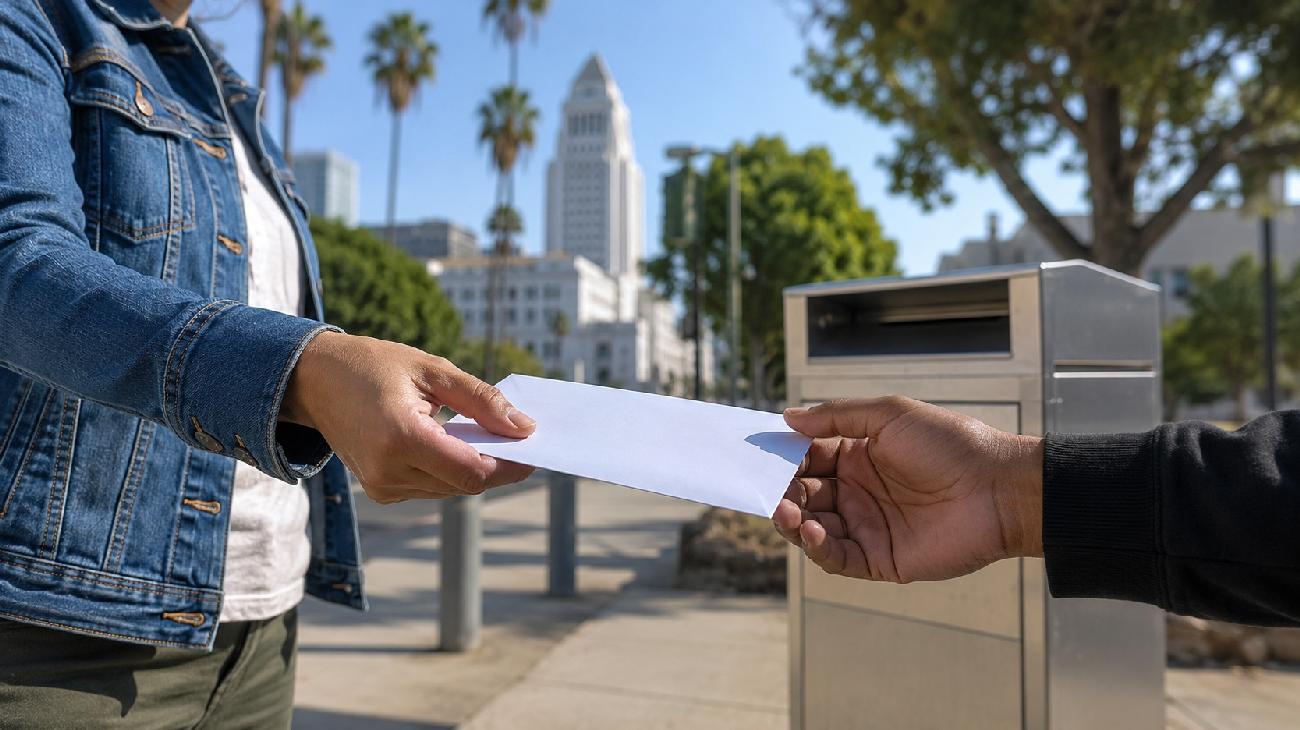
*Los Angeles educator and former county supervisor candidate Daphne Bradford has launched the Bipartisan Lincoln Independent Project, or BLIP, a nonpartisan effort calling for tighter accountability when voters entrust completed mail ballots to third parties.
Bradford, who was honored at the Obama White House as a “Champion of Change,” says her concern grew during her 2024 campaign for Los Angeles County supervisor. She alleges she was encouraged to participate in outreach involving financial, meal and other incentives connected with registering homeless people and RV dwellers to vote. Bradford says she declined because she believed the practices raised ethical concerns.
That experience, she says, led to a larger question: What happens to a ballot after a voter hands it to somebody else?
“Across Los Angeles County, I have seen up close how ballots are being collected from people who have no way to know if their vote ever reached the county,” Bradford said. “This is not about one party. It is about whether every voter, in every neighborhood, can trust that the ballot they filled out is the ballot that gets counted.”
What California Law Allows
California law permits voters to designate another person to return their vote-by-mail ballot. Assembly Bill 1921, signed in 2016, broadened the law beyond earlier restrictions on who could return a ballot.
Scroll to continue reading






BLIP argues that existing safeguards do not amount to a fully verifiable chain of custody documenting everyone who possessed a ballot before election officials received it. The organization wants greater accountability for that period between voter and election office.
California law does contain protections surrounding ballot return, including restrictions against compensation based on the number of ballots returned. Criminal interference with ballots also remains illegal.
That distinction matters: third-party ballot return is legal in California, while BLIP is advocating for changes to how that practice is regulated and documented.
Rejected Ballots Raise Separate Questions
BLIP also points to California’s high number of rejected mail ballots as evidence that voters need greater confidence in the process.
State data show 148,241 mail ballots were rejected during California’s June 2026 primary, or 1.73% of mail ballots received. The largest category was late ballots, accounting for 93,479 rejections. Nearly 44,000 were rejected over signature mismatches, while more than 8,300 lacked a signature.
Those numbers do not demonstrate misconduct by third-party ballot collectors. They do, however, underscore the different ways a mailed ballot can fail to be counted after a voter completes it.
“A ballot should be protected from the moment it leaves your hands to the moment it is counted,” Bradford said. “Right now, once it is handed to a stranger, that protection disappears.”
Federal Case Adds a Los Angeles Connection
A separate 2026 federal prosecution brought the issue of improper voter-registration incentives directly to Los Angeles.
The U.S. Department of Justice charged longtime petition circulator Brenda Lee Brown Armstrong with paying individuals, including homeless people on Skid Row, to register to vote. Armstrong agreed to plead guilty to a felony count of paying another person to register.
Federal prosecutors said Armstrong sometimes used her former address on registration forms for homeless individuals who lacked an address. Because California automatically sends vote-by-mail ballots to registered voters, prosecutors said ballots in some registrants’ names potentially could have been mailed to an address where they did not live or collect mail.
The federal case does not establish that Bradford’s 2024 campaign experience involved Armstrong or the same operation, and Bradford has made no such connection.

BLIP Looks Toward the November Election
Bradford stresses that BLIP’s campaign is intended to cross party lines. The organization cites past election controversies, including North Carolina’s 2018 Ninth Congressional District race, where the state ordered a new election after an investigation into an unlawful absentee-ballot operation that benefited a Republican candidate.
BLIP is consulting counsel about possible avenues for change, including state legislation, a ballot measure or county policy. Because California law governs third-party ballot collection, the organization acknowledges that Los Angeles County cannot necessarily accomplish its entire objective through local action alone.
With the Nov. 3 election approaching, Bradford wants the organization’s central question in front of voters regardless of party affiliation: Once a completed ballot leaves a voter’s hands, how much should that voter be able to know about the path it takes before being counted?
For BLIP, that gap between voter and election office is precisely where it wants greater transparency.
(If You Like/Appreciate This EURweb Story, Please SHARE it!)
MORE NEWS ON EURWEB.COM: Daphne Bradford Responds to LA BLMer Joseph Williams Who She Claims is Trying to Knock Her off the Shoulders of Rosa Parks
We Publish Breaking News 24/7. Don’t Miss Out! Sign up for our Free daily newsletter HERE.