Slavery panels removed from President’s House memorial site
*The National Park Service recently removed several key exhibits from the President’s House site in Philadelphia, sparking outrage and legal action. The site, located near Independence Hall, was created in 2010 to honor the lives of nine enslaved people held by George Washington while he served as president in the city from 1790 to 1797.
Among the panels taken down were those titled “The Dirty Business of Slavery” and “Life Under Slavery.” These displays detailed the trans-Atlantic slave trade, the role of slavery in Philadelphia’s economy, and Washington’s efforts to keep enslaved people from gaining their freedom under Pennsylvania law. As of Jan. 23, the NPS has not publicly explained the full scope of the removal.
Trump administration order blamed for exhibit removal
NPS staff confirmed the action followed a directive issued under the Trump administration. The policy reportedly instructs federal agencies to eliminate content deemed “divisive,” “corrosive,” or overly negative about American history or its founding figures.
According to workers present at the scene, they were “just following orders” as they dismantled the panels on Jan. 22. Critics argue the move is part of a wider trend to censor or “whitewash” history, especially topics related to race and oppression in early America.
Scroll to continue reading






Philadelphia sues federal government over erased history
The city of Philadelphia responded swiftly by filing a lawsuit against the Trump administration and the federal government. The suit seeks a court injunction to stop further removals and restore the educational panels. Officials argue the action violates preservation laws and constitutional protections of historical interpretation.
City leaders labeled the removal “an attempt to erase essential truths about America’s past.” They claim the exhibits were a vital part of telling a full and honest story of U.S. history—one that includes both founding ideals and the brutal realities of slavery.
Lawmakers and community leaders push back
Several Democratic members of Congress from Pennsylvania—including Reps. Dwight Evans, Brendan Boyle, and Mary Gay Scanlon have demanded answers. In a letter to the Interior Department and NPS, they asked for transparency and immediate action to restore the displays.
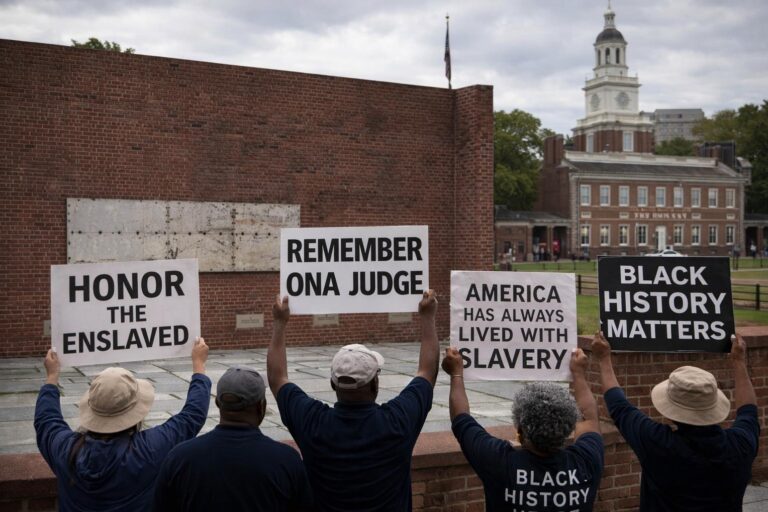
Meanwhile, community activists gathered at the site in protest. Some brought homemade signs referencing the lives of Ona Judge and other enslaved individuals once held at the house. Others accused the government of erasing Black history to promote a sanitized version of the American story.
Philadelphia’s deep, complex ties to slavery and abolition
Though part of a Northern state, Philadelphia has a long and complicated history with slavery. Enslaved Africans were brought to the region as early as the 1600s, and by the 1700s, slavery was central to the local economy. Urban slavery in Philadelphia often involved small-scale ownership and isolated labor in homes, shops, and shipyards.
George Washington brought enslaved people to Philadelphia during his presidency, rotating them back to Virginia to avoid Pennsylvania’s gradual abolition law. Ona Judge, one of those enslaved, famously escaped and remains a symbol of resistance and courage.
Philadelphia’s role in early abolition efforts
Philadelphia was also a hub for anti-slavery activism. In 1688, the Germantown Quaker Petition became the first formal protest against slavery in the American colonies. Influential Quakers like Anthony Benezet and John Woolman worked to end the practice among their communities.
The Pennsylvania Abolition Society, founded in 1775, was the first of its kind in the U.S. Benjamin Franklin even served as its president. Pennsylvania passed the Gradual Abolition Act in 1780, and by the early 1800s, the state had nearly eliminated slavery.
Legacy sites and ongoing preservation efforts
The President’s House memorial is one of several Philadelphia landmarks that highlight the lives and contributions of enslaved people and the city’s abolitionist past. Other notable sites include locations tied to the Underground Railroad and free Black communities of the 19th century.
Institutions like the African Methodist Episcopal Church (founded in 1816) and the Penn & Slavery Project at the University of Pennsylvania continue to explore and teach this history. Advocates argue that removing exhibits like those at the President’s House site undermines decades of work to honor and remember the full American story.
Why the President’s House exhibit matters now
For many, this site offered a rare and truthful portrayal of America’s founding that included enslaved voices. Its removal is seen as a warning sign about where historical discourse is headed under politically motivated censorship. Supporters of the site say it’s not about tearing down heroes—but about telling the truth.
As legal battles unfold and public outcry grows, the fate of the President’s House panels remains uncertain. What’s clear is that the fight to preserve honest, inclusive history is far from over.
(If You Like/Appreciate This EURweb Story, Please SHARE it!)
MORE NEWS ON EURWEB.COM: Roy Wood Jr. Says His Pops Helped Start ‘Soul Train’ … Then Said ‘Nah, Gimme My Money Back’ | WATCH
We Publish Breaking News 24/7. Don’t Miss Out! Sign up for our Free daily newsletter HERE.