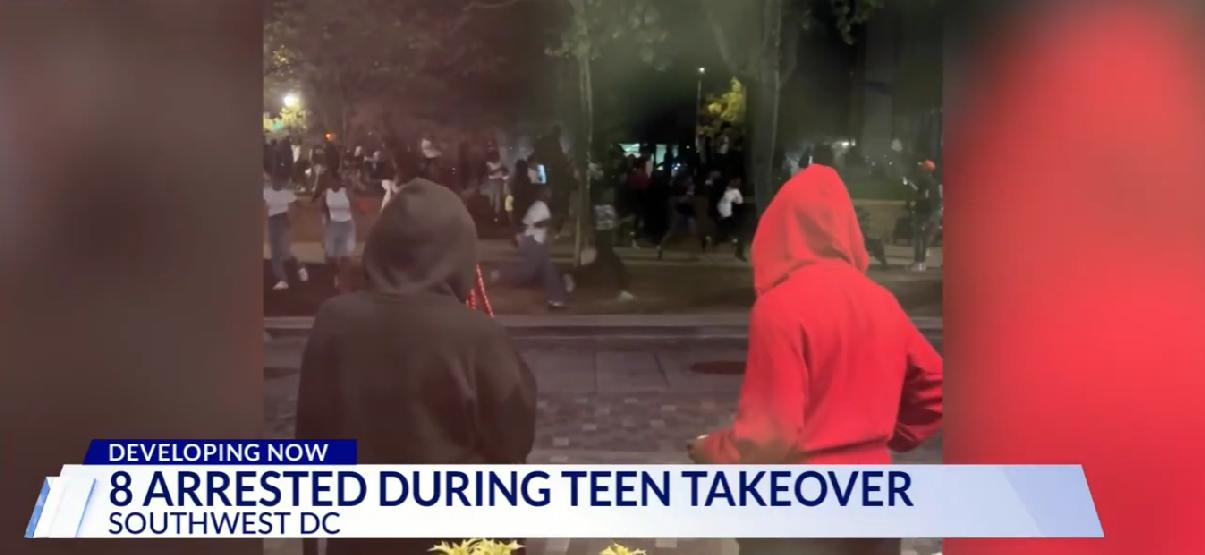
*It starts with a single post. A location. A time. A challenge. Within hours, hundreds of teenagers descend on a city street, mall, or waterfront. Within minutes, chaos erupts.
This is the new reality of the American city. Large groups of adolescents, organized entirely through social media platforms like TikTok, Snapchat, and Instagram, are staging spontaneous “takeovers” that frequently escalate into property damage, fights, car-climbing, store rushes, theft, and occasional violence. Police departments nationwide are scrambling to respond – and often failing.
Recent Incidents Paint a Disturbing Picture
The past year has seen a wave of these flash-mob-style events. In Chicago’s Hyde Park, teens climbed on cars, triggered alarms, and caused significant damage to more than a dozen vehicles. One arrest followed, along with citations that many felt were far too lenient.
In Washington, D.C., fights broke out in the Southwest Waterfront area. Police arrested eight teens, and reports indicated some juveniles were actually robbed during the unrest they helped create. In Detroit, groups rushed into stores, with witnesses describing thefts involving oversized items – as if consequences didn’t exist.
Other locations tell the same story: Milwaukee, Boston-area communities, Los Angeles, Wisconsin malls, and Jacksonville, Florida, where five teens were shot during one takeover. Planned events have been reported in Columbus and Montgomery County, Maryland. Law enforcement describes these as “flash-mob” events that overwhelm police response due to their sudden, viral nature. Some have turned deadly, with stampedes, shootings, attacks on officers, and what residents call “Purge”-like disorder in otherwise quiet city centers.
Scroll to continue reading








The Enforcement Argument: Swift Justice, Parental Accountability
The trend has sparked sharp disagreement – but one side is gaining volume. Many officials, police chiefs, and critics (often from Republican or law-and-order perspectives) argue for stricter measures. Their platform includes swift arrests, parental accountability (including charging parents criminally), expanded curfews like Chicago’s “snap” curfews, real-time social media monitoring by police, and treating participants as fully responsible for crimes like vandalism, theft, and assault.
U.S. Attorney for the District of Columbia Jeanine Pirro has been blistering. “The problem is they don’t believe that these young people need to be treated as criminals,” Pirro said in a recent interview. She and other critics argue that leniency or “soft” approaches in some Democrat-led cities have allowed the problem to persist or worsen – turning public spaces into no-go zones and eroding community safety.
In Washington, D.C., curfews restricting when teens can gather are already in place, a policy strongly supported by Mayor Muriel Bowser. However, candidates seeking to replace her have been less clear about whether they would maintain those restrictions.
The Alternative View: Prevention and Root Causes
Other city leaders question heavy reliance on arrests. They ask whether resources should prioritize prevention, “investment” in youth programs, or addressing root causes like boredom, lack of supervision, and family breakdown.
In Chicago, Mayor Brandon Johnson has urged parents to intervene while emphasizing that gatherings “can turn deadly.” Johnson specifically called on parents: “Please do not allow your child to attend any of these trends. They’re unsafe and they can turn deadly.”
Critics of strict enforcement frame heavy policing as overly punitive toward “kids” or tied to broader social issues. But incidents have occurred in cities with varying leadership – red and blue – confirming this is a nationwide problem. Social media amplifies everything: one viral video inspires the next.
View this post on Instagram
Realistic Assessment: Deterrence, Prevention, and Accountability
These aren’t random “youthful fun.” Large unsupervised crowds of adolescents, incentivized by online clout and enabled by weak immediate consequences, predictably lead to disorder. Basic crowd dynamics plus immature impulse control equal disaster. Property owners, residents, and bystanders bear the costs: damaged cars, closed businesses, heightened fear, and diverted police resources.
Effective responses historically include three pillars. First, deterrence – consistent arrests, prosecutions, and parental liability, including fines or loss of custody in extreme cases. Second, prevention – real-time social media monitoring by police, strictly enforced curfews, and holding schools and parents accountable. Third, the cultural element – family structure, supervision, and values matter more than “programs.” Excusing behavior as “kids being kids” or avoiding uncomfortable patterns only delays fixes.
Blaming “poverty” or “lack of activities” ignores that prior generations faced harder conditions without normalizing mob chaos. Social media acts as an accelerant, lowering the barrier for coordination while diffusing responsibility.
Public safety requires clear rules, swift enforcement, and rejecting the idea that disorder is inevitable. Cities ignoring this risk escalation as warmer months approach and copycat events multiply. Parents allowing unchecked participation share blame. Accountability starts at home – then moves to the streets.
View this post on Instagram
(If You Like/Appreciate This EURweb Story, Please SHARE it!)
MORE NEWS ON EURWEB.COM: Ashlee Jenae Found Dead in Tanzania – Friends, Family Reject Suicide Claim
We Publish Breaking News 24/7. Don’t Miss Out! Sign up for our Free daily newsletter HERE.