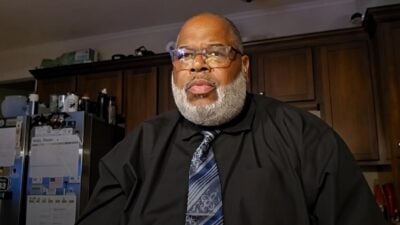
*I asked Alexander how he was doing. “I’ll make it.” Sigh. “Lately, I’ve been slippin’ into darkness, but I’m good.”
While Alex later made it clear that things weren’t as dismal as his sigh, neither of us gave a nanosecond of attention to the phrase, “Slippin’ Into Darkness” being the title of the 1971 hit by the band War.
That’s because we both speak fluent R&B. For me and some of my Old School music enthusiasts, periodically communicating through song titles, lyrics, and phrases from R&B and pop songs is a language all its own.
It might not even be a lyric. Depending on the conversation, an act’s name could express the sentiment. The other day, I was caught up in a deadline when a friend invited me to join him and others for Sunday brunch. “I could kill a Belgian waffle right now,” I admitted, “but this time I’m gonna do the New Edition.” He knew what that meant—“Count Me Out,” the group’s 1985 single.
Scroll to continue reading



I know. It’s all extremely corny. But if you have enough of a pop music vocabulary, it all comes naturally. No music catalog is safe; we go deep. It’s a good thing there are no royalties to be paid songwriters every time my friends and I converse; we’d owe thousands.
Sometimes, what we say doesn’t align with what we’re talking about at the moment. Parts of a conversation can trigger us, and we just can’t help it.
Like when Terry asked me if I knew the location of a trusted computer repair shop. I said, “I’m not sure, but I believe…” And in the two seconds I hesitated, Terry finished my sentence with, “…the children are our future…” He couldn’t resist. It was just hanging there. He had to finish it.
Of course, that led us down a rabbit hole about who wrote “The Greatest Love of All,” the Whitney Houston song from which that lyric comes. Bets and debates ensue. While recalling that Michael Masser wrote the music, I’d forgotten that the words were written by Linda Creed, songwriter/producer Thom Bell’s dedicated songwriting partner.
I have a buddy who shall remain unnamed, whom I call the “Soul Savant.” My man can speak entire paragraphs using song titles and lyrics. Last year, he shared with me a conversation he had with a woman he’d been dating, who at some point seemed to be drifting away. He said, “I told her, ‘Listen, you gettin’ The Best of My Love here. When we met, for me, it was A Night to Remember, and I still feel that way. I Want You…But I Want You to Want Me, Too.’”
He talks like this so often that I’m not sure he realizes he expressed his feelings to this woman evoking the Emotions, Shalamar, and Marvin Gaye.
But then, anyone who truly loves pop music occasionally references some element of it. Sometime back, CNN’s Laura Coates, in the middle of her on-air commentary about someone’s choices, mischievously referenced Bobby Brown and his hit, “My Prerogative.”
For me, and I believe others as well, this eccentricity started early in life. Mama used to say (there’s that ‘80s hit by Junior), “Stevie, if you knew your schoolwork as well as you know the words to all those songs on the radio, you’d be a genius.”
I don’t know about that, but among the songs the Beatles recorded and released, about 200 of them are original compositions, and I know the lyrics to most of them.
The R&B, pop, rock, and jazz I grew up with weren’t just songs to me. They still aren’t. They were my friends, voiced my conscience, and connected me to what I related to more than anyone or anything else. Why wouldn’t all those lyrics evolve into a language?
By the way, in R&B, “Ooh Wee” is a certified lyric.
Beyond melodies and lyrics, there are the sounds. The mournful, weeping synthesizers on Stevie Wonder’s “Where Were You When I Needed You” — part two of “Superwoman,” the opening track from Music of My Mind, his landmark 1972 masterpiece–echoed the longing of my teenage loneliness. At 16, I hadn’t experienced the kind of heartbreak Stevie wrote about, but so what? I knew that if I had, this song and its intimate production would have perfectly expressed how I’d feel.
When I grew up and started working as a music journalist, I was surprised to realize that some of the songs I loved most weren’t created with the same spirit that I had embraced.
According to Paul McCartney, he and John Lennon wrote and recorded some of the Beatles’ early hits under the gun–Capitol, their label, wanted new music ready before they went on tour.
Brian Holland of the legendary Motown songwriting and production team Holland-Dozier-Holland, known for hits by the Supremes, the Four Tops, Martha and the Vandellas, and Marvin Gaye, told a naive young me that a songwriting team often doesn’t actually write together. “A lot of the songs credited to HDH were written by just one of us.”
“Really? Who wrote what?”
“I’m not going to tell you that.”
Barrett Strong seemed genuinely annoyed when a friend of mine ran into him in Los Angeles a few years back and asked how he and his songwriting partner and production icon Norman Whitfield, wrote such classics as “I Heard It Through The Grapevine,” “War (What is it Good For),” “Papa Was A Rollin’ Stone,” and “Smiling Faces Sometimes.” “We just wrote ‘em, man,” he said. It somehow feels sacrilegious to think that the Temptations’ majestic “Just My Imagination (Running Away with Me),” a Whitfield/Strong standard, was written on a deadline.
How the music was created doesn’t diminish its significance to me or its place in my psyche. But what I’d discover is that someone besides my friends “seconded my emotion,” so to speak.
Sometime in the late ‘80s, I interviewed Smokey Robinson. Motown flew me from L.A. to Las Vegas, where I spent a couple of hours interviewing the singer/songwriter after catching one of his limited engagement shows at Bally’s the night before. A few days later, we had another interview by phone once I returned to L.A.
During our conversations, a good-natured Smokey shared fascinating stories about the creation of Motown and how many of those hits were made, to which, out of habit, I’d occasionally respond with, “I’ll be doggone.” To which Smokey would casually retort, “…if I wouldn’t work all day.” Hmmm. Okay. Whatever that means.
During two days of interviews, Smokey shared plenty of great stories, many of which prompted me to say, “I’ll be doggone,” followed by Smokey’s usual reply: “…if I wouldn’t work all day.” He didn’t bring any attention to this remark; he’d just say it matter-of-factly after my ‘I’ll be doggone,’ and continue the conversation. I thought the consistency of his response was odd, but I never mentioned it.
In any case, a few days after the interviews, while researching Smokey’s history as an artist, songwriter, and producer, I came across Marvin Gaye’s 1965 hit, “I’ll Be Doggone,” produced by Smokey, and co-written by him and Miracles members Warren “Pete” Moore and the group’s guitarist, Marv Tarplin.
And there it was in the song’s first verse: “I’ll be doggone If I WOULDN’T WORK ALL DAY.”
One of the architects of popular music–the man responsible for writing or co-writing such classics as “My Girl,” “My Guy,” “I Second That Emotion,” “Tears of A Clown,” “More Love,” among others—was talking R&B with me and didn’t even realize it.
It took a master of lyrical language to teach me that I can always listen more and talk less.
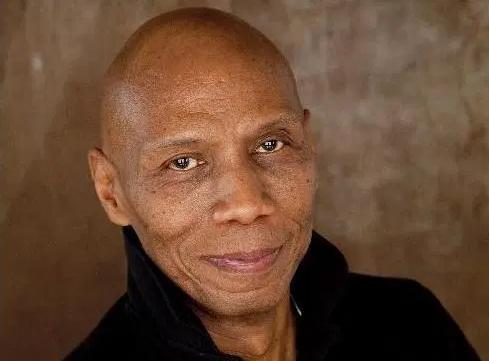
Steven Ivory, veteran journalist, essayist, and author, writes and discusses popular culture across various platforms, including the Internet, TV, radio, documentaries, magazines, and newspapers. The Last Man on AOL is at [email protected]
(If You Like/Appreciate This EURweb Story, Please SHARE it!)
MORE NEWS ON EURWEB.COM: Suge Knight Says He Knows What Happened the Night Tupac Was Shot
We Publish Breaking News 24/7. Don’t Miss Out! Sign up for our Free daily newsletter HERE.