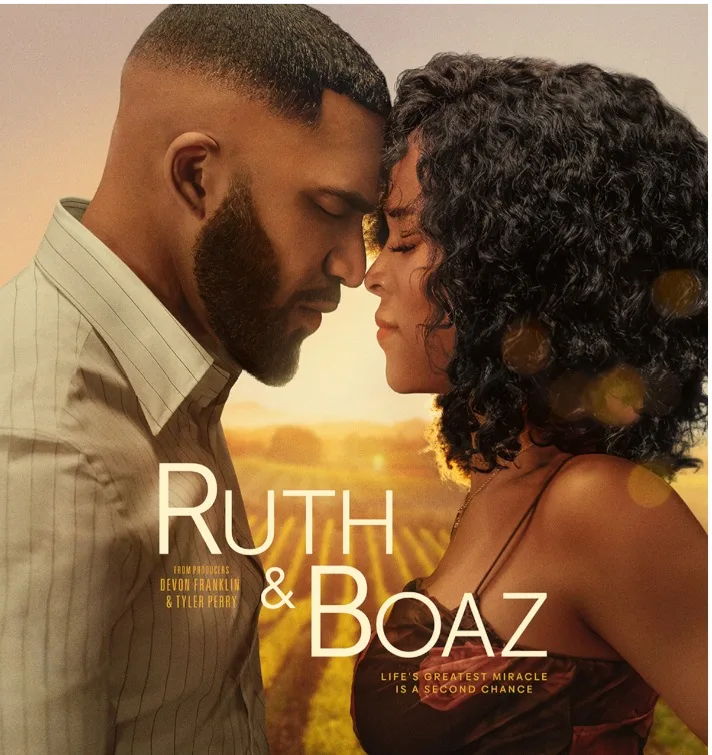
*In the first faith-based Netflix release co-produced by Tyler Perry and Devon Franklin, the age-old Biblical story of Ruth and Boaz is reborn. This time not B.C., but in the heart of a modern, urban landscape that pulses with real-life challenges, heartbreak, and hope.
Starring Tyler Lepley (The Haves and Have Nots), Serayah (Empire) and Felicia Rashad, the bold retelling of unexpected sisterhood and love trades traveling on foot for a bus ride, as two women embark on a new life after loss. Set in Tennessee, the contemporary context of the story broadened its appeal. Once viewers are drawn in by the adept shooting of captivating scenes, the story that unfolds will keep their attention.
Ruth and Boaz was deeply watchable, relatable and an outright heart-rich production in form and substance. Yet, certain modifications of the story made it too different from the original. This review analyzes what the producers got right and wrong.

Realism That Resonates
What makes this film a standout is its use of realism. Franklin, who had his hand in casting and creative aspects of the film, doesn’t sugarcoat how far people will go to survive loss or displacement. Instead, he grounds Ruth’s story in a situational conflict many viewers will recognize: economic hardship, fractured families, and the painful process of starting over. She chooses to tag along with Naomi, the mother of her boyfriend who was gunned down in a carjacking with his father. Both women must start over just as the Bible portrays. Naomi is reimagined as a bitter widow who does not welcome but tolerates Ruth. “You’re not going with me to Tennessee or anywhere else,” Naomi firmly tells Ruth while she sits next to her on the bus. The heaviness of her circumstances causes the elder widow to lose faith in God. As she begins to heal she realizes that Ruth is the daughter she never had and the friend she needed. While this is not how it happened in the Bible, this point of view is plausible.
Ruth, an aspiring singer who leaves Atlanta after she breaks her contract, is a young woman of quiet strength. When Boaz falls for her, she gets blessed with the full package even though she was not even looking for it. To have thrust her in the arms of another man so soon after losing her boyfriend would have been too fast. Serayah convincingly conveyed that dating was the farthest thing from her mind.
Boaz, a handsome man with means, money and character, is willing to love unconditionally, be a protector and live with integrity. He is depicted as a single working man who was attracted to an employee. Boaz did not allow the work construct to get in the way of what he was feeling in his heart. Love has a way of melting boundaries and Boaz dared to let it flow.
The film conveys the Christian lifestyle example by omitting curse words or sex scenes, showing that a film can be thoroughly entertaining without either.
A Story Beyond Romance
Yes, the story includes romance—but the strong subplots force it to go beyond the love interest level. It is hard to concentrate solely on the budding relationship between the two main characters when Ruth has broken a contract and her former manager tracks her down threatening to take out Naomi after he was tied to the death of her husband and son. What do you do when life gets that complicated? Ruth prayed and held on to her faith, seeking God for direction.
Naomi’s part (played by Phylicia Rashad) also brings further depth to the storyline. Her narration provides sage wisdom that can apply to life in general. Rashad’s performance as the storyteller and character within the film is commendable. She owned the part, bringing feeling to what it means to be an aging woman with no bookends — her whole world shattered. Through tears and silent physical reactions — not words — she conveyed a gamut of emotions that come when the unimaginable happens and you are left with nothing. She had only learned that the company she helped her late husband build was failing after his death, leaving her no choice but to move back from a mansion to a starter home in another state, Tennessee. The lesson she teaches, among other things, is about processing grief one day at a time.
One of the clearest examples of how the film downplays romance in favor of protection and duty is the scene where Naomi’s home is protected by the vineyard manager. When the bodygaurd and Ruth’s fotmer manager comes to Naomi’s house with violent intentions, Boaz intervenes physically, stepping in to defend Naomi and Ruth. A fight breaks out, but the situation escalates until Naomi herself fires a rifle to end the threat. This moment is intense, but not romantic—it’s about justice, safety, and Boaz fulfilling a role of protector, not suitor. He doesn’t initiate affection or courtship; he shows up as a man of integrity who defends the vulnerable. To some extent, the spirit of this scene aligns more with the biblical Boaz, whose actions were rooted in law and honor, rather than romance or emotional pursuit.
You don’t have to be in a relationship to feel seen or inspired by this story. That alone makes it more accessible than many faith-based films that often lean too heavily into idealized themes.
The Contrast to the Original Story
It is important to note that the way the relationship of Ruth and Boaz developed in the movie was not exactly parallel to the Biblical account. The Bible story was also not strictly about love but about being practical and Naomi wisely securing both her and Ruth’s future through a “work-around” for seizing family assets. But the deviation from the original text was not necessary and is the greatest flaw in Ruth and Boaz.
One of the film’s most significant departures from the biblical narrative is its reversal of who initiates the relationship. In Scripture, it is Ruth—prompted by Naomi—who boldly approaches Boaz in a culturally symbolic act, asking him to fulfill his role as a kinsman-redeemer. The film, however, shifts this dynamic by having Boaz pursue Ruth, which alters the theological and cultural significance of the original story.
In Old Testament times those who owned fields would allow those who didn’t to glean in their fields. Boaz not only allowed Ruth to work in his filed but noticed her and showed favor toward her. When Ruth returned and told Naomi whose field she had gleaned in, Naomi recognized Boaz was a relative of her husband, or kinsman-redeemer (Ruth 2:20). According to the law, a kinsman-redeemer could step in and redeem a relative’s land and, if necessary, marry the widow of a deceased kinsman to preserve the family line (Deuteronomy 25:5–10). Ruth was childless, single, foreign and had no family. She declared to Naomi, “Your people shall be my people, and your God my God” (Ruth 1:16). In contrast to what occurred in the film , this devotion was returned when Naomi instructed Ruth to ask Boaz about becoming her kinsman-redeemer.
Naomi, understanding the legal and spiritual implications, guided Ruth to approach Boaz and request that he fulfill this role (Ruth 3:1–4). Ruth obeyed, not as a romantic gesture initially. Boaz obliged with integrity and honor but he had already begun to show Ruth favor. He acknowledged the request and affirmed Ruth’s virtue, but he also noted that there was a closer relative who had the first right to redeem the land and marry Ruth (Ruth 3:12–13). Because the first in line was not interested, Boaz was the rightful redeemer and did what was honorable. They conceived Obed, the father of David who are direct ancestors of Jesus Christ.
Anyone who already knew the Biblical version of the story would understand that Ruth picking grapes at Boaz’s winery was a loose reference to this. The absence of a similar scriptural context in this scene almost changes the entire story. I would have liked to seen the producers highlight the significant orchestration Naomi demonstrated in scripture to secure her future. Naomi is a heroine in this story whose power and influence has been downplayed or rarely seen in traditional sermonic interpretations. The film missed an opportunity to augment her role as well.
Representation and Relevance
In this modern-day environment, the film reflects the diversity and depth of Black people. Boaz is a vintner employing people of various races to harvest grapes. Characters speak in today’s language, wear today’s cloths yet grapple with timeless conflicts. This cultural translation of a biblical tale feels fresh and grounded—proof that faith-based storytelling doesn’t have to be stuck in the past to be powerful.
Critique
“Ruth and Boaz” does not address how Ruth broke her contract and fled without making a concrete arrangement to repay the debt. She had been warned of potential consequences Understandably, out of fear she fled with no intention of looking back. In doing so she wrongfully placed a financial burden on someone else. This part of the story could have been reconciled for a ministry moment. Skirting over the issues
However, the greater flaw is central details of the Bible story were omitted. In the Bible version Boaz is the “Kinsman Redeemer” Ruth calls on to marry her.
Main Takeaways
Ruth and Boaz reflects secular ideals, asking viewers to reconsider what love, faith, and loyalty look like in real life. With strong performances, thoughtful writing, and a story that reaches across both time and circumstance, this film isn’t just for believers—it’s for anyone who has ever had to rebuild, wait, or hope. One of the film’s biggest triumphs is its ability to extract and emphasize the deeper meaning behind Ruth and Boaz’s connection: unconditional love and authentic concern. At its core, the film delivers a message of resilience and unexpected love.
Look for celebrity cameo appearances throughout the movie including Babyface, Jermaine Dupri, Young Joc and Lecrae.
Rating: ★★★★☆ (4/5)
Powerful, relatable, and refreshingly grounded in modern truth.
Based in the DMV, Mona Austin is a White House and Congressional Correspondent with a background in political and entertainment journalism. She has been an avid writer since elementary school. Starting in 2009 she coupled radio broadcasting with online news. As a well-traveled Southern girl with respect for facts and compassion for humanity, she appreciate the nuances in a story. Mona also enjoys music, history and cooking. She is also the creator of The News Slice (www.newsslice.blogspot.com) and the digital news site www.theslicenews.com.

(If You Like/Appreciate This EURweb Story, Please SHARE it!)
MORE NEWS ON EURWEB.COM: Diddy Warned of Violence at FCI Fort Dix by Former Reality Star Amid Prison Request
We Publish Breaking News 24/7. Don’t Miss Out! Sign up for our Free daily newsletterHERE.