*As the measles outbreak continues to evolve in West Texas and neighboring New Mexico, public concern mounts regarding the potential severity of the epidemic.
With the current count of cases skyrocketing from 14 to nearly 90 in just a week, health authorities are left grappling with how to control one of the world’s most contagious diseases. How bad could it get? The answer lies in understanding the fundamental characteristics of measles and the implications of declining vaccination rates, NPR is reporting.
The Contagion Factor: Measles’ High Reproduction Number
To comprehend the potential for a measles outbreak, one must first consider the disease’s remarkable contagiousness. The basic reproduction number, or R naught, quantifies the average number of people to whom a single infected person can transmit the disease. For measles, this number ranges from 12 to 18—far above any other infectious disease, including the notoriously contagious Ebola, which has an R naught of about 2.
“It’s not some magical constant,” explains Justin Lessler, an epidemiologist at the University of North Carolina. “R naught assumes that no one has immunity to the disease. In reality, multiple factors can affect how easily measles transmits.”
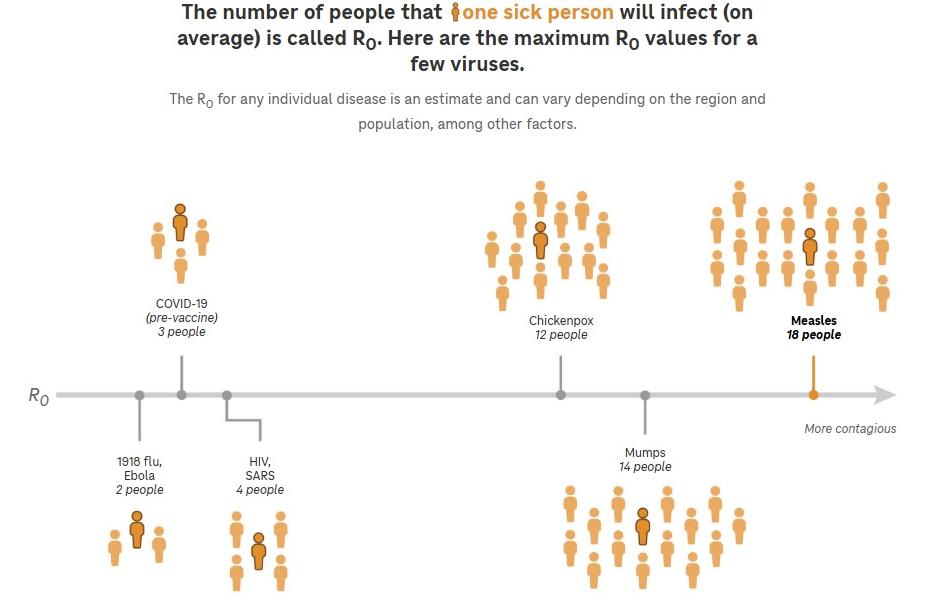
Scroll to continue reading









Herd Immunity in Jeopardy
Vaccination has effectively kept measles outbreaks at bay since the 1960s, dramatically decreasing associated fatalities, which once accounted for 400 to 500 annual deaths among children in the United States. Yet, as public confidence in vaccinations wanes and rates dip, the power of herd immunity to contain such diseases weakens.
Matt Ferrari, a professor of biology and director of the Center for Infectious Disease Dynamics at Penn State University, warns of the consequences of lower vaccination rates. “It’s not unreasonable to think that measles could spread as fast as pre-vaccine SARS-CoV-2 in populations, particularly in school settings where kids are vaccinated at 80–85%,” he says.
Given the current kindergarten vaccination rates and the clustering of unvaccinated populations, communities could find themselves facing severe outbreaks. If an outbreak sees an effective reproduction number of just 3, each infected individual has the potential to spread the virus further, leading to exponential growth in cases.
Adverse Trends in West Texas
The rapid rise in measles cases in West Texas—notably from 14 to 90 cases in a matter of days—illustrates the challenges health authorities face in containing the outbreak. Dr. Paul Offit, director of the Vaccine Education Center at the Children’s Hospital of Philadelphia, emphasizes, “It’s very hard to control measles.” Currently, the majority of individuals contracting measles in Texas are unvaccinated.
The alarming spike in cases highlights a critical issue: the vast majority of illnesses occurring are preventable through vaccination. “The measles vaccine is both safe and highly effective,” asserts Dr. William Schaffner, a professor of infectious diseases at Vanderbilt University Medical Center. “If you have been vaccinated with two doses of the vaccine as per routine, you have a 95-plus percent chance of being completely protected throughout your life.”
Revaccination: A Necessary Precaution for Adults
It’s not just children who need vaccinations; public health officials assert that some adults may require revaccination. Measles can spread incredibly fast, and catching the disease can have severe repercussions.
In particular, older adults vaccinated before 1968 may not possess sufficient immunity due to the ineffectiveness of early vaccines developed from inactivated viruses.
“Those vaccinated between 1968 and 1989 may have only received one dose of the measles vaccine, rather than the two doses that are now standard,” says Dr. Adam Ratner, a pediatric infectious disease specialist. “One dose alone is highly effective for most people, but there’s no downside in checking one’s immunity or considering a booster shot.”
The Centers for Disease Control and Prevention recommends that anyone vaccinated prior to 1968 receive at least one dose of a live attenuated vaccine. This policy reflects a nuanced approach to combatting potential outbreaks and protecting vulnerable populations.

Moving Forward: The Community’s Role in Immunization
The resurgence of measles presents a stark reminder that vaccination is a communal responsibility. As parents and guardians, ensuring that children are vaccinated is crucial, but adults must also take proactive steps to maintain their immunity. Engaging in open discussions about vaccination status and addressing misconceptions surrounding the measles vaccine will be essential in preventing future outbreaks.
Dr. Schaffner asserts, “If you’re unsure of your immunity or vaccination status, there’s no harm in getting a shot.” Building community awareness about the importance of vaccination can reduce fear and misinformation surrounding this life-saving intervention.
A Call to Action
The ongoing measles outbreak in West Texas highlights the critical importance of maintaining high vaccination rates across populations. In a time when misinformation around vaccines is prevalent, it is crucial for individuals, families, and communities to unite in supporting vaccination efforts. By proactively addressing their fears and concerns, we can foster a community willing to embrace vaccination once again.
As we confront rising infection rates and the potential of an outbreak spiraling out of control, the message is clear: Vaccines are our strongest defense against diseases like measles. If we are to protect not only ourselves but also our neighbors—and especially those who cannot be vaccinated—we must prioritize vaccination and education about its importance.
In the face of this outbreak, let us remember that the well-being of our communities lies in our hands. By ensuring that we and those we love are vaccinated, we can help prevent a resurgence of measles and safeguard the health of our most vulnerable populations.
MORE NEWS ON EURWEB.COM: Dr. Ben Carson Says Blame Measels Outbreak on Illegal Immigrants
Sign up for our Free daily newsletter HERE.