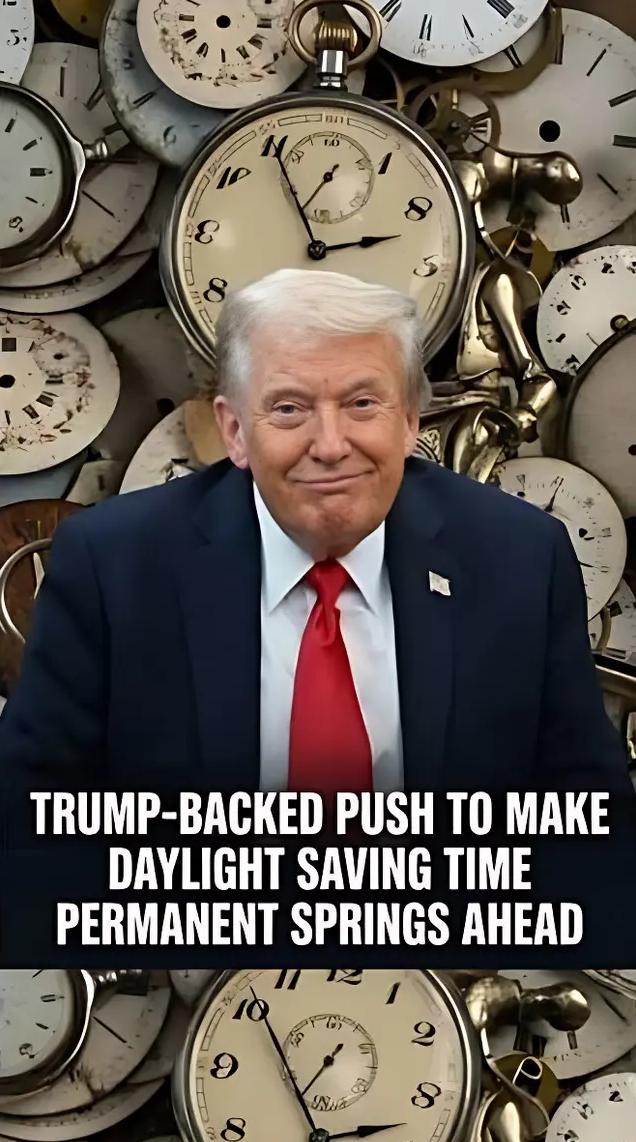
*Just about a week after the House passed President Donald Trump‘s push to make daylight saving time permanent, we’re learning the bill is facing resistance in the Senate, where concerns about darker winter mornings for children threaten its passage despite broad bipartisan support in the House.
As we reported earlier, the House approved the Sunshine Protection Act by a 308-117 vote, sending the legislation to the Senate. But Senate Majority Leader John Thune said there remains “a lot of opposition” among senators who question whether permanent daylight saving time is the right solution.
“It’s not an issue that we’ve really probed much yet,” Thune told reporters. “But we will.”
Children’s Safety Becomes Central Issue
Opponents of the legislation say permanent daylight saving time would create darker winter mornings, leaving some children waiting for school buses or commuting before sunrise during the winter months.
Keeping daylight saving time year-round would eliminate the annual “fall back” clock change but also delay winter sunrises by about an hour in many parts of the country. In northern states, that could leave children traveling to school in darkness for weeks, according to Newsweek.
Scroll to continue reading









Republican Sen. Mike Rounds of South Dakota said those concerns are enough for him to oppose the proposal.
“It doesn’t work in South Dakota,” Rounds told reporters. “We’d have kids going to school in the dark until 9 o’clock, 9:30 in the morning. It won’t work.”
Thune echoed those concerns, saying, “I just don’t think we want a mandate,” while noting the United States previously experimented with permanent daylight saving time before abandoning it.
The South Dakota Republican added that lawmakers remain divided.
“There’s a lot of interest in it from members on our side over here. Some for, some against,” Thune said.
Resistance Extends Beyond Partisan Politics
Opposition to the bill is not strictly partisan.
Several Republican and Democratic senators previously voted against advancing the legislation in the Senate Commerce Committee, reflecting concerns shared across party lines. Lawmakers representing northern states, where winter mornings remain especially dark, have emerged as some of the proposal’s strongest skeptics.
Arkansas Republican Sen. Tom Cotton has also warned that keeping daylight saving time year-round would force many children to travel to school before sunrise.
During House debate, Rep. Mary Gay Scanlon of Pennsylvania likewise cautioned that permanent daylight saving time could create “serious health and safety concerns” because of darker winter mornings.
Although lawmakers broadly agree Americans are tired of changing their clocks twice each year, many remain divided over whether permanent daylight saving time or permanent standard time is the better alternative.
Experts and Religious Leaders Raise Concerns
The proposal has also drawn criticism from sleep researchers and religious organizations.
The American Academy of Sleep Medicine has advocated permanent standard time instead of permanent daylight saving time, arguing that earlier morning sunlight better aligns with the body’s natural circadian rhythm. Researchers also contend later winter sunrises can make waking naturally more difficult, increasing what is commonly described as “social jet lag.”
Several Orthodox Jewish organizations have also expressed opposition. Rabbi Yaakov Menken, executive vice president of the Coalition for Jewish Values, told Jewish News Syndicate that permanent daylight saving time would disrupt morning prayer schedules tied to sunrise, making it harder for many Orthodox Jews to balance religious obligations with work and school. Other Jewish advocacy organizations have echoed concerns about both religious observance and children traveling before daylight.
History May Shape the Outcome
The debate is also influenced by history.
During the 1970s energy crisis, Congress adopted year-round daylight saving time to conserve fuel. Although the policy initially enjoyed public support, it quickly lost favor after families experienced a winter of late sunrises and children traveling to school before dawn. Congress eventually restored standard time during the winter months.
Supporters argue permanent daylight saving time would provide brighter evenings and finally end the twice-yearly clock change. Opponents counter that the benefits are outweighed by the risks associated with darker winter mornings.
With the House having already approved the measure, attention now turns to a Senate that remains divided over how best to end the nation’s long-running clock debate. Whether the bill reaches Trump’s desk may ultimately depend on whether senators conclude the convenience of ending twice-yearly clock changes outweighs concerns about darker winter mornings for millions of Americans
(If You Like/Appreciate This EURweb Story, Please SHARE it!)
MORE NEWS ON EURWEB.COM: Why the US Kept Daylight Saving Time – Some Say It’s Unhealthy | WATCH
We Publish Breaking News 24/7. Don’t Miss Out! Sign up for our Free daily newsletter HERE.