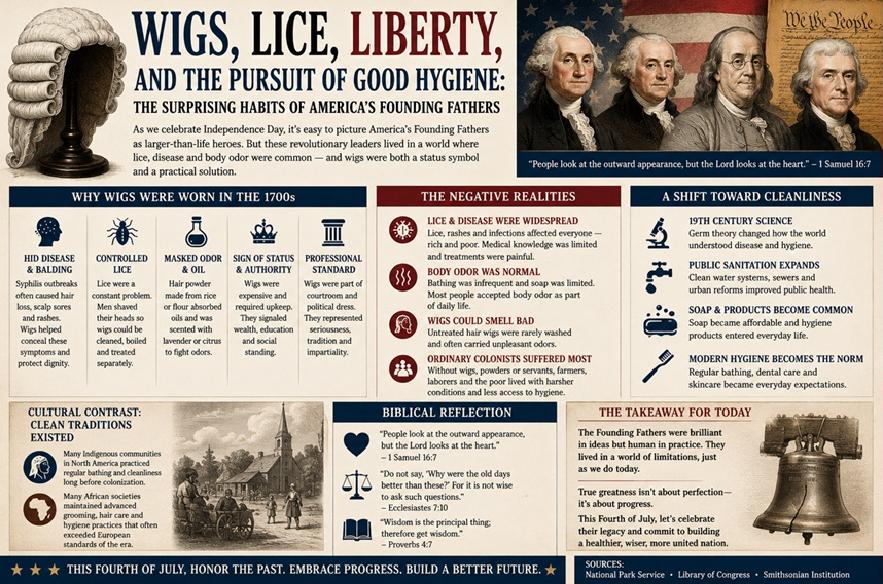
*As Americans celebrate Independence Day, we often picture the nation’s Founding Fathers as larger-than-life figures—men of wisdom, courage, intellect, and vision who helped launch a revolutionary experiment in self-government in 1776.
We imagine dignified statesmen standing in Philadelphia, drafting declarations, debating liberty, and shaping the future of a new nation.
Yet there is another side to their story that rarely appears in textbooks, patriotic speeches, or Fourth of July celebrations.
Many of America’s most respected leaders lived in a world where lice infestations were common, bathing was infrequent, body odor was expected, and powdered wigs often served as a practical solution to health and hygiene challenges.
It may sound humorous today, but it is historically true.
Scroll to continue reading









The powdered wigs worn by judges, politicians, military officers, and colonial governors were more than fashion statements. They were symbols of authority, status, and professionalism. They also helped conceal a variety of physical realities that many people preferred not to discuss.
One of those realities was disease.
Throughout Europe during the seventeenth and eighteenth centuries, outbreaks of syphilis often resulted in patchy hair loss, scalp sores, and premature balding. European monarchs such as King Louis XIII and later King Louis XIV popularized wigs, partly to preserve an image of strength and dignity. As royal fashions spread, colonial leaders adopted them as well.
Another reason was lice.
Head lice were a widespread problem in both Europe and colonial America. Wealthy men frequently shaved their natural hair and wore wigs instead. The wig could be cleaned, powdered, repaired, or even boiled to remove parasites more easily than treating natural hair.
In many ways, the powdered wig was the eighteenth-century version of a cosmetic cover-up combined with a professional uniform.
It was also expensive.
A high-quality wig required skilled craftsmanship and ongoing maintenance. Wearing one signaled wealth, education, and social rank. To appear in public without one could be viewed as unprofessional or socially inappropriate.
Ironically, what many modern Americans associate with dignity and sophistication was often connected to efforts to manage hygiene problems that would be considered unacceptable today.
This reality raises a fascinating question.
If the wealthiest and most powerful men in colonial America struggled with hygiene, what was life like for ordinary farmers, laborers, servants, and poor colonists?
The answer is often uncomfortable.
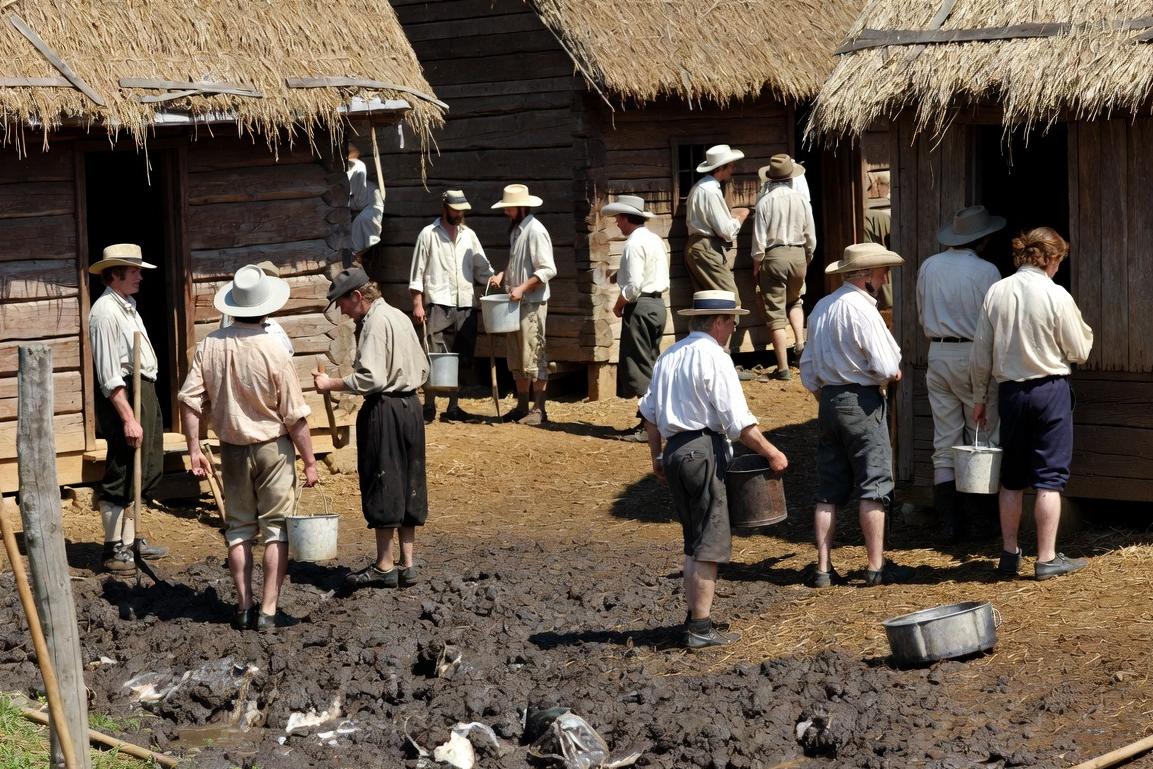
Running water did not exist in homes. Modern plumbing had not been invented. Soap was limited. Medical knowledge remained primitive. Germ theory was unknown. Many people believed frequent bathing could actually make a person sick.
In other words, the America that declared liberty in 1776 was politically revolutionary but scientifically underdeveloped.
That does not diminish the achievements of the Founding Fathers.
Rather, it reminds us that greatness and imperfection often coexist.
The same men who debated constitutional principles and natural rights were also navigating a world that lacked modern sanitation, antibiotics, deodorant, toothpaste, and public health systems.
History is filled with such contradictions.
The Bible reminds us in 1 Samuel 16:7, “People look at the outward appearance, but the Lord looks at the heart.”

The Founding Fathers certainly looked impressive in their powdered wigs and tailored coats. Yet their true legacy was not found in their appearance but in the ideas they advanced regarding representation, governance, and liberty.
At the same time, we should resist romanticizing the past.
Every generation tends to imagine that earlier eras were somehow cleaner, more moral, or more refined than the present. Historical evidence often tells a different story.
Today, Americans frequently criticize various cultural styles, fashions, and grooming practices. Sagging pants, tattoos, hairstyles, and other expressions are often portrayed as signs of social decline.
Yet the powdered wig itself was once considered the height of professionalism.
Imagine a modern presidential candidate appearing on television wearing a white flour-covered wig scented with lavender powder.
Most Americans would find it absurd.
What one generation considers respectable, another may consider outdated.
That is one reason humility is essential when evaluating history.
The Bible teaches in Ecclesiastes 7:10, “Do not say, ‘Why were the old days better than these?’ For it is not wise to ask such questions.”
The truth is that every era has strengths and weaknesses.
The eighteenth century gave us constitutional government, but it also gave us poor sanitation.
The twenty-first century has given us extraordinary medical advances, yet we continue to wrestle with social divisions, economic inequality, and cultural conflict.
Progress is rarely perfect.
Another overlooked aspect of this story involves cultural exchange.
Historical records indicate that many Indigenous communities in North America practiced regular bathing and cleanliness traditions long before European settlement. Likewise, numerous African societies maintained sophisticated grooming, hair care, and hygiene practices that often exceeded prevailing European standards of the era.
Civilizations learn from one another.

Advancement occurs when societies remain willing to adopt better ideas regardless of where those ideas originate.
As Proverbs 4:7 reminds us, “Wisdom is the principal thing; therefore get wisdom.”
Eventually, science transformed public understanding of hygiene. During the nineteenth century, advances in medicine, sanitation, and public health reshaped daily life. Indoor plumbing expanded. Soap became widely available. Germ theory revolutionized healthcare. Regular bathing became normal.
The powdered wig gradually disappeared into history.
Yet the larger lesson remains.
America’s Founding Fathers were not extraordinary because they wore powdered wigs. They were not great because they looked distinguished in portraits.
They were influential because they attempted to build institutions larger than themselves.
This Fourth of July, perhaps the most patriotic thing we can do is remember that the founders were human beings—not myths.
They struggled with disease, lice, limited medical knowledge, and the challenges of their age.
Like us, they lived imperfect lives in an imperfect world.
And perhaps that is the most encouraging lesson of all.
A nation does not move forward because its leaders are flawless.
It moves forward because each generation learns, improves, and continues the unfinished pursuit of a more perfect union.
Sources:
- National Park Service – Colonial America and daily life resources.
- Library of Congress – Historical collections on colonial culture and eighteenth-century America.
- Smithsonian Institution – Research on colonial fashion, wigs, hygiene, and early American society.
Edmond W. Davis is a social historian, journalist, retired history professor, socioemotional intelligence expert, author of multiple historical texts, Arkansas’s first and only Tuskegee Airmen history textbook, and an international speaker. Davis had a role as a Shelby County Courtroom Jail Deputy on the NBC TV series Bluff City Law. He is a former director of the Derek Olivier Research Institute for the Prevention of Gun Violence. Davis is also the founder of the National HBCU Black Wall Street Career Fest and an Amazon #1 author. Contact him via www.edmondwdavis.com.
(If You Like/Appreciate This EURweb Story, Please SHARE it!)
MORE NEWS ON EURWEB.COM: Protesters Demand Justice for Black Indiana Man in Attempted Lynching on 4th of July [VIDEO]
We Publish Breaking News 24/7. Don’t Miss Out! Sign up for our Free daily newsletter HERE.