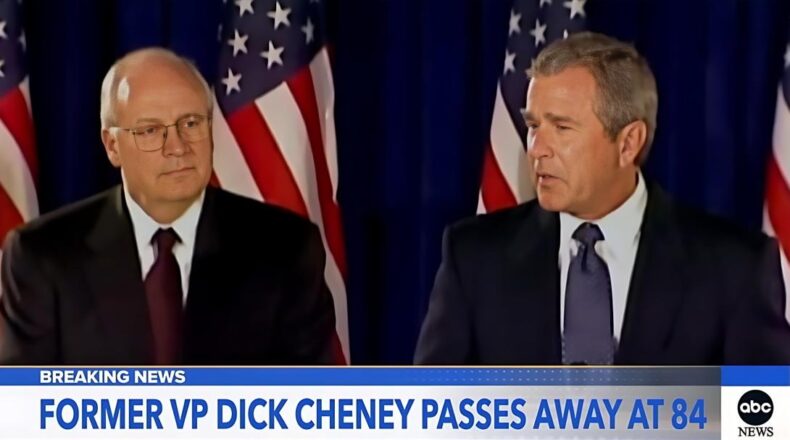
*Richard ‘Dick‘ Cheney’s public life traced a hard, flinty line through some of America’s most testing decades — from Cold War endgames to the morning the homeland was struck on September 11, 2001. Today, the former vice-president has died at 84 from complications of pneumonia and cardiac and vascular disease, his family said. He was surrounded by loved ones, including his wife, Lynne, and daughters, Liz and Mary.
For more than half a century, Cheney served at virtually every level of national leadership: White House chief of staff to Gerald Ford, Wyoming’s at-large member of Congress and a member of House leadership, secretary of defense to George H. W. Bush during the Gulf War, and finally vice-president to George W. Bush. In the fraught hours of 9/11, he directed continuity-of-government actions from a secure facility as the President and congressional leaders were dispersed. Those decisions, controversial or not, reflected a governing philosophy that saw national defense as a foremost moral duty.
The measure of a statesman is not the absence of storms but the posture one takes within them. Scripture teaches that trials, when met with steadfastness, can shape character and maturity; “testing” can forge endurance that refines purpose (a re-wording of James 1:2–4). In Cheney’s case, the storms were literal and figurative: five heart attacks, a heart transplant in 2012, and decades of political combat — all met with an ironclad focus on mission. Even critics often conceded his consistency.
As Secretary of Defense, Cheney helped marshal and maintain a multinational coalition to expel Iraqi forces from Kuwait in 1991. The limited aim, clear timeline, and alliance management of the Gulf War shaped a generation’s understanding of how America could use power with restraint and clarity. In his early Pentagon days, he also pushed budget discipline amid post-Cold War drawdowns—proof that hawkishness and fiscal prudence could coexist. Those achievements do not cancel later controversies; they do, however, testify to a capacity for organization and steadiness that many citizens still prize in public service.
Scroll to continue reading



As vice-president, Cheney wielded unprecedented influence in shaping the post-9/11 response. He argued, relentlessly and often unapologetically, that the first duty of government is to keep its people safe. While the Iraq invasion became a wound that still aches across our civic life, Cheney never abandoned his conviction that vigilance deterred future attacks—a stance rooted in the belief that complacency invites danger. Agree or disagree, we owe ourselves the honesty to admit that his objective was not chaos but security, not spectacle but the perceived protection of American lives.
A second scriptural lens frames the paradox of power and pain: suffering can produce endurance; endurance, tested character; and character, a hope that does not put us to shame (a re-wording of Romans 5:3–5). Cheney’s political seasons included both acclaim and scorn—plaudits for resolve during crisis and ridicule after a hunting accident; praise for coalition leadership and condemnation for intelligence failures. Through all of it, he pressed forward. That relentlessness—rightly guided or wrongly directed in different moments—sprang from an ethos many Americans recognize: do the hard thing you believe duty requires, shoulder the consequences, and carry on.
It is also fair to remember the man beyond the office. He mentored aides who later shaped national-security thinking, and he lived to see his daughter Liz rise in congressional leadership. His family’s statement today was tender and proud, reminding us that behind every public fight is a private table where someone’s spouse, parent, or grandparent sits, listens, and loves. The public square can be loud; the living room is where the full humanity of our leaders is most visible.
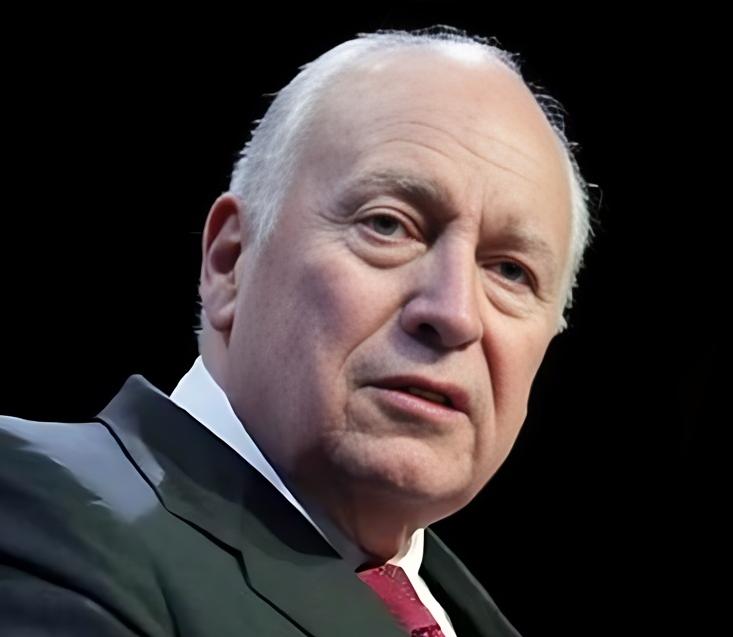
Cheney’s legacy will likely remain contested—historians will continue to debate executive power, intelligence assessments, and the use of force. Yet an objective accounting must include what many Americans value: calm under pressure; a willingness to absorb blame during dangerous hours; and the administrative competence to move large institutions when minutes matter. On 9/11 and in the anxious years after, he offered a certain kind of ballast—stern, sometimes unyielding, but undeniably present.
A third scripture, often recited at hospital bedsides and battlefield chapels, carries us to the heart of leadership amid fear: “even when one walks through the darkest valley, one need not be overcome, for divine guidance and comfort steady the soul” (a re-wording of Psalm 23:4). If you strip away policy memos and podium lights, Cheney’s vocation centered on this: step into the valley, absorb the terror of a nation’s long night, and make decisions you believe will hasten the dawn.
In an age that rewards performance over perseverance, Cheney’s public witness—imperfect, immovable, and intensely duty-bound—reminds us that governing is not a highlight reel. It is a series of burdens carried in real time, with imperfect information, for an anxious people. America will continue to debate his choices. But on the day he has passed, we can choose gratitude for the intention behind those choices: the protection of a nation he believed was worth every ounce of his formidable will. May comfort attend his family, and may our public dialogue about his life be as serious as the times he tried to meet.

ABOUT THE AUTHOR
Edmond W. Davis is a Social Historian, Speaker, Collegiate Professor, International Journalist, and former Director of the Derek Olivier Research Institute. He is an expert on various historical and emotional intelligence topics. He’s globally known for his work as a researcher regarding the history of the Tuskegee Airmen and Airwomen. He’s the Founder and Executive Director of America’s first & only National HBCU Black Wall Street Career Fest.
(If You Like/Appreciate This EURweb Story, Please SHARE it!)
MORE NEWS ON EURWEB.COM: Judges Rule USDA Must Release Emergency SNAP Funds | WATCH
We Publish Breaking News 24/7. Don’t Miss Out! Sign up for our Free daily newsletter HERE