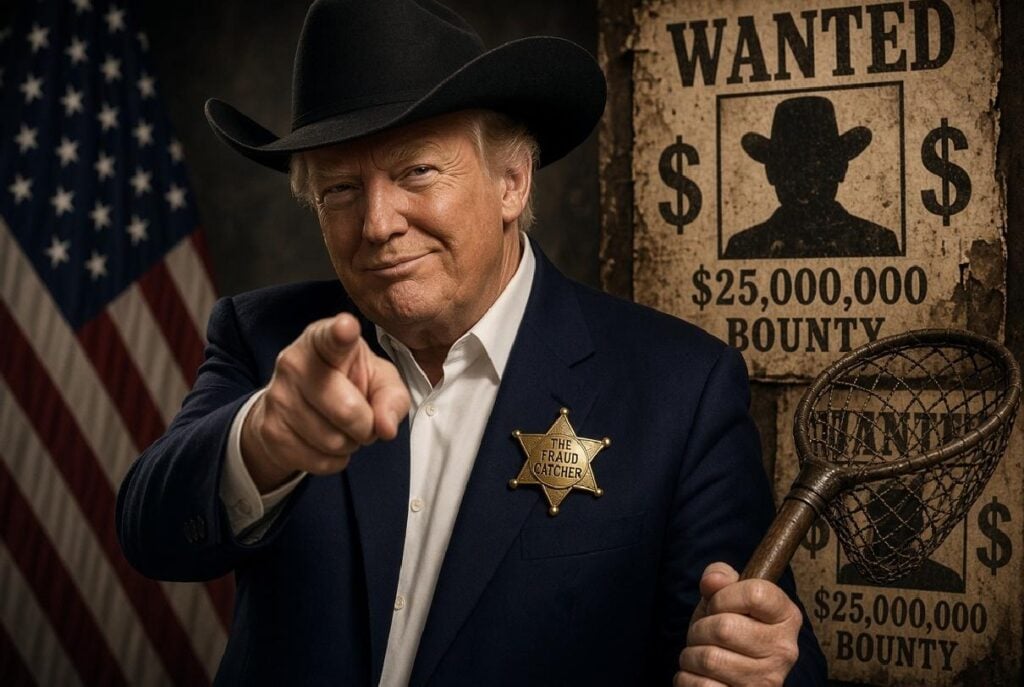
*Donald Trump, of all people, wants Americans to help catch fraudsters, and he’s putting $25 million behind the invitation. Report suspected wrongdoing, help authorities build a case, and you might collect a cash reward.
Sounds straightforward enough. But there’s a twist: Trump says he may personally decide who deserves the money.
And there’s another wrinkle. The president launching this nationwide fraud crackdown has a civil fraud finding of his own.
The irony is hard to miss, especially given Trump’s own legal history involving allegations of financial wrongdoing.
And with millions in taxpayer dollars on the table, questions about who controls the rewards are hardly a minor detail.
Scroll to continue reading









Trump’s $25 Million Fraud Reward Program
Trump and Vice President JD Vance announced the Fraud Whistleblower Incentive Program during an October 20 Oval Office gathering.
According to the Justice Department, the initiative will pay eligible whistleblowers $10,000 to $30,000 for information leading to criminal charges involving certain types of fraud.
The Treasury Department is committing $25 million to support the program.
Trump, however, described something considerably more generous: rewards worth 1% of the fraud uncovered, potentially reaching millions of dollars.
He also declared that he would settle disputes over who deserves payment.
“I will be the arbitrator of all of these decisions,” Trump said, according to CBS News.
Apparently, the president isn’t just promoting the program. He wants a say in handing out the prizes.
The Fraud Finding That Won’t Disappear
There’s considerable irony in Trump positioning himself as America’s chief fraud fighter.
A New York judge found Trump and his business associates liable for civil fraud involving inflated property valuations used in dealings with lenders and insurers.
In August 2025, a state appeals court threw out the enormous financial penalty, which had grown to roughly half a billion dollars, while leaving the underlying fraud finding in place.
As The Associated Press reported, the appeals court was sharply divided over the merits of the case.
Trump has denied wrongdoing and called the prosecution politically motivated.
The distinction matters: His case involved civil liability, not a criminal fraud conviction. Still, the legal history adds context to his latest campaign against financial wrongdoing.
An Oval Office Announcement Takes a Turn
The event also became a forum for Trump’s criticism of political opponents and immigrants.
In an opinion column for The Independent, Holly Baxter described an increasingly confrontational gathering involving Trump, Vance, Dr. Mehmet Oz and White House deputy chief of staff Stephen Miller.
Trump singled out Democratic Rep. Ilhan Omar of Minnesota, while Miller accused immigrants and refugees of exploiting American taxpayers.
Asked whether Omar could be deported, Trump suggested she could instead face imprisonment.
“She could also go to jail,” Trump said, calling Omar “a very dishonest person” who “hates our country.”
Trump then attacked Somalia, Omar’s birthplace, using profanity to disparage the country. He also mocked her invocation of constitutional rights and claimed Somali immigrants had a 98% unemployment rate, without presenting supporting evidence.
The president’s remarks came during an event supposedly devoted to protecting taxpayer dollars. Somewhere between rewarding fraud tipsters and attacking a sitting member of Congress, the original announcement began competing for attention.
Trump also confronted Andrew Feinberg, a correspondent for The Independent, while White House adviser Stephen Miller made sweeping accusations about immigrants and fraud.
Who Decides Who Gets Paid?
The Justice Department’s published rules say awards are discretionary and generally require original information that leads to criminal charges.
That leaves an obvious question about Trump’s promised 1% commissions: How do those remarks fit with the department’s stated $30,000 maximum for its new program?
Whistleblower rewards are not inherently controversial. Government agencies have long used financial incentives to uncover misconduct.
But effective programs need clear standards, reliable evidence and safeguards against false accusations.
(If You Like/Appreciate This EURweb Story, Please SHARE it!)
RELATED NEWS ON EURWEB.COM: Judge Blocked Overly Aggressive DOJ Access to Ilhan Omar’s Records in Immigration Fraud Probe | VIDEO
We Publish Breaking News 24/7. Don’t Miss Out! Sign up for our Free daily newsletter HERE.