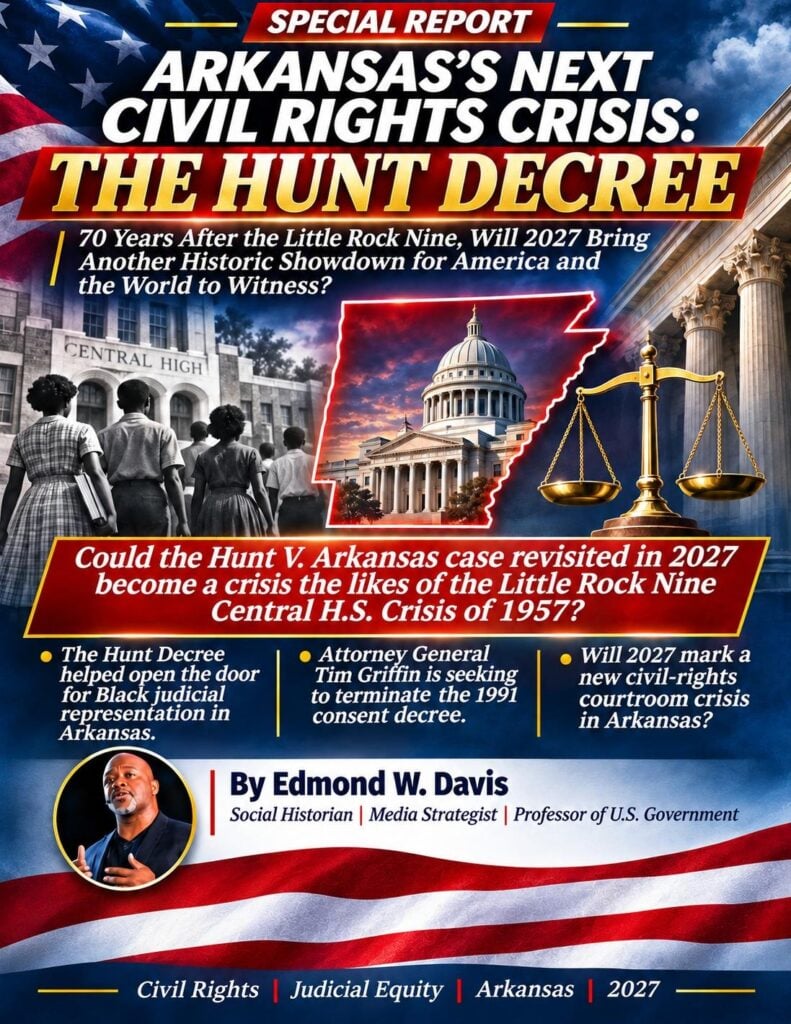
*In 1991, America watched Los Angeles police officers brutally beat Rodney King. That same year, Arkansas entered a historic federal agreement designed to confront another form of institutional injustice: a judicial election system that had never elected a Black judge.
Thirty-five years later, Arkansas Attorney General Tim Griffin wants to terminate that agreement. On November 5, 2026, barely 48 hours after a Democratic electoral wave swept across much of America, Griffin announced a federal motion to end the consent decree in Hunt v. Arkansas. He characterized the agreement as an “unconstitutional relic.” A relic? At 35 years old?
What, then, should Americans call the 13th Amendment, ratified in 1865, or the 14th Amendment, ratified in 1868? Their age hardly diminishes their constitutional significance. To be clear, amendments and consent decrees occupy different legal positions. But the moral question remains: When does time automatically extinguish the need for justice? Arkansas appears determined to make America great again by revisiting precisely which Americans benefited from its past.
1. The Hunt Decree: When Legal Discrimination Required a Legal Remedy
The original lawsuit, filed in 1989, challenged Arkansas’s system of electing trial judges through large, multimember districts. Black plaintiffs argued that the arrangement diminished their electoral influence. The 1991 Hunt consent decree established majority-Black judicial election subdistricts. According to the Legal Defense Fund, the agreement opened opportunities for Black judicial candidates in five Arkansas judicial circuits where they had previously been excluded from elected service.
Scroll to continue reading







Those judges administer justice throughout their respective circuits, not exclusively to Black residents. That distinction matters. The decree did not create separate courts for separate races. It addressed unequal opportunities to elect the people who preside over courts serving everyone. Griffin contends that race-conscious districting violates constitutional equal protection and that decades of compliance have rendered the decree unnecessary. His argument invokes the Supreme Court’s April 2026 decision in Louisiana v. Callais, which sharply restricted race-conscious congressional redistricting.
But the constitutionality of continuing this particular judicial remedy remains for the federal court to determine. Retired circuit judge and incoming Pulaski County Judge Wendell Griffen disagrees with the state’s reasoning. “The Hunt Decree should remain in effect,” Griffen declared in his public statement opposing the attorney general’s motion. He further explained: “Calling these electoral subdistricts ‘segregation’ confuses
a remedy designed to expand equal electoral opportunity with the exclusion that made the remedy necessary.” Griffen knows this system from experience. He served as a circuit judge from 2011 through 2022.
Veteran Arkansas journalist Max Brantley similarly described the Legal Defense Fund as “standing up to Attorney Tim Griffin’s effort” to dismantle the judicial-election arrangement. Judge Olly Neal, an original participant in the litigation, maintains that the decree is directly responsible for Black judicial electoral success.
Consider Isaiah 10:1–2, which condemns unjust decrees and the denial of justice.
A government can enforce a law and still face profound questions about its morality.
2. Ohio Broke Through. Arkansas Held the Line.
Republican-controlled legislatures have repeatedly used redistricting to pursue electoral advantages. Democrats have practiced partisan mapmaking too. But the distinction between permissible partisanship and unlawful racial discrimination becomes especially important when district boundaries divide historically marginalized communities.
Consider Ohio. Republicans approved new congressional boundaries in October 2025, with the statewide plan expected to improve their party’s electoral position. Yet on November 3, Democratic newcomer Kristina Knickerbocker, an Air Force veteran, oncology nurse practitioner, and mother of two, defeated longtime Republican Congressman Mike Turner. Turner had represented the Dayton area since 2003 and won reelection in 2024 by approximately 18 percentage points. According to Ohio public-radio reporting, Knickerbocker captured approximately 49.3% of the vote to Turner’s 47.7%. Her margin was fewer than 5,000 votes. After nearly a quarter-century, Dayton will have a new representative.
Arkansas experienced the opposite outcome. In the Second Congressional District, Republican French Hill narrowly defeated Democrat Dr. Chris Jones. Election returns showed Hill ahead by approximately 4,356 votes. But this contest unfolded under Arkansas’s controversial 2021 congressional map, which divided Pulaski County among three districts. The Legal Defense Fund challenged that map, arguing that its configuration weakened Black voting power. A three-judge federal panel rejected the racial-discrimination challenge in 2025. That judicial outcome must be acknowledged. Nevertheless, the political and moral questions surrounding the division of Black communities remain legitimate subjects of public debate. Ohio demonstrates that electoral boundaries do not guarantee political survival. Arkansas demonstrates how close a historically Republican district can become.
Redistricting can be legal. It can also be challenged as racist or sexist when evidence supports discriminatory intent or consequences. Political legality and moral legitimacy are not always synonymous.

3. From the Little Rock Nine in 1957 to Hunt v. Arkansas in 2027?
Arkansas could be poised to return to center stage in the American civil rights movement—not through schoolhouse doors, but through federal courtrooms and the judicial election system itself. The year 2027 marks the 70th anniversary of the Little Rock Nine Crisis of 1957, when nine courageous African American students confronted organized resistance to integrating Little Rock Central High School. Governor Orval Faubus deployed the Arkansas National Guard to block their entry, forcing President Dwight D. Eisenhower to intervene with federal troops and uphold the authority of federal law.
Now, seven decades later, Arkansas faces another consequential legal confrontation over racial equality, representation, and constitutional protections. In 1957, the question was whether Black children could enter previously all-white public schools. In 2027, the question could become whether Black Arkansas voters will retain the electoral protections that helped them elect judges to administer justice in those same communities.
Will America commemorate the Little Rock Nine crisis of 1957 while witnessing what future historians might call the Hunt v. Arkansas Crisis of 2027?
The comparison is not an assertion that the two legal disputes are identical. They involve different constitutional questions, historical circumstances, and institutions. But both concern the role of federal authority in protecting equal opportunity against resistance from the state. And the timing is extraordinary.
Just two days after the 2026 midterm elections, Griffin moved to reopen a judicial arrangement that has shaped Arkansas’s courts for 35 years. His filing does not establish an unconstitutional scheme; it asks a federal judge to determine whether the decree should remain enforceable. That distinction matters, but so does the historical symbolism.
In 1957, federal intervention helped dismantle a system of educational exclusion. In 1991, a federal agreement helped remove barriers to Black judicial representation. In 2027, Arkansas may confront whether those judicial protections should survive. History does not repeat itself precisely. But sometimes it returns to the same state, demanding a new answer to an old question.
4. Arkansas’s Red Fortress and the New Civil Rights Reckoning
Arkansas, Idaho, Oklahoma, Wyoming, and South Dakota remained largely Republican-controlled despite Democratic gains on November 3. Yet Arkansas revealed a deeper problem. According to early post-election turnout reporting, approximately 893,335 of 1,856,044 registered Arkansans cast ballots—only 48.12%. That leaves approximately 963,000 registered citizens who did not vote, based on those preliminary totals. Nearly one million missing voices.
A state can claim a powerful electoral mandate while more than half its registered electorate remains unrepresented at the ballot box. Meanwhile, Arkansas continues debating private-school vouchers, restrictions involving diversity initiatives, and the future of public education. An Arkansas Advocate investigation found that many participating private schools charge more than the state’s voucher allowance, raising questions about access for low-income families. These issues are not legally identical to Hunt, but they belong to the same larger discussion: Who benefits when government changes the rules?
Arkansas is not the only state reopening old voting-rights arrangements. In April 2026, Alabama Republican Attorney General Steve Marshall asked courts to lift congressional-map injunctions, relying on Callais. Louisiana previously pursued termination of a judicial-election consent decree in Chisom v. Louisiana. The Fifth Circuit ruled for the state in 2024. Arkansas therefore participates in a larger national argument over whether longstanding remedies for racial exclusion remain necessary.
Micah 6:8 instructs believers to act justly, love mercy and walk humbly with God. Proverbs 31:8–9 calls for defending those whose voices are overlooked. In 1957, Louis Armstrong publicly challenged Governor Orval Faubus’s resistance to integrating Little Rock Central High School. The Louis Armstrong House Museum preserves that remarkable moment of moral courage. Nearly seven decades later, Arkansas again faces questions about the relationship between lawful authority and equal opportunity.
Attorney General Griffin is entitled to pursue constitutional arguments. The Legal Defense Fund is equally entitled to contest them. And citizens deserve a judiciary that evaluates both positions according to evidence rather than politics. My argument is simple: The Hunt Decree should not be discarded merely because it is old or because racial equality has become politically inconvenient. If Arkansas can demonstrate that Black voters will retain genuinely equal judicial-electoral opportunity without the decree, it should present persuasive evidence. Until then, preserving a remedy that helped dismantle historic exclusion is a defensible constitutional and moral position.
In 2027, America will remember nine Black teenagers who forced a state to confront its own injustice. Will Arkansas spend that same anniversary year defending 35 years of progress—or becoming the center of another historic civil rights confrontation? The answer may emerge not from Little Rock Central High School but from a federal courtroom. Because a law can be old without being obsolete—and a policy can be legal without being just.

About the Author:
Edmond W. Davis is an American social historian, media strategist, international journalist, Grambling State University graduate, professor at Arkansas Baptist College and Philander Smith University, and founder of the National HBCU Black Wall Street Career Festival. His work focuses on history, education, emotional intelligence, civic engagement, economic mobility, and the advancement of historically Black colleges and universities. Davis was a grand marshal at the National African American History Month Parade, the largest in the U.S. during Black History Month.
(If You Like This EURweb Story, Please SHARE it!)
MORE NEWS ON EURWEB.COM: Arkansas Law Enforcement Under National Scrutiny
We Publish Breaking News 24/7. Don’t Miss Out! Sign up for our Free daily newsletter HERE.